
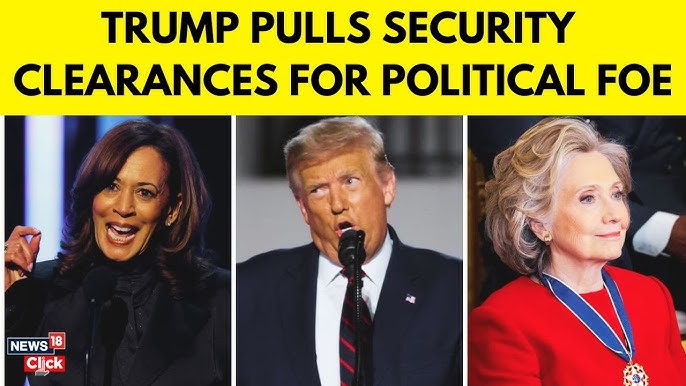
Trump Checks Kamala Harris’ Power Through Security Clearance Revocation
Following a pattern of punishing his political nemeses, President Donald Trump declared in a late-night decree on a recent Friday that an assortment of his perceived adversaries would no longer have access to top-secret information included in their security clearances. This directive particularly affected Kamala Harris, the former Vice President, as well as Hillary Clinton, the erstwhile Secretary of State, both of whom are prominent figures in the Democratic party.
Trump decreed in his official memo, aimed at the heads of all executive departments and agencies, that the conduct of the mentioned individuals had convinced him that they were no longer worthy of accessing classified information. He explained that their unjust usage of sensitive information was incompatible with national interests.
The implications of this edict are wide-reaching, extending to the classified briefings and privileged information these individuals would have been privy to in their prior tenures. This move syncs with Trump’s tendency to use this form of reprisal against political opponents. His utilization of security clearance revocations as a political weapon marks yet another instance of his aggressive tactics.
This recent bookkeeping move isn’t an unprecedented action in Trump’s playbook. He is well known for using rescissions to deal with entities that oppose him, including highly respected law firms. The Friday memo officialized the annulment of prior clearance provisions and further firmed up the block on access to classified material.
Trump’s memo moved even beyond disavowing the security privileges of Democrats, reaching into his own party. Two Republicans on the House committee, which was tasked with investigating previous events, also had their clearances revoked, showcasing the breadth and indiscriminate nature of Trump’s retributory decisions.
Pointing to a new direction in typical security protocols, Trump’s action was affirmed by the Director of National Intelligence who revealed earlier this month the revocation of clearances for a diverse group of individuals. This included those who had sought legal recourse, showing a wide-ranging application of his directive.
Trump was not done, however, with his late-night decree and proceeded to harken back to old disputes. He expressed his sentiments about opposing legal practitioners, vowing to exact punishment on them by rescinding their access to classified information, in addition to terminating any federal contracts bestowed upon them.
His disdain for what he perceives as frivolous litigation led him to request an exhaustive review of the practices of lawyers and law firms that, in the eyes of his administration, have been meddling too often in courtrooms and governmental affairs. This expansion of his crackdown further permeates the national legal landscape.
In Trump’s perspective, these lawyers and their associated law firms have overstepped their professional boundaries by resorting to extensive litigation three too many times to obstruct his initiatives. This decree from Trump extends the crackdown into a broader segment of the United States’ legal community.
Trump, with this directive, pulls yet another unprecedented move. Using clearance revocations as a method of punishment against his perceived enemies moves beyond casual politicking and begins to tread in troubling territories of retribution and suppression.
By implementing such strikingly partisan clampdowns, Trump expounds his version of national interests – a version that seems conveniently aligned with punishing those who dare to have opposing viewpoints or challenge his decisions and actions.
For the former Vice President Kamala Harris and other democratic figures affected, this revocation entails an entire other level of political maneuvering from Trump. Both the ex-vice president and other democrats have expressed varying degrees of alarm and dissatisfaction over these proceedings.
Under the veneer of safeguarding national interest, the move can be interpreted as a manifestation of Trump’s way of managing inter-party dynamics, particularly between his administration and his foes. Of course, one must ask: is it really the ‘national’ interest Trump is looking out for, or simply his own?
Clearly, this represents a broadside against Democrats like Harris, whom he perceives as having overstepped her bounds. However, this narrative also paints a troubling picture of his own ability to tolerate opposition and alternative viewpoints in the ostensibly democratic nation.
The inclusion of Republicans in Trump’s clearance-purging spree suggests a worrying lack of differentiation between friends and foes in his decision-making process. Is this indiscriminate revenge or a calculated political ploy? Either way, it paints a bleak picture of Trump’s leadership style.
Trump’s memo, and the string of clearance revocations it enacts, appear more as a manifestation of his personal grievances than any discernible strategy of national interest. Concerns are mounting over the former president’s inclination to wield his influence to settle personal scores.