
Adrian Joins Nationwide ‘Hands Off’ Protest Against Trump Policies
Adrian was the scene of a significant protest with hundreds gathering to voice their opposition to the policies and actions of President Trump. Critical issues raised by the demonstrators touched on health care, education, environmental protections, and various other social services. This protest wasn’t a standalone event, rather, it was an extension of a larger, nationwide initiative known as the ‘Hands Off’ protest that spanned across 1,200 locations in the US.
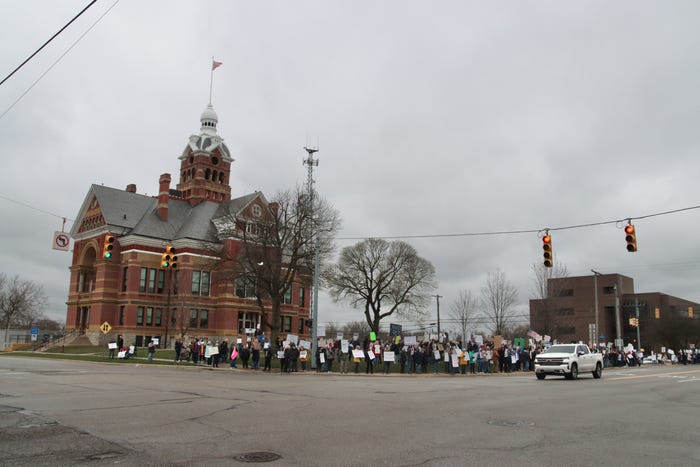
The Old Lenawee County Courthouse played host to hundreds of disconcerted participants on Saturday, expressing their discontent towards the developments that have arisen since President Trump’s initiation of his presidential term in January. The protest nicknamed ‘Hands Off’, acted as a national call to action. Its aim was to spotlight efforts by President Trump, his adviser Elon Musk and his Department of Government Efficiency (DOGE), including some of his cabinet secretaries to minimize the federal government’s expanse through mass employee dismissals and cancellation of contracts and grants.
The demonstration was one of the 50 taking place across the state of Michigan and one among the staggering 1,200 that were held nationally. Protesters at Adrian voiced their appeals for various subjects, encompassing Medicare, Medicaid, women’s rights, Social Security, cancer research, LGBTQIA+ rights, fair elections and worker’s rights. Their chants echoed strong sentiments and messages, such as ‘Rights are what we’re fighting for; we don’t want a fascist state,’ and, ‘No hate, no fear, immigrants are welcome here.’
The essence of the demonstration lay in their ‘Hands-Off’ rally cry, maintaining the focus on the subjects at hand. The aim was to prompt legislators to prevent the slashing of so many benefits that citizens have been financially supporting throughout their lives. The proposed cuts to the Department of Education and financing for libraries and national parks as well as reduction of air and water quality regulations are among the issues that drew this substantial crowd to the historic courthouse lawn.
The turnout was such that the crowd overflowed onto Main Street and Maple Avenue. Demonstrators lined the Main Street sidewalk, reaching all the way to the entrance of the judicial building. Protesters were firm in expressing their dissatisfaction with the current state of our government, fearing a steady erosion of their freedoms.
There was a strong belief among attendees that the government’s current trajectory represented an unprecedented level of cruelty. Concerns were not only broad but also specific, with one co-organizer of the protest expressing her anxiety about the potential loss of federal funding for assisting at-risk students. As an educator, she pointed out that reading specialists who work with students are often paid using federal funding.
She stated that while no one opposes the aim of creating a leaner, more efficient system, the measures presently being implemented were misguided and extreme. Throughout the duration of the event that lasted for about an hour and a half, passersby expressed their support by honking as they drove past.
The response to the protest wasn’t universally positive though. Several pickup trucks displaying Trump flags drove by as if to assert their presence. In one particularly confrontational incident, a protester was forced to use their sign to waft away the thick black smoke that a pickup truck deliberately discharged right beside them.
Yet the spirit of unity among demonstrators remained undeterred. Contrary to the confrontation and opposition they encountered, the atmosphere among the protesters was surprisingly optimistic. A heartening sentiment was expressed, revealing a renewed sense of hope and positive feelings for the first time in a month.
In the end, the protest was more than just a demonstration against policies. It was a call to action against what the participants saw as a looming threat to their civil liberties and the societal safety nets they’ve come to rely on.
It was an outcry for a more compassionate, tolerant, and inclusive society and demonstrated a community’s capacity to rally together in the face of common concerns. They served as a plea for empathy and as a reminder that democracy is, at its core, a government by the people, for the people.
Ultimately, the Adrian protest was part of a larger nationwide tableau of discontent. Still, it served as an amplified microcosm of the widespread opposition to policies that seemed aimed at cuts to basic services and protections.
The unity and determination displayed by the protesters at Adrian echoed across the other 1,199 demonstrations, reaffirming their commitment to their causes and creating a ripple effect of public resistance against policy moves they’re viewing as harmful.
Regardless of where one might stand on the political spectrum, it was clear that this ‘Hands Off’ protest brought communities together, and illustrated the embodiment of active citizen participation, a cornerstone of democracy.
These nationwide protests, Adrian’s included, signaled a resounding message to policymakers. The citizens are watching, they care deeply about these issues, and they will voice their concerns proactively and collectively when they fear their rights and services are under threat.