
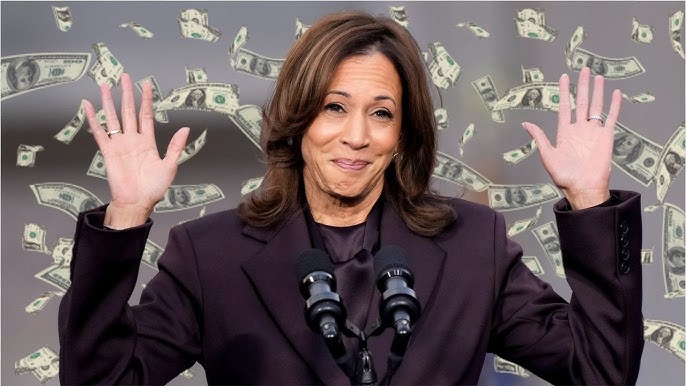
Democratic Disarray: Is Kamala Harris Destined for Another Defeat?
William Henry Harrison, the ninth president of the United States, holds several unique elements in history including being the last president to be born under British rule and the first figurehead of the Whig Party to hear the presidential mantle. His inaugural address was the longest to date, a draining two-hour speech, however, his term in the presidency was the shortest, cut off by his demise just a month in. Interestingly, Harrison was also the final political figure to lose his initial presidential bid, only to secure victory in the subsequent election. Since the time of Harrison, those who suffered defeat in their first attempt and bravely pursued again met with the same fate. This does not bode well for Kamala Harris, whose recent withdrawal from a gubernatorial run in California has pushed her towards the limelight of presidential speculation.
The Democratic Party, in its current state, is facing steep unpopularity. Statistically, it experiences a net favorability deficit of 30 points, nearly triple that of their Republican rivals, who sit at a negative 11. In fact, the Democratic Party is now the least popular it has been in over three decades. Although you might expect the unpopularity of figures like Donald Trump to encourage support for the Democrats, the opposite effect appears to be taking place, with 63% of Americans bearing a negative view of the party.
A significant reason for this adverse public view does not lie with Kamala Harris, but rather, most of the culpability rests on the shoulders of Joe Biden and the crowd of supporters who pushed for his candidacy. Harris’ predicament is that she stands as a symbol of Democratic dissatisfaction within the party itself. This dissent is not unidimensional, as the more progressive voices within the party complain that the Democrats aren’t putting up a sufficiently strong fight, while the more moderate members see the party as taking up arms for the wrong causes, shifting too far to the left, particularly when it comes to identity politics and cultural battles.
Despite the existing internal schisms, both factions agree on the unmistakable thirst and need to win. This doesn’t bode well for Harris, who is primarily recognized for a past marked by defeat than victory. Harris’s potential nomination in 2024 seems to be largely due to her selection as a diversity candidate by Biden. The promise Biden made to choose a female, and eventually an African American running mate, makes it hard to imagine anyone else filling that spot currently.
Harris’ position is indeed not derived from her race or gender – these are not issues most Democrats take issue with, nor should they in general. Similar to many others, even white male candidates, Harris’ selection was mainly due to an effort to appeal to a certain demographic. In reality, her predicament has less to do with her sex or race, and more to do with her inability to reach and engage constituents in a way that broadens the Democratic faction.
For the Democrats to stand a chance, they require a candidate capable of converting Trump followers. She did not fail due to a lack of Democratic interest but because she failed to strike a chord with a swiftly evolving electorate. Her nebulous speeches likened her more to an academic rather than a political leader. She came across as a product of public sentiment analysis rather than a genuine, relatable person, a quality highly sought after by the modern electorate.
Compounding matters, Harris lent her compliance to Biden’s insistence that she should uphold his principles and not distance herself from him. Such unswerving allegiance to the old norms, coupled with clichéd gestures to progressive groups, which were a product of her years in San Francisco and California politics, made her a simplistic answer to a complex question that didn’t exist, to start with.
Her decision to grant her first post-office interview to Stephen Colbert’s The Late Show was revealing in itself. With CBS deciding to terminate Colbert’s show due to strictly business reasons, it revealed that Colbert had steeply narrowed down his audience to cater to a small, strongly anti-Trump faction.
Upon her appearance, Harris expressed her unwillingness to reintegrate into the system, bemoaning its failure, the naivety, and the lack of leadership, a rant that would surely resonate deeply with Colbert’s firmly ideological audience. However, the Democrats need to cater to a much wider and diverse audience if they wish to emerge victorious.
This explains why if the Democrats decide to place their bets on Harris again, she might just be destined to be the answer to a trivia question, without ever taking the oath as the 48th president of the United States.
The Democratic Party’s disapproval is indicative of internal conflict and dissatisfaction with their leaders. They are disillusioned by a weary defeat to Trump and have failed to mount substantial opposition against him since he’s taken office. As reckoned by journalist Nick Cattogio, ‘Even Democrats have learned to dislike Democrats.’
It’s noteworthy that the blame isn’t exclusively Kamala Harris’s. The lion’s share of it goes to Joe Biden and his cadre of supporters who pushed him to run for the presidency again. Harris’ predicament is rooted more in the party’s failure than any shortcomings of her own.
Voters abhor losers. This makes a second attempt at the presidency quite precarious for Harris, especially considering she was not successful in her first bid. Despite her notable role as a diversity pick in Biden’s administration, her ability to appeal to a wider demographic and convert supporters from the other side of the aisle has been decidedly lacking. Unless the Democratic Party can find an effective way to address this appeal issue, they may continue to struggle.
Harris acquiesced to Joe Biden’s insistence that she not distance herself from him, which further amplified her shortcomings as a candidate. Her style, molded by years of California politics, often came across as learned, and uninspiring – had she the freedom to develop her unique voice, perhaps things could have been different.
The decision to give her first interview post-office to Stephen Colbert’s The Late Show paints a telling image of the Democrat’s current situation. Colbert’s show, mainly catering to a vehemently anti-Trump segment of the public, may not be the platform that the Democrats need to use to win over a broader audience.
Looking ahead, the question remains if the Democratic Party will continue to place its bets on candidates like Harris who, despite their diversity and engagement with progressive causes, struggle to resonate with a wider electorate. This situation would underline why, if the Democrats decide to nominate Harris again, she might end up being remembered more as a trivia question than the 48th president of the United States.