
Bihar’s New Leap Towards Prosperity with Rs 7,616 crore Infrastructure Enhancements
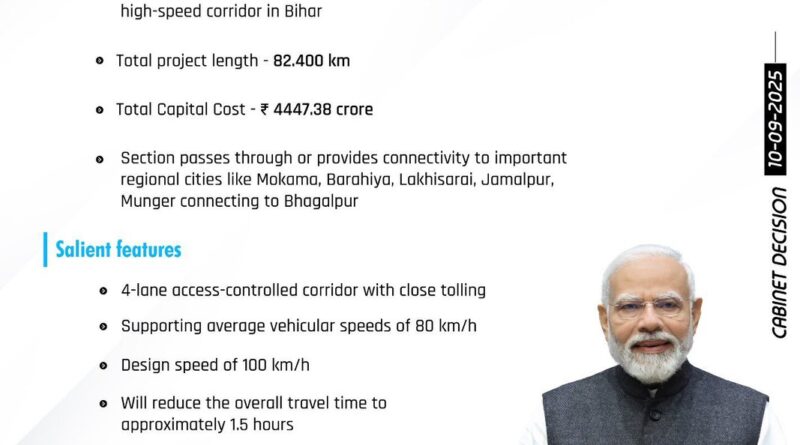
The national administrative council recently signed off on two significant infrastructure enhancements in Bihar, representing an all-in investment of Rs 7,616 crore. In particular, the Mokama-Munger connection will transform into a four-lane highway stretching 82.4 km at a cost projected to be Rs 4,447 crore. Furthermore, the proposal to double the Bhagalpur-Dumka-Rampurhat, a route spanning 117 km, has a budget allocation of Rs 3,169 crore.
The forthcoming highway between Mokama and Munger creates an access-controlled route promising to stitch together multiple regional cities and towns. This road network will introduce a smoother integration between Mokama, Barahiya, Lakhisarai, Jamalpur, and Munger, eventually paving a path to Bhagalpur.
The project features a four-lane roadway, with tolling stations set up to ensure streamlined transit. The carefully engineered design envisages a running speed of up to 100 kmph, while maintaining an average speed of 80 kmph for regular travel. This infrastructure plan is part of a greater vision to improve road travel across the region.
The journey duration between these cities is anticipated to drop to approximately 1.5 hours. Advanced features of the proposed highway include high safety standards and reliable access, catering to both passenger and cargo traffic. This forms part of a holistic road improvement strategy, targeted at facilitating smoother, faster, and more efficient transportation.
The eastern Bihar belt, specifically the trio of Munger, Jamalpur, and Bhagalpur, is fast emerging as a significant industrial center. Key areas of interest include a presently operational ordnance factory and the potential establishment of another. These developments mark the region’s growth as a part of the Ordnance Factory Corridor initiative by the defence ministry.
Another noteworthy project in the pipeline is the locomotive workshop stationed in Jamalpur. Moreover, the region is witnessing a surge in food processing activities, courtesy of corporations like ITC, which has established its base in Munger. This is complemented by supporting logistics and warehousing facilities that cater to the burgeoning industrial needs.
The government, in its effort to push Bihar’s economic propulsion, acknowledges the need for better connectivity. Infrastructure development hence becomes a key aspect in the acceleration of the state’s growth trajectory. A visit to the region has been planned for Monday to further materialize this vision.
On a parallel front, the subject of doubling the Bhagalpur-Dumka-Rampurhat section spanning Bihar, Jharkhand, and Bengal has been brought into the spotlight. The projected enhancements in line capacity hold immense potential to radically uplift mobility, opening avenues for greater efficiency and operational reliability.
Offering a harmonized blend of passenger and freight services, this railway line expansion is a pivotal move towards improving the region’s infrastructure. The overarching objective to enhance the railway network’s ability to handle substantially more traffic is a testament to the government’s judicious vision of growth.
Such infrastructural upgrades fostering greater connectivity and transportation options often tend to have a multiplicative effect on economic development. This dual-focus proposition of expanding roadways and railway lines in Bihar is an illustration of the government’s far-sighted investment in infrastructure, aiming to bring about an intrinsic change in the state’s economic landscape.
The strategic collaboration between different stakeholders to bring about these changes represents a dynamic shift towards comprehensive growth and development. Insights and inputs from various government ministries, along with participation from several corporations, stands testament to the unison effort towards making Bihar a hub of industrious activities.
Furthermore, these forthcoming projects hint at an optimistic future, promising increased mobility, enhanced trade connections, and improved logistic efficiency. Bihar is looking at an era of improved connectivity and transportation services, injecting new life into the local economy, and improving the everyday lives of its residents.
Bihar’s journey of transformation signifies a bold stride towards economic prosperity. With meticulously planned infrastructure improvements, it’s on the path towards a brighter future. The state will continue to actively work upon opportunities that foster comprehensive growth.
In conclusion, the approved measures signify an important progression towards fulfilling Bihar’s infrastructural objectives. The state’s prospective growth and betterment in the coming years continues to remain a promising beacon of hope for its residents. There’s a strong sense of anticipation, optimism, and confidence in Bihar’s future, thanks to these developmental strides.