
Billie Joe Armstrong’s Lopsided Roast of Politicians
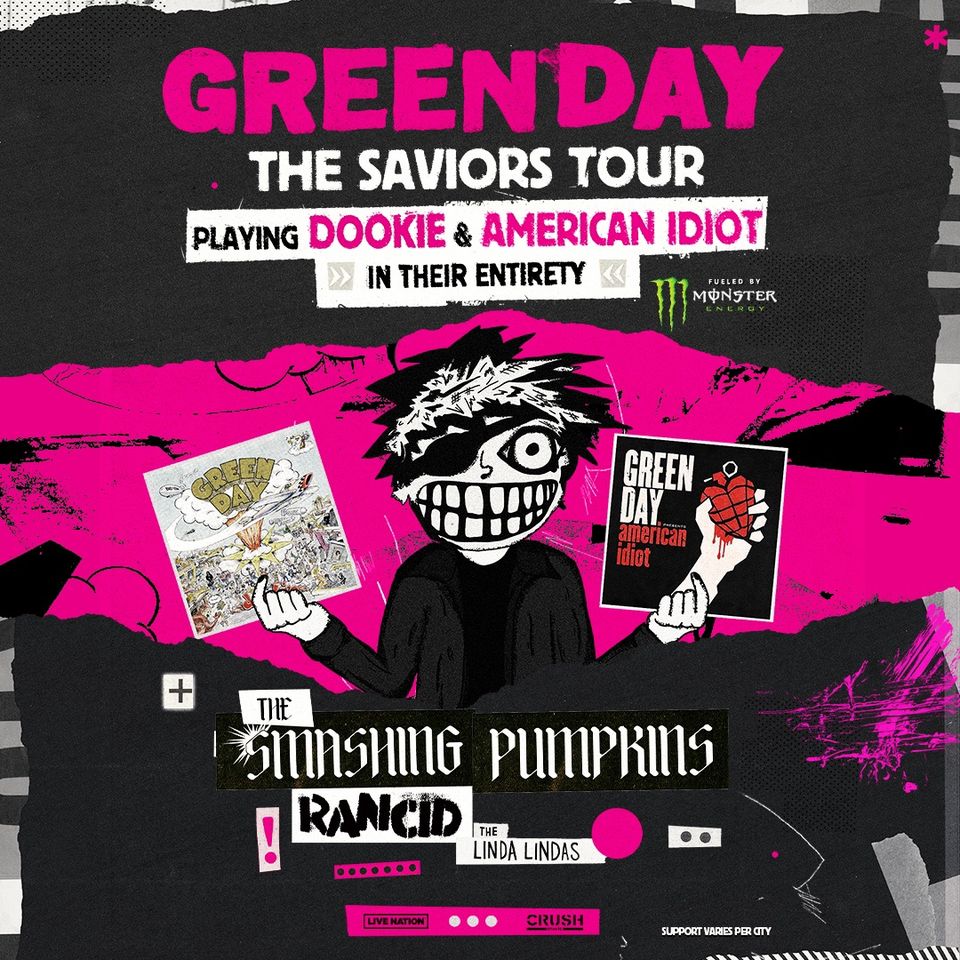
Green Day’s lead vocalist, Billie Joe Armstrong, leveled criticism at JD Vance, presently Vice President under the Trump administration, by twisting the lyrics of a renowned song during a recent concert. The punk rock group, composed of Billy on the lead vocals, Mike Dirnt as the bassist, and the drummer Tré Cool, are currently delighting fans in Australia with their ongoing ‘Saviors’ tour.
Armstrong, 53, publicly criticized JD Vance during a performance in Melbourne on March 1. The Green Day crew performed Jesus of Suburbia, a hit from 2004, with the lyrics cleverly altered as ‘Am I r******d or am I just JD Vance?’ instead of the original line ‘Am I r******d or am I just overjoyed?’
Aimed allegations flown at JD Vance weren’t the only highlight of the evening. Armstrong proceeded to critique both Donald Trump, the current American President, and Elon Musk, the notorious Tesla entrepreneur. Addressing the Australian crowd, Armstrong asked, ‘Do you wish Elon Musk would stop spouting nonsense? Don’t you desire Donald Trump to cease speaking too?’ suggesting that both public figures might be better off being muted.
It’s not the initial instance when Armstrong has made his distaste for Trump known. In the lead-up to the 2024 US Presidential election, Armstrong even encouraged his followers to throw their support behind Kamala Harris. He stated back then: ‘Vote for Harris. I think there’s probably a lot of things that people disagree with, but the one thing that we do agree on, is Trump has got to go and we need to turn the page.’
Arguably, there’s a great deal to critique about Kamala Harris, so it’s somewhat intriguing that Armstrong, who’s clearly comfortable with vocalizing personal opinions to a large crowd, only delineates the reasons to rid ourselves of Trump. It seems Armstrong is oblivious to the numerous and substantial issues associated with Harris’s candidacy, indicating more his personal bias than a sound, well-constructed political stance.
Meanwhile, the punk rock brigade made the news again by abruptly nixing the final performance of their Australian Saviors Tour scheduled for Wednesday, March 5, held at Robina Stadium in Gold Coast, Queensland. The trio, Billie Joe Armstrong, Tré Cool and Mike Dirnt, took to social media to announce the cancellation, citing unreachable circumstances.
They explained the cause as ‘With Cyclone Alfred bringing some seriously nasty weather, it’s just not possible to go ahead safely.’ To their Australian fans, they extended apologies: ‘Hey Australia, unfortunately due to circumstances out of our control, tomorrow’s Gold Coast show has been cancelled.’
The unexpected cancellation was triggered by the impending threat of Cyclone Alfred, a severe tropical storm that has the potential to be the first to severely affect Queensland in over half a century. The cyclone’s predicted strength, featuring wind gusts reaching up to 130km/h and should be accompanied by a staggering 450mm of rain within three days period, certainly suggests that the situation is far from ideal to host a concert.
All things considered, it might be interesting to wonder if Armstrong would be so quick to criticize and dismiss public figures in a situation that didn’t involve a cozy stage and a captive audience of fans. It’s one thing to cast aspersions from the safety of a concert stage and quite another to constructively participate in a dialogue or debate.
Furthermore, the commentary offered by Armstrong, whilst perhaps resonating with some of his constituency, doesn’t necessarily reflect an informed or balanced perspective on the failings and challenges of the Trump administration or Harris’s suitability to surmount such challenges.
Ultimately, it formulates a troubling paradox in the way we, as a society, often receive and process political messages. When given a platform due to their celebrity status, some individuals seem all too ready to share their personal (and often lacking) perspective on complex geopolitical issues – arguably to our detriment.
Hence, it is essential to absorb such criticism, not as a definitive evaluation, but as a casual commentary of a single individual who happens to have a following. The critique offered on Leonard or Armstrong’s political commentary or decisions is in itself just another form of critique.
In conclusion, while Green Day’s music and their charismatic frontman might be effective in entertaining and delighting their fans, it becomes necessary to question whether Armstrong’s political stances, often delivered with a snide remark or a rhetorical question during his performances, are as sound or as well-constructed as his lyrics.