
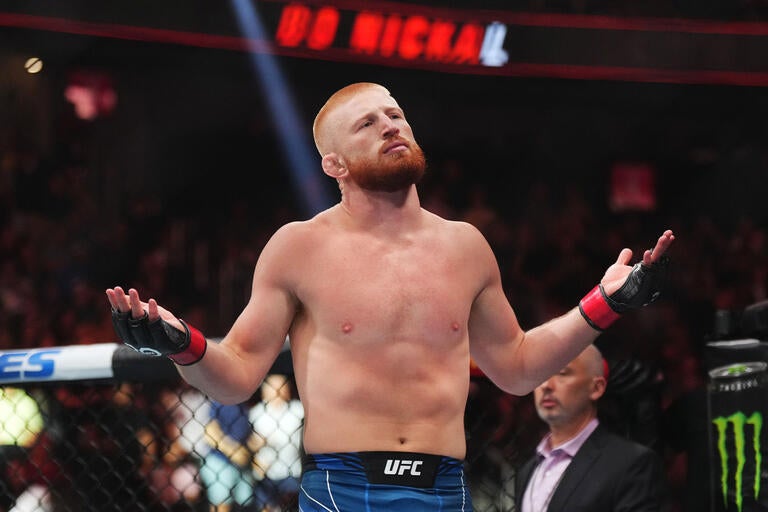
Bo Nickal’s Struggle in the UFC Arena Stirs the MMA World
The Mixed Martial Arts (MMA) sphere is a fascinating, yet unforgiving platform where athletes often find themselves under high-pressure scrutiny. A striking example is Bo Nickal, a fighter whose reputation precedes him thanks to his outstanding National Collegiate Athletic Association (NCAA) wrestling record. The anticipation accompanying Nickal, amplified by extensive media coverage and his glorious achievements, quickly propelled him to fan-favorite status.
However, such high prospects can sometimes lead to a crushing downfall, when the anticipated outcomes do not align with reality. This searing truth resonated loudly when Nickal’s potential supremacy failed to materialize within the Ultimate Fighting Championship (UFC) arena. This mismatch between expectation and performance sparked a wave of criticism.
At the forefront of this backlash stands Dricus Du Plessis, a decorated UFC champion. He openly voiced his criticism of Nickal’s strategy, primarily his heavy reliance on his wrestling expertise. Du Plessis also objected to Nickal’s apparent dismissal of those fighters who have achieved higher levels of success in MMA.
Indeed, Du Plessis’s critique went beyond vocalizing his personal issues with Nickal’s attitude. His concern centred on the basis of Nickal’s hype, which, in his opinion, was primarily fueled by the wrestler’s NCAA glory. Du Plessis expressed skepticism over the effectiveness of these skills within MMA, arguing that collegiate wrestling accolades don’t always make for successful transitions to MMA fighting.
Du Plessis offered a sharp review of Nickal’s performance against seasoned UFC opponents. He pointed to Nickal’s struggle to subdue adversaries, especially when his traditional takedown strategies fail to deliver results. This observed shortfall, according to Du Plessis, only confirms that strategies honed in college wrestling bouts may not always be effective in the MMA space.
In seeing Nickal’s mental unravelling inside the ring, Du Plessis found a sense of vindication, highlighting the importance of respecting seasoned fighters’ wisdom and experience. Du Plessis shared, ‘Nickal’s hype isn’t what concerns me, rather how he belittled those who’ve achieved feats he hasn’t yet. MMA is not mere wrestling, and it seems he had to learn this lesson in a tough way.’
He further added, ‘True, his wrestling skills have sometimes rescued him from defeat, but now, even that unique advantage seems to be failing him; his takedowns are increasingly being blocked.’ Du Plessis’s comments underline the seismic shift Nickal is forced to accommodate to survive in the tough terrain of UFC fighting.
While Du Plessis framed his critique towards Nickal in a hard-hitting light, another renowned UFC fighter, Matt Brown, took to Nickal’s defense in a surprisingly sympathetic manner following Nickal’s difficult loss. Brown advocated for Nickal’s growth and potential, suggesting the young combatant was pitted against an opponent whose level of experience far superseded his own.
Brown elucidated his point of view stating that situations like Nickal’s underscore the danger of accelerating the career of burgeoning fighters prematurely, pushing them into tough high-stakes UFC conflicts too early. His arguments question the wisdom of fast-tracking novices like Nickal into the big leagues before they’ve accumulated enough ring experience.
Nickal’s unfolding story appears to be a subject of diverse interpretation among the pundits. While some, like Du Plessis, deemed his performance a powerful humility lesson served to an overhyped and possibly haughty fighter, Brown’s discourse advocated a softer yet critical examination. The latter suggests that Nickal’s misstep was more of a developmental misjudgment by his handlers rather than a testament to his abilities or potential.
Indeed, it seems that everyone interprets the state of Bo Nickal through their own lens. One side sees a necessary wake-up call to a fighter perched on the high seat of hype, while the other views the situation as a mishandled growth opportunity for a promising talent. The contrasting perspectives illustrate the complex layers of success, development, and managing expectations in the world of MMA.
In such a high-stakes environment, maintaining an objective outlook can often be challenging. Where one sees overconfidence or entitlement, another sees a charisma that needs well-guided nurturing. The viewpoints of Du Plessis and Brown embody this dichotomy, offering us a profound glimpse of the real challenges for athletes at the pinnacle of MMA.
Nickal’s case encourages us to take a hard look at the processes surrounding MMA fighters transitioning from college wrestling. It forces us to question whether an impressive track record in the collegiate arena directly paves the way for MMA success, or if other variables, like mental strength, humbleness, and adaptability, are equally significant.
In conclusion, Bo Nickal’s journey, colored with high expectations, critique, and controversy, serves as an intriguing case study for the MMA world. It pushes us to question whether glory achieved in one domain guarantees success in another, and prompts us to ponder on the importance of respect for experienced fighters and patience in nurturing budding talents.
Representing the journey of a promising fighter embarking on his MMA path, Nickal’s career thus far serves as a powerful reminder of the essential pillars of success: unwavering respect for peers, adaptability and constant learning. It equally spotlights the balancing act required between harnessing hype and managing the organic growth of a fighter’s career. As the MMA world continues to observe and learn from his ups and downs, only time will tell what lies ahead for Bo Nickal.