
Democratic Despair: Harris’s Delusional Presidential Aspirations
William Henry Harrison, the ninth president of the United States, was known for being the last president born under British rule and the pioneer of the Whig Party in the presidency. He is notoriously remembered for his extremely lengthy inaugural speech, which lasted for almost two hours, and his exceptionally short presidential term. Harrison holds the dubious honor of being the first incumbent president passed away in office, a mere 31 days into his presidency. This peculiar mix of historical firsts paints a rather complex portrait of presidential careers in the US.
Harrison’s entity is also unique in breaking a certain presidential losing streak – he was the last politician who experienced defeat in his first presidential race only to secure a win in the next round. Noteworthy figures such as Thomas Jefferson and Andrew Jackson have accomplished this feat before Harrison. Others, like Richard Nixon, had to wait for much longer after a loss to claim victory. Politicians like Grover Cleveland and Donald Trump hold a distinct record in the annals of US history having won, then lost, and finally won the presidency again.
Favoring the winners seems to be an enduring characteristic of the American electorate. Most politicians who lose their first race and attempt to run in the subsequent elections tend to lose again. This has been the fate of eminent figures such as Democrat Adlai Stevenson and Republican Thomas Dewey, who both contested twice and were defeated on both occasions. Similarly, multiple continuous losses were also the destiny of Henry Clay and William Jennings Bryan.
The recent decision of Kamala Harris to abstain from the governor’s race in California has resulted in increased speculation concerning her aspirations for the White House. Yet, given the historical precedent and the declining popularity of the Democratic Party, Harris’s ambition seems ill-founded. The Democratic Party is battling a large-scale image crisis with an unprecedented negative favorability score, which is nearly three times worse than that of the Republican Party.
In the eyes of the public, the Democratic Party seems to be incurring the wrath of its own supporters for their twin failures. First, for their inability to prevent Trump’s victory, and second, for their ineffectiveness in posing substantial resistance to the Trump agenda while in office. Unfortunately for Harris, she has become the face of this widespread Democratic discontent.
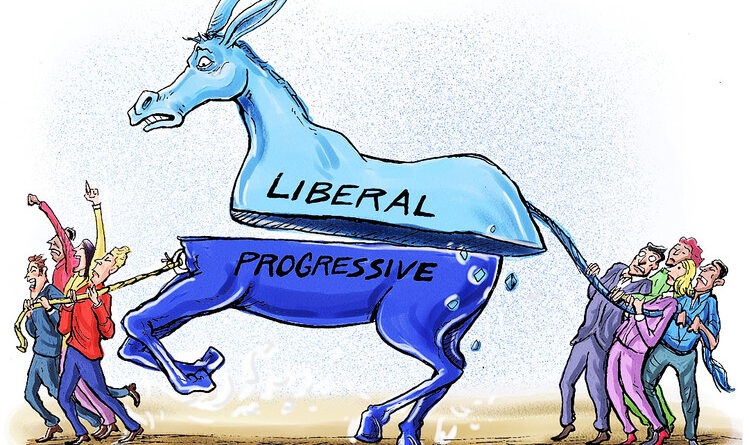
The dissatisfaction within the ranks of the Democratic Party, however, is not homogeneous. There are varied reasons underpinning the disillusionment of party supporters. On one hand, the progressives fault the Democrats for their lacking vigor in their fight. On the other, the party’s centrist wing views the issue as Democrats pursuing undesirable paths in their battles, increasingly tilting towards culture war and identity politics.
The rifts within the Democratic Party are alarming but there’s one singular cause uniting the disgruntled. The desire to secure victories. Harris’s position as a potential 2024 nominee was arguably a result of her filling a diversity quota, due to Biden’s outspoken preference for a female, African American running mate.
But Harris’s problems go beyond her racial or gender identity. Rather, her key issue ties back to her inability to broaden the Democratic coalition’s reach. In order to taste electoral victory, Democrats must field someone who can switch the loyalties of Trump’s base. Harris’s failure doesn’t stem from inadequate Democratic turnout. Instead, her inability to resonate with an evolving electorate is to blame.
Harris’s public discourse makes her seem more akin to a university administrator rather than a persuasive political figure. Apart from her unequivocal stance on reproductive rights, Harris’s beliefs often come across as blatantly tailored by focus groups in a time where voters are seeking genuine authenticity.
Adding fuel to the flames, Harris willingly accepted Joe Biden’s request not to distance herself from him or his policies, which in time may prove to be a costly mistake. Her decision to give her first interview post-office at ‘The Late Show’ with Stephen Colbert is telling of her questionable choices. While the show might indulge its ideologically consistent viewers, it is not the audience that the Democrats need to sway to secure wins.
If the Democratic party chooses to back Harris again for the presidency, the chances are that she would end up being just another name in a trivia question. It’s most likely that the trivia question wouldn’t be ‘Who was the 48th President of the United States?’, reinforcing the narrative that the Democratic party needs to reassess its strategy and candidate choices before it is too late.