
Texas Governor Puts Democrats on Heels with New Districting
Greg Abbott, the Governor of Texas, recently gave the green light to a fresh congressional districting map. This move positions Republicans to potentially secure five additional seats, adding a noteworthy reinforcement to their existing control. Prior to this, Democrats had momentarily sidestepped their legislative responsibilities in the state, fleeing Texas to avoid a vote. Only after Abbott convened a second exceptional session did they return, and the map passed through both the Texas House and Senate.
In the present balance of power, Republicans oversee 25 out of 38 of Texas’s congressional seats. Should this adjustment take effect as expected, the lead could stretch distinctly, raising the tally to 30 out of 38 come the midterms due in 2026. If all goes according to the Republican plan, the Lone Star State could see a substantial shift to the right, a shift that is sure to ruffle some feathers.
Gavin Newsom, the Democratic Governor of California, seemed to have taken a leaf from Abbott’s book. Rather than simply accepting Abbott’s strategic manoeuvre, Newsom, known for his opposition to any power shift away from the Democrats, seemingly attempted to ridicule Abbott by demeaning him to the position of ‘Trump’s #1 lapdog’. While this is hardly a mature response, it does illustrate the utter distress Democrats are feeling regarding potential Republican gains.
Newsom was not sitting idly by, though. Instead, it’s worth noting his own attempt to tilt the scale in favor of Democrats. He signed a bill that permits a special election in November, opening up the chance for voters to approve a new democratic-leaning congressional map. Would it surprise us to learn that this proposed map could see Democratic congressional seats grow by up to five more in California? No, it wouldn’t.
On the other hand, this plan to increase Democratic representation might severely impact Republican representation in Congress. The Republicans’ hold could slide from nine to a lowly four out of the 52 total seats in California. This would mean that the Republicans make up less than 8 percent of the total, despite President Donald Trump achieving a substantial 38 percent of the vote in the Golden State in the last presidential election.
The Democratic machinery might try to present Texas’s redrawing of its map as an outrageous, unjust political move. However, they conveniently forget the imbalances in states like Illinois, Massachusetts, and New York, where Democrats rule the roost, thanks to their own partisan districting. Their model is laughably obvious – ignore the popular vote and arrange districts to their advantage.
In Illinois, for instance, Trump secured 44 percent of the popular vote. However, Republicans could only lay claim to three congressional victories in the state, owing to the Democrats’ intricate control of the district placement and layout within the Land of Lincoln’s 17 districts. Is it any wonder that the state has such a vastly Democratic Congressional representation?
Let’s not forget about New York. The Democrats there bulldozed their way through a new congressional map after the state experienced a Republican surge during the 2022 midterm elections. Yes, there was a time when the Republican delegation sat at 11, but that number shrank to fewer than half of the total 26 seats in the subsequent Congress.
Again, despite Trump claiming a substantial 44 percent of the vote in New York. This factor did not prevent the Democrats from skewing Congressional seats heavily in their favor. The mid-decade redistricting in New York happened to play a vital role in this shift. Consequently, this reduced Republican representation despite a commendable national victory for them, accounting for all seven ‘swing states’.
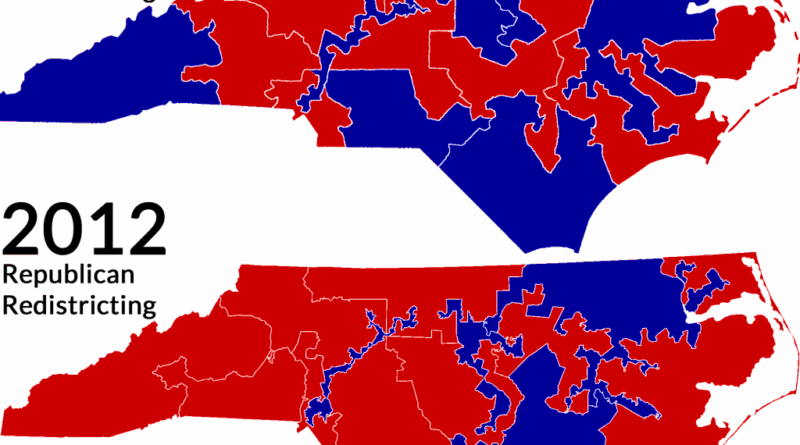
But of course, Texas’s new districting map isn’t just a random development. It’s obviously a counteraction to the Democratic Party’s attempts to gerrymander in their favor across various states. Only ‘fair and balanced’ when it suits them, Democratic supporters have no qualms about legal gerrymandering when it appears to uphold their interests.
Voting rights organizations surfaced with a lawsuit following the bill’s signing. They argued that the revised map effectively erodes the voting influence of Black Texans. To entirely thwart the new Texas map, plaintiffs must demonstrate it as a direct violation of the Voting Rights Act of 1965. This act specifically prohibits districting in a manner intended to marginalize minority communities.
However, Republican leaders in Texas remain unbothered by these accusations. They strongly refute any claims asserting that the map is racially unfair. They hold their ground, maintaining that the reimagined layout conveys more not fewer, new majority-minority seats than its predecessor. It’s simply a matter of perspective and setting the narrative.
Naturally, Democrats will see Texas’ move as brazenly partisan. They may claim it’s an underhanded strategy aimed at snagging more votes for the Republican base. However, one can argue with equal conviction that this is just their ploy to draw attention away from their own gerrymandering habits. As is often said, one’s actions are often a reflection of one’s fears.