
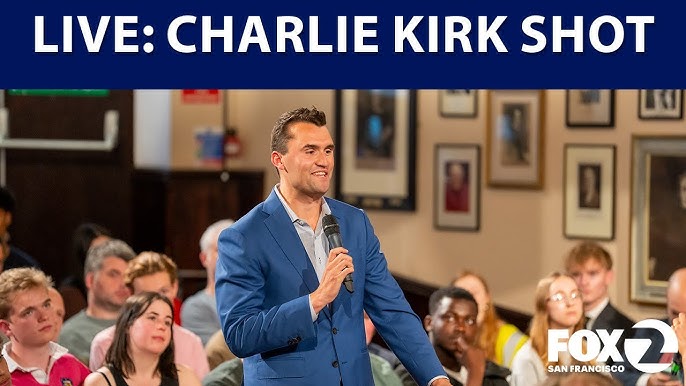
Tragic End for Activist Charlie Kirk Incites Political Firestorm
The untimely demise of right-wing activist Charlie Kirk, who was shot while participating in an event in Utah, ignited a storm of fury from far-right social media influencers and extremist groups, often displaying an inclination toward hostility against the left. Charlie Kirk, who holds notable recognition as the cofounder of Turning Point USA, a conservative youth movement, faced this cruel fate while addressing queries at a TPUSA function hosted within Utah Valley University. As late as Wednesday afternoon, local law enforcement declared that they had a ‘person of interest’ detained, though subsequently, they released this individual. The reasons behind the tragic incident still remain undisclosed by officials.
Ignoring the absence of official information from the authorities, immediate accusations were directed towards the left by numerous far-right influencers and Republicans, assuming them to be the orchestrators of the shooting. The sharp edges of militancy were shown by several extremist groups’ members, who veered toward calls for an armed conflict and a violent reaction. The situation was starkly described by an influencer in a live video session, repeatedly framing it as a war.
A high-ranking official, in a pre-recorded address, claimed that such heinous incidents are the direct outcome of lashing rhetoric which paints commendable Americans like Charlie as equal to the world’s most notorious criminals and mass killers. He added to this fiery narrative by suggesting that such discourse was creating the terrorist events today’s country is experiencing. Another influencer responded to this tragedy by announcing plans to resurrect his militia group with the primary aim of ensuring the safeguarding of public figures akin to Kirk.
Mainstream right-wing political commentators and lawmakers also jumped on the bandwagon to implicate the left and call for action. Official voices on social media called for retribution, claiming that the left had become synonymous with murder. Hasty conclusions were drawn accusing even those who condemned such acts of violence of having ‘blood on their hands’.
Several voices from across the political arena pointed fingers at those abstaining from an explicit denouncement of the incident as contributing to the predicament. Following a unity ‘moment of prayer’ in Congress, one Representative sought a verbal prayer. This request was met with resistance from some Democrats who instead brought up the school shooting incident that took place in Colorado on the same day. Heated arguments ensued.
The exchange of harsh words continued on various online platforms. Several individuals took it as an opportunity to point out that the escalating violence was a direct consequence of polarized political ideologies. Public figures along with ordinary social media users shared opinions and expressed concern over the increasing severity of the situation.
Certain participants used the tragic incident to advocate for probes into nongovernmental organizations due to their alleged role in fermenting such violence. Thoughts were ventilated stipulating that ‘uncontrollable left-wing violence is not an anomaly; we must respond now, or it will obliterate us.’ Others vocalized their perspective rather bluntly as they declared, ‘THIS IS WAR.’
Echoes calling for a conflict were resonating across diverse social media platforms. In a discussion thread dedicated to the incident, a user gravely prophesied, ‘War is impending.’ Another user reacted with, ‘War is upon us.’ The incident was also linked by many to previous violent attacks on conservative figures, indicating a pattern.
One commentator observed, ‘It feels like we are peering into the face of a civil war.’ Tragically, even opposition groups sought to leverage the unfortunate incident as a means for recruitment. Others viewed the grievous event as a gateway to advance their cause.
From the point of view of researchers investigating these groups, the prompt and aligning reactions to the incident can be seen as alarming. It must be realized that while a majority of these community members might not follow through on their belligerent rhetoric, a minor fraction acting on this aggression can lead to significant amounts of harm.
A common observation in all these narratives was the immediate blame game directed towards the left without proper investigation from authorities. The lack of factual statements led to the inflaming of already heightened sentiments. As a result, these unfounded accusations escalated the division and resulted in calls for revenge and more violence.
In the midst of the chaos, extremist groups, both mainstream and fringe, pushed their ulterior motives. They capitalized on the incident to rally their followers, incite fervor, and find their respective version of ‘justice’. However, justice delivered in such a manner may only escalate the situation rather than provide a resolution.
In the mainstream political spectrum, it was disappointing to see public figures citing this incident to further inflame tensions rather than to bridge divides. While polarization may be beneficial for political mileage, it often comes at the cost of societal harmony and peaceful coexistence. The incident hence reflected a symptom of an unhealthy political discourse.
The incident compelled society to contend with the impacts of divisive narrative and intolerance, highlighting the potential consequences of extreme ideologies. It emphasized the urgency to cultivate a discourse based on understanding and productive dialogue to preempt such tragic events. The heated statements and calls for war underscored not only the need for responsible civic behavior but also the importance of restraint during difficult times.