
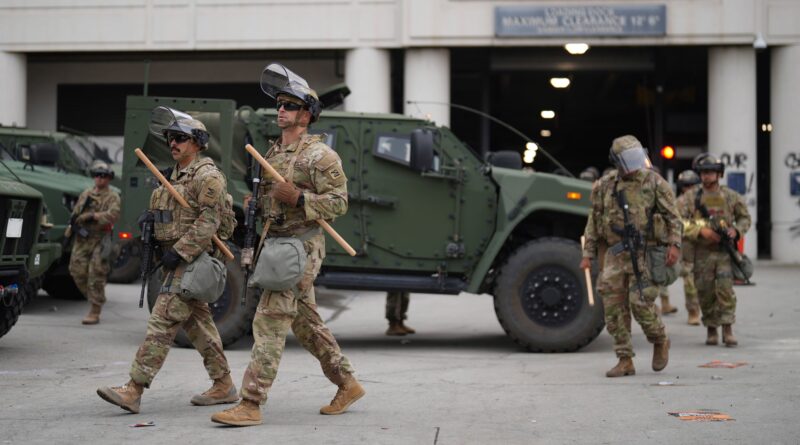
Trump’s Planned Militarization of Chicago: A $1.6 Million Daily Price Tag
Speculation is rife over President Donald Trump’s intent to militarize Chicago, a move that financial experts predict may tally to a staggering sum of nearly $1.6 million per day. The Governor of Illinois, JB Pritzker, dropped hints this Tuesday about a possible mobilization of the Texas National Guard into Chicago. This suggested plan, however, has been disputed by the office of Texas’ Governor, Greg Abbott. President Trump, when probed about this plan of deploying National Guard forces to Chicago, remained equivocal, confirming the plan but providing no specific timeline.
Expert computations based on potential troop numbers underscore the hefty price tag that such a plan could carry for American taxpayers. Should President Trump go ahead with a 3,000-strong National Guard force in the windy city, it is projected that the cost would amount to around $1,590,000 each day. However, the President’s past actions of similar intent have been met with legal resistance.
A recent example includes a federal court’s judgment on Tuesday, declaring Trump’s previous troop deployment to Los Angeles unlawful. The ruling judge issued a stark warning against Trump’s recurring attempts to convert the National Guard into a unit akin to a presidential police force. Whether this ruling will carry any weight in preventing further such deployments is yet unclear.
For several weeks now, President Trump has been hinting at a possible military operation in Chicago. This follows precedent set with previous militarizations in Los Angeles in June and Washington, D.C. in the prior month. In these instances, an executive order signed by President Trump gave the Defense Department more authority in domestic law enforcement.
In his judgment, Judge Breyer pointed out that the Pentagon had been systematically employing armed soldiers to carry out enforcement duties in California, an act in direct contravention of Posse Comitatus. The crystal-clear subtext behind Trump’s pursuit of military presence in Chicago was not lost on Governor Pritzker.
“None of this is about mitigating crime,” stated Pritzker. According to him, the issue boils down to Trump’s attempts to utilize military forces to exert fretful influence in politically blue-cited cities. This, he suggests, is the President’s attempt at baring his teeth to his political opposites in Democratic-led states.
FBI statistics from 2024 indicate that several other cities in the U.S. record substantially higher homicide rates compared to Chicago. Despite this data, Trump’s threats to establish military operations in cities headed by Democratic mayors persist.
Data analysis reveals an interesting comparison when it comes to costs. The placement of 3,000 Guard members in Chicago would cost around $1.6 million per day. Providing housing for Chicago’s homeless population, by contrast, would only require about $383,000 per day. This cost is roughly a quarter of that required for a full troop deployment.
Although estimates currently stand at 3,000 Guard troops for the hypothesized deployment, the actual number of troops sent might be significantly more, leading to even higher costs. With this potential scenario, it is widely expected that the financial implications would see a concomitant increase.
The speculation regarding the deployment of troops in Chicago, coupled with the ambiguity surrounding it, has only added fuel to the fire. Trump’s refusal to confirm a fixed timeline for the deployment has left the city in a state of suspense. Both Governor Pritzker and Governor Abbott’s contradicting statements also add to this uncertainty.
The legality of such deployments has also come under intense scrutiny following the recent ruling of Trump’s deployment to Los Angeles being unlawful. As it stands, it is still uncertain how much this verdict will impact potential future deployments, if at all.
Meanwhile, the President’s threats of military occupations echo persistently- mainly targeting cities governed by Democratic mayors. There is a sense of growing concern, as these threats combined with recent precedents set by militarizations in Los Angeles and Washington D.C. create a picture of a ubiquitous pattern.
Given the financial, legal, and social implications of such a large-scale mobilization, many eyes will be on President Trump’s next move vis-a-vis deploying National Guard forces into Chicago. The heavy cost to the taxpayer could seismically shift public opinion, which is why careful attention is being paid to these unfolding events by stakeholders on all sides.