
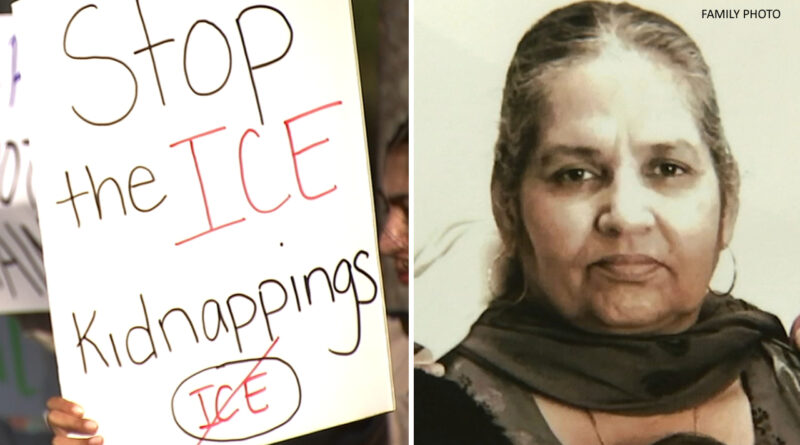
73-year-old grandmother faced ICE detention despite adherence to immigration laws
Last week, an unforeseen incident unfolded involving Harjit Kaur, a 73-year-old grandmother residing in the Bay Area of California. Kaur, who has USA as her home for over thirty years now, was seized by U.S. Immigration and Customs Enforcement (ICE). This sudden event of her apprehension occurred during her regular check-in at the institution. Even though she displays a record of complying with immigration stipulations for over a decade, Kaur’s detention has spurred turmoil and outrage within her close-knit community.
In the aftermath of Kaur’s detention, her community members quickly mobilized to voice their opposition. The subsequent Friday saw roughly two hundred individuals convening in El Sobrante, California. Their purpose was to vehemently demand Kaur’s release. They expressed their sentiment through banners and placards bearing messages such as ‘Hands off our grandma’ and ‘She’s no criminal’, making their stance clear.
Being a mother of two and a grandmother of five attests to the value Kaur has in the society she belongs to. She made the USA her home in 1992 and since then has lived a blameless life devoid of any criminal acts. In 2007, her pursuit of asylum encountered rejection. However, this did not deter her. Kaur appealed her case vigorously, making it reach as far as the 9th U.S. Circuit Court of Appeals.
Unfortunately, her resilient fight came to an end around 2012 or 2013 when her final appeal was declined. From then onwards, as per the judicial order, Kaur adhered to the requirement of reporting to ICE every six months – a practice she followed diligently for the next 13 years. Her detention abruptly put an end to this routine.
The occurrence of Kaur’s detention is not an isolated case. Rather, it contributes to a concerning trend in the nation. There have recently been mounting activities of immigration enforcement in various corners of the country. ICE seems to have increased its instances of arresting immigrants during their routine check-ins or even during court proceedings.
Interestingly, the country’s immigration authorities appear to be focusing their clampdown more on cities known for their sanctuary status. Several cities like Los Angeles, Chicago, Boston, and Washington D.C. seem to find themselves in the crosshairs. Kaur found herself in the midst of this heightened enforcement when she was taken into custody on September 8 at a San Francisco ICE facility.
Following her detention in San Francisco, Kaur was transferred to an office in Fresno soon after. The journey did not stop there; she was escorted to a detention center in Bakersfield, under the restrictive premise of handcuffs. It was not until the early hours of 3 a.m. when she finally reached her destination.
As a committed vegetarian, Kaur faced further challenges in Bakersfield. It was not until six days into her stay at the center that she was finally catered to with a vegetarian meal. For those initial days, she was reluctantly served meals that included meat items.
Kaur’s medical ailments further compounded the challenges she faced at the detention center. She has undergone both knees replacement surgery and endures multiple health complications like thyroid problems and frequent migraines. Despite her dire need for medical assistance, she unfortunately still awaits the necessary care from a medical professional.
Kaur had prepared herself mentally for the possibility of adhering to the final order of removal and returning to India. Oddly, ICE informed her that they didn’t possess the requisite travel documents to facilitate her return. This left Kaur with two potential courses of action. She could either challenge her detention via a habeas petition, an endeavor that could potentially drag on for months. Alternately, she could encourage the Indian consulate to issue the necessary travel documents to enable her release from ICE custody and her subsequent return to India.
Attempts at seeking a statement from the Indian Consulate General of San Francisco have so far been unsuccessful, as no response was received in return. However, representatives of the district where Kaur resides sternly expressed their dissatisfaction with the treatment meted out to Kaur.
Kaur’s commitment to her community shone through her work as a seamstress at an Indian clothing boutique based in Berkeley over the past two decades. Her skilled hands have expertly tailored garments for various community members, making her presence indispensable to many.
It is clear that the repercussions of Kaur’s sudden detention have been far-reaching and severe for her community. Her absence has been felt keenly, creating a void that resonates within her family and beyond. Despite the bleak circumstances that currently surround her, Kaur has shown her fortitude. She inexplicably managed to express gratitude to her well-wishers amidst these trying times during one of the few phone calls she was allowed from the detention center.
The ramifications of Kaur’s detention and the consoling support of her community paint a poignant picture that underlines the intricate complexities surrounding immigration enforcement. The evolving situation provides a stark reminder of the concerning immigration issues facing the country, compelling one to consider the deeper implications of such actions.