
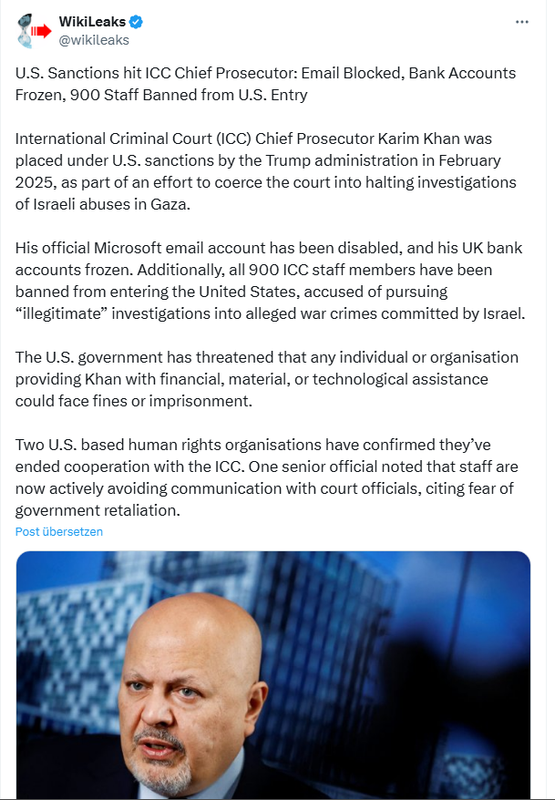
Microsoft in Throes of Global Politics: ICC Prosecutor’s Email Suspended on Trump’s Directive
In a move aligned with a directive from former U.S. President Trump, Microsoft recently assisted in suspending the email account of a prosecutor from the International Criminal Court in the Netherlands. The prosecutor had been delving into allegations of war crimes involving Israel. This put Microsoft, who had been providing digital resources to the court for years, at the crossroads of a complex geopolitical skirmish as a result of President Trump’s executive order emailed in early 2020.
The International Criminal Court, stationed in The Hague, Netherlands, is tasked with the duty of investigating and handling cases related to human rights violations, genocides, and other global offenses. Microsoft’s provision of digital services, including email services, proved crucial for such operations, making the sudden disruption due to Mr. Trump’s order rather difficult to manage.
The executive order issued by President Trump specifically barred U.S. establishments from offering any services to the chief prosecutor, Karim Khan. Following the directive, Microsoft, based in Redmond, WA, cooperated by disabling Mr. Khan’s ICC email account.
The shutoff in digital communication effectively severed Mr. Khan’s inter-colleague communication routes. All this transpired just a few months after the court had issued an arrest directive for Prime Minister Benjamin Netanyahu of Israel, pertaining to his country’s activities in Gaza.
Microsoft’s immediate compliance with President Trump’s executive order was initially reported by The Associated Press. The tech giant’s swift action raised eyebrows amongst policymakers on a continental scale.
The entire debacle served as a stark warning, highlighting an issue much larger than a mere email suspension. It kindled the fear that the American administration, under Trump’s leadership, could exploit America’s tech industry dominance to penalize adversaries, extending even to allied nations.
This incident has clearly demonstrated the possible precarious scenarios that could befall, serves Bart Groothuis. The former cybersecurity chief for the Dutch Ministry of Defense, who currently holds a position in the European Parliament, used the incident with the ICC as an additional case in point.
Previously, Mr. Groothuis was an advocate for U.S tech corporations. However, following this ordeal, he revealed he has done a complete ‘about-face’. He highlighted, ‘Our case in point here, with the ICC, is a testament to the reality of these situations. They are not make-belief.’
In Mr. Groothuis’ own words, European nations need to consider solid steps to ensure regional sovereignty. The incident mirrored the potential geopolitical power that U.S tech giants could possess and the consequences of their actions in international affairs.
His views are reflective of a wider concern within European circles about their digital sovereignty, as U.S. tech giants continue to grow in influence. The incident has revealed potential geopolitical factors that could come into play in the realm of digital communication services, sparking a dialogue on the issue.
This realization, resulting from the Microsoft-ICC episode, has added a fresh dimension to the discussions about global tech supremacy. It outlines how such companies, when entangled in geopolitical multitudes, can function as powerful tools in the hands of nation-states.
The quick action by Microsoft in response to the Trump administration’s executive order demonstrates the far-reaching implications of this globally. It could set a precedent for future scenarios in which technology powerhouses could be used to drive political agendas.
Situations like these highlight the fine line technology companies will have to grapple with as their services grow increasingly indispensable on an international scale. The tech companies’ policies and actions can indeed be influenced by domestic political agendas, complicating their global charter.
These cases exemplify the immense responsibility that incumbent tech firms shoulder in the international arena. Their ability to provide, or withdraw, services can have serious repercussions at both a personal and an international level.
Finally, this rather atypical situation has sparked an important conversation, awakening the larger global community to the potential leverage points that exist due to an over-reliance on tech giants. With this case, measures towards digital sovereignty have become more than just an abstract concept; they have become a real necessity.
Tech companies such as Microsoft find themselves increasingly involved in international politics. While fulfilling national mandates, they also have a responsibility towards their global stakeholders. As reliance on technology for activities from the mundane to critical legal processes increases, so does the need for transparency and robust, equitable tech policies.