
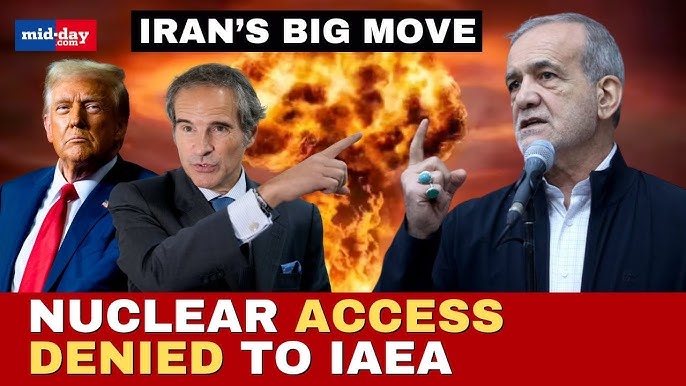
Iran Cuts Ties with IAEA Amid Rising Global Tensions
In a move that has raised global tensions, Iran’s President, Masoud Pezeshkian, directed his nation on July 3 to halt its alliance with the International Atomic Energy Agency (IAEA), following significant attacks on key Iranian nuclear installations by the United States. This response came as Iran found itself mired in aerial combat with Israel.
Forecasts about the imminent discussions between Iran and the IAEA suggest them to be both very ‘technical’ and ‘complex’, according to declarations made by the Foreign Ministry of the Islamic Republic. These pronouncements were made in anticipation of the IAEA’s maiden visit since the ties were severed abruptly by Tehran a month ago.
The deterioration of the bilateral relationship between Iran and the IAEA was further exacerbated by the 12-day air conflict initiated by Israel and the US in June. The fallout from this assault led to considerable damage to critical nuclear installations in Iran.
On June 12, the IAEA board publicly rebuked Iran, expressing a belief that the country had violated its commitments towards non-proliferation. Interestingly, this accusation was made a day ahead of the Israeli-led air raids over Iran, a watershed event that eventually triggered the war.
The IAEA remained silent on the forthcoming visit by the deputy chief of the agency and offered no clarity on whether this visit would include scheduled access to nuclear sites in Iran. It remains unclear if the visit is part of an attempt to mend the severed ties or simply procedural matters.
Iran’s Foreign Ministry spokesperson, Esmail Baghaei, revealed to journalists that there are chances of a sit-down with Foreign Minister Abbas Aragchi, although it’s premature to anticipate the output of said talks considering their technical and intricate nature.
Baghaei was also critical of IAEA’s lack of an appropriate response during the conflict with Israel in June, suggesting the agency failed to condemn the direct strikes on monitored peaceful facilities. He expressed his disapproval on their inability to showcase a judicious and sensible reaction to the aggressive actions.
Aragchi had expressed earlier that cooperation with the IAEA would now necessitate the green light from Iran’s Supreme National Security Council. This substantial shift in policy indicates that Iran contemplates recalibrating its cooperation arrangements with the IAEA.
This development will probably restrict the IAEA inspectors’ capability to scrutinize Iran’s nuclear progression, which had steadily been enriching uranium close to weaponry-grade levels.
Iran’s President, Masoud Pezeshkian, on July 3 compelled the nation to freeze its involvement with the IAEA, reacting to the US’s aerial bombings of three major Iranian nuclear facilities. This military action was undertaken as Israel plunged into an air conflict with Iran, which resulted in the casualties of nearly 1,100 individuals, including quite a few military personnel.
Israel experienced its fair share of losses as well, with 28 fatalities reported as a consequence of Iran’s retaliatory strikes. This chain of events illustrates the escalating hostilities in the region.
Iran has leveraged the restriction of IAEA inspections in the past as a negotiation strategy with Western countries. Nonetheless, it remains uncertain as to when Tehran and Washington will resume talks to strike an agreement over Iran’s nuclear ambitions.
Both the IAEA and the US intelligence services have concluded that Iran reportedly last managed a formal nuclear arms program in 2003. However, it’s noteworthy that Iran has been refining uranium as much as 60%, which suggests they were merely technically a few stages away from reaching weaponry-grade levels of 90%.