
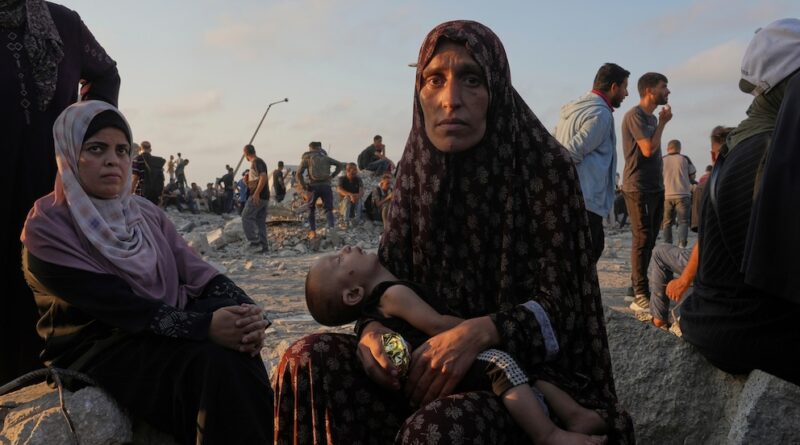
Israel Counters UN’s Claims of Famine in Gaza
The Israeli government has countered a United Nations report alleging that parts of Gaza are experiencing famine. The United Nations’ Integrated Food Security Phase Classification (IPC), which prepared the report, largely takes into account data from sources tied to Hamas, presenting Israel as the cause of a humanitarian situation primarily instigated by terror groups in Gaza. The Ministry of Foreign Affairs in Israel discredited the UN’s publication as a contrived account designed to support the baseless allegations propagated by Hamas.
In reaction to the report, Israeli foreign ministry lambasted the IPC for manipulating data to propagate a misleading narrative. The UN body has been accused of altering established standards to portray the situation in Gaza as one of famine. The Israeli ministry argued that the IPC report is founded on false information proliferated by Hamas through bodies with vested interests.
The Israeli side firmly asserts that there is no famine crisis in Gaza. They point to over 100,000 aid supply trucks that have entered Gaza since the outbreak of hostilities. The recent weeks have seen an overwhelming rush of food assistance flood the Gaza Strip, leading to a significant drop in food prices in the local markets.
On the other hand, the UN report seems to overlook the fact that, according to its own statistics, approximately 90% of the aid trucks entering Gaza have either been seized or commandeered by Hamas or other Palestinian extremist factions since mid-May. The document doesn’t mention that the control and administration of Gaza City and its surrounding territories are predominantly in the hands of Hamas and not Israeli forces.
The IPC’s allegations are being cast as a gross distortion of the truth by Israel. The country insists it has no policies in place to induce starvation, rather it strives to alleviate it. From the commencement of the military conflict, Israel has facilitated the entry of 2 million tons of aid into the Gaza Strip, that’s over a ton of aid per resident.
The Trump administration, a strong supporter of the Gaza Humanitarian Foundation (GHF) that manages food distribution in Gaza, has also questioned the credibility of the UN report. In early August, the US Special Envoy to the Middle East, Steve Witkoff, visited GHF facilities in Gaza and noted the presence of difficulty and scarcity, but not to the point of famine.
When the US State Department spokesperson was questioned regarding the IPC’s assertions, they reechoed the accusations of aide pillaging and emphasized Hamas’s systematic effort to propagate a false narrative of deliberate mass starvation in order to exert political pressure on Israel. The spokesperson stressed that the US government’s priority is facilitating the delivery of aid to Gaza’s residents.
The US official also refuted the misdirected usage of words, insisting that real problems needed honest addresses for the sake of Gazan people who deserves better. The spokesperson firmly emphasized on dealing with the challenging conditions rather than getting lost in semantics.
In a related event on Friday evening, Houthi militants based in Yemen initiated a ballistic missile attack on Israel. Preliminary statement from the Israel Defense Forces (IDF) disclosed that several attempts to intercept the missile were undertaken by their aerial defense systems, and the missile likely fragmented in mid-air.
On the day of the missile attack, Israel’s air defense system also neutralized a Houthi drone prior to the event. The IDF effectively countered the missile attack, reaffirming their preparedness and responsiveness in the face of growing threats from surrounding territories.
Meanwhile, the Israeli military discovered and dismantled a weapon storage facility run by Hezbollah in southern Lebanon on the same Friday. Shortly after, the IDF confirmed the attack on the facility, clarifying that it was situated in the area of Dier Kifa, located in southern Lebanon.
The IDF’s disclosure on Friday night stressed the fact that the existence of the weapons storage facility goes against the agreement between Israel and Lebanon. The situation underlines the volatile nature of the region, with various factions attempting to assert their influence and dominance.
While tensions rise in the area, the Israeli authorities are keen to illustrate their commitment to preventing a humanitarian crisis in Gaza. Israel dismisses the UN report as a biased document that fails to present an accurate picture of the aid situation and the role of Gaza-based factions in hijacking aid, coupled with neglecting the fact that Gaza is primarily controlled by Hamas and not Israel.
The ongoing conflict has seen international organizations and concerned nations offering a hand is aid distribution. However, the reality of hijacked aid trucks and the manipulation of narratives to apply political pressure remain critical issues, overshadowing these efforts at assistance.
Ultimately, these developments reiterate the complexity of the situation in Gaza, Israel, and the broader Middle East. The multifaceted narrative about aid, control, and accountability compels a more comprehensive understanding regarding the role and influence of various actors involved in this context. As the situation unfolds, maintaining a clear and accurate account of the facts remains essential in the interest of those depending on aid relief.