
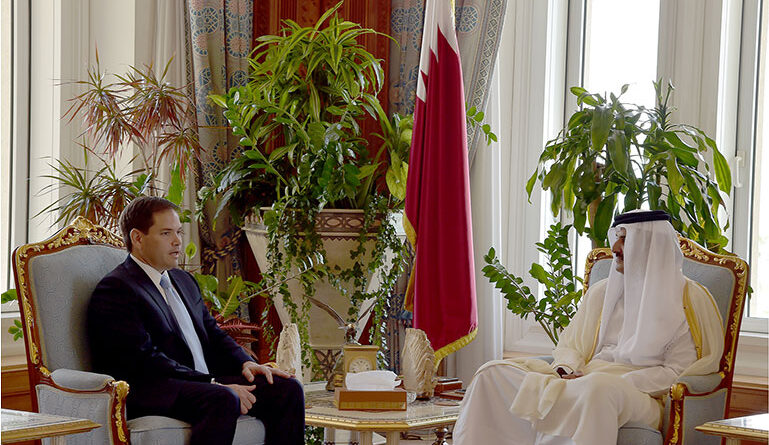
Marco Rubio’s Urgent Diplomatic Visit to Qatar Amid Gaza Conflict
United States Secretary of State, Marco Rubio, recently made a prompt visit to Qatar and met with His Highness, the emir, Sheikh Tamim bin Hamad Al Thani. The impromptu meeting was arranged in the wake of the military attacks on Hamas leaders in Gaza. The Israeli warplanes’ attack happened a week before Rubio’s visit, which added tension to the dynamics of the meeting.
Marco Rubio landed in Doha, Qatar, right after the ground offensive was initiated by Israel into Gaza City. This situation added gravity and urgency to the meeting between the U.S. Secretary of State and the Qatari leader. His gloomy sentiment about the potential outcome, however, did not prevent him from appealing to Qatar to intervene as a mediator.
During closed-door discussions with his delegates, Marco Rubio urged Qatar to stay consistent in the role of a peace mediator pertaining to the Gaza talks. The U.S desired that Qatar continue leveraging their diplomatic influence to try and control the escalating crisis. Rubio’s visit was more than a mere courtesy; it was a tactical move aimed at negotiation and conflict resolution.
Rubio articulated, ‘We, the United States, are requesting Qatar to persist in their constructive intervention, an effort we highly appreciate’. He went on to articulate that Qatar possesses a unique capability to aid in resolving the ongoing conflict. These words were not only meant to seek assistance, but to also express gratitude and confidence in Qatar’s ability to contribute to peace negotiations.
The United States Secretary of State brought a significant statement to the table saying, ‘Qatar might ponder whether to proceed with mediation in the light of last week’s developments. However, we want to express our belief that they are positioned well to facilitate the negotiation providing potential solutions for the end of this conflict’. This was a clear expression of how the United States valued Qatar’s role in the ongoing conundrum.
Rubio’s discussions came after the Doha-hosted Arab-Islamic summit, where strong criticism was directed towards Israel for the strikes which have tensioned the relationship between the Gulf Arab states and America. Adding to this ruckus, UN Rights Chief, Volker Turk, voiced his condemnation of Israel’s attack on Doha which he described as a shocking violation of international laws and a threat to global peace.
Volker Turk slammed Israel’s raid on Doha, terming it as an unexpected breach of international regulations. Turk’s comments added further weight to the prevailing discontentment, proclaiming it as a threat to regional peace and stability, as well as a disruption to the global norms of mediation and negotiation processes.
The influence of the Washington on Israel was highlighted when the head of the influential six-nation Gulf Cooperation Council recommended the U.S. to leverage its instrumental sway over Israel. As diplomatic maneuvers intensified, Rubio stated that America would collaborate with Qatar to finalize a protection pact, regardless of the Israeli military action.
In a press conversation back in Washington, President Donald Trump provided reassurances that Prime Minister Benjamin Netanyahu would be refrained from attacking Qatar further. Amid these political dynamics and potential conflicts, Qatar has emerged as a reliable strategic partner.
Qatar has been pivotal in the peace diplomacy aimed at ending the nearly two-year-long war in Gaza. As talks regarding a potential US-proposed ceasefire took place among Hamas leaders, Israel initiated a strike. Qatar, with its extensive diplomatic relationships and strategic location, was plunged into the heart of these recent events.
In context of military use, Qatar is home to the largest American air base in the Middle East. It also serves as the operational headquarters of Central Command, the American military authority overseeing the region. Such significant strategic positioning has made Qatar a key ally of the US in the Middle East.
Qatar is a vital player in the region, not just diplomatrically, but also due to its enormous natural gas reserves. Recognizing this, the United States has classified Qatar as a principal non-NATO ally, revealing the importance of their strategic partnership.
The conflict that involved U.S Secretary of State Rubio’s visit to Qatar was originally sparked by Hamas’ attack on Israel in October 2023. Israeli Prime Minister Benjamin Netanyahu then took ‘full responsibility’ for a retaliatory strike on Doha, citing justified retribution against a ‘haven for terrorists.’
Israel’s leadership, under the direction of Netanyahu, expressed that the attack on Doha was conducted under their ‘full responsibility’. Netanyahu justified the assault by saying it was critical to deny ‘terrorists a safe refuge’. This brought a full circle to the ongoing conflict that started with Hamas’ onslaught on Israel in October 2023.
Amidst these upheavals, prior to the October 7 raid, Israel and the United States had confidentially endorsed Qatar’s role. This support went as far as backing Doha’s financial aid to Hamas aiming at maintaining stability in Gaza. The latest military actions reveal a stark contrast to previously held stances, highlighting the complexities of the conflicts that remain.
In conclusion, Rubio’s urgent visit to Qatar aims to catalyze a mediation process for the lasting conflict in Gaza. The dynamic relations between Israel, the United States and Qatar, and the various diplomatic efforts involved, are all part of the larger geopolitical landscape. The outcomes of these negotiations can shape not just regional stability, but also significantly influence global peace and security.