
Arctic Vision: Russia’s Expanding Trade Routes with Central Asia
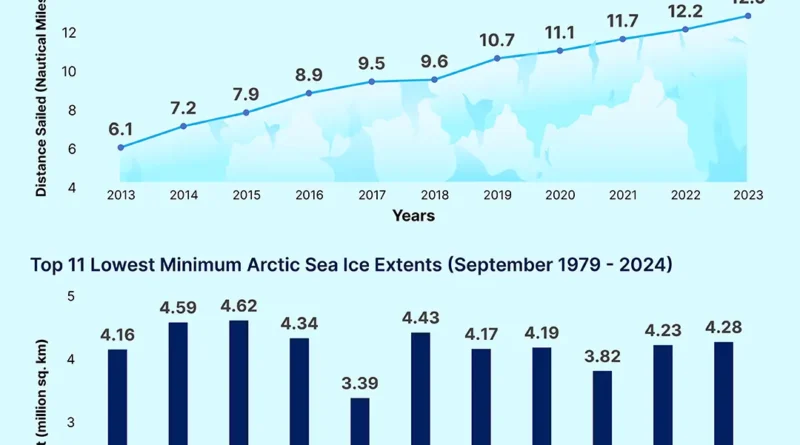
Exciting changes are taking place within the Arctic region, predominantly led by Russia and the nations of Central Asia. Within the context of ‘Arctic: territory of the dialogue’, the sixth forum held on March 27, Russian President Vladimir Putin unveiled an ambitious strategic vision for the Arctic. It includes the critical enhancement of the Northern Sea Route’s (NSR) transportation and logistic potentials to boost Arctic trade.
The president conveyed the importance of improving Russia’s well-established inland rivers by investing in ports and facilities. These initiatives aim to enhance the Arctic Ocean’s connectivity through waterways. Among these inland water networks, the Ob-Irtysh river system gains precedence due to its strategic location traversing China, Kazakhstan, and Russia.
In response to this bold vision, discussions have begun among key stakeholders, namely Russia, China, and Kazakhstan. This trilateral engagement aims to probe opportunities for cross-border transportation along the expansive Ob-Irtysh river system. Both Russia and Kazakhstan have initiated steps towards implementing strategies to enable complete operational functionality of the Ob-Irtysh transport corridor by 2030.
The full operational capability of the south-north Irtysh corridor would usher in remarkable economic advantages for Central Asia and Russia’s relatively underdeveloped Siberian regions. Besides the economic growth, the transcontinental connection holds the potential to create significant geopolitical shifts. This prospect echoes with the notion proposed by British geopolitician Mackinder, which underpins the domination of the world through control over the ‘heartland’, encompassing Central Asia and Siberia, funded by Eurasia’s vast continental resources and a comprehensive network of railways.
However, Mackinder’s hypotheses didn’t consider the merits of maritime transportation over its rail counterpart. Orientialist and strategist Alfred T. Mahan outlined this oversight in Mackinder’s viewpoint. Moreover, the downfall of the Soviet Union in 1991 indicated the constraints of Mackinder’s theory.
Yet, current environmental transformations, particularly the surge in Arctic temperatures, may offer a new lease of life to Mackinder’s concept, paving the way for novel trade routes and enabling access to continental resources. An initial project propelling the creation of a multimodal transport corridor spanning RussiaÐKazakhstanÐChina using Ob-Irtysh is being developed. This ambitious venture promises cost-effective, enhanced transport solutions.
Small-scale operations have demonstrated promising outcomes thus far, and turbulent global supply chain conditions have accentuated the need for versatile trade route alternatives. Nevertheless, the Middle Corridor encounters several steep challenges that need to be overcome to realize this vision. The Ob-Irtysh corridor could potentially mitigate these issues, given that considerable infrastructure requisite for massive operations already exists.
Russia and Kazakhstan harbor expectations from China to support their envisaged Eurasian riverine connectivity. As conventional EU-China routes encounter hurdles and escalating costs, and China contemplates diversifying its supply chains from the Malacca Strait, Ob-Irtysh is progressively gaining traction. However, this also comes with the potential to increase Russia’s regional influence, and multinational shipping companies would need to grapple with nationalization and sanction risks associated with the region’s conflicts.
The complex interplay of the U.S. and China’s technological rivalry and geopolitical strategizing further complicates matters. On top of this, China’s heightened investment in Central Asia’s mineral sector adds another layer of complexity. Given the tightened partnership between Russia and China and their potential to exercise comprehensive dominance over Central Asia’s trade and resources, the implications for U.S. strategy are significant.
In response, the U.S. has secured a 99-year lease over the South Caucasus’s Zangezur Corridor, which establishes an alternative trade route sidelining Chinese influence. Yet it’s evident that more strategies must be put into place to foster trade and investment to elevate American competitiveness in the region. These policies could offer the region alternative growth opportunities and prevent the consolidation of Russian or Chinese influence.