
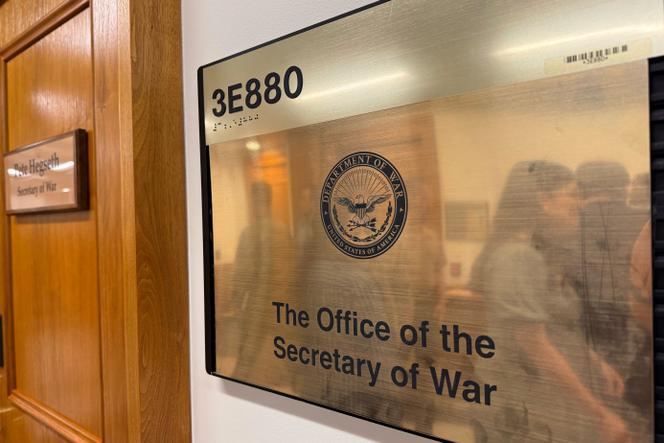
Trump Revives the Department of War: A Historical Analysis
President Donald Trump made headlines when he announced plans to change the name of the United States Department of Defense back to its pre-1949 moniker, the Department of War. He argued that it gave off a more formidable image, signaling strength and power. In his view, ‘defense’ was too passive an approach and suggested that the country might take a more agressive stance if necessary. The re-emergence of the Department of War, according to him, was an attempt to recreate the victorious era in American history, a time when the country had ‘won everything’.
Such views and public statements by Trump underscore the inadequate comprehension of past failures by current American leaders. It overlooks the fact that numerous significant achievements were credited to American policies following the Second World War. These accomplishments included not only aiding the restructuring and revival of the battered economies of Europe and Japan but also developing a proper integrated global economy, which catalyzed an unprecedented era of growth.
Certainly, American strategy was not devoid of imperfections, yet, they scarcely (if at all) arisen due to a lack of aggressiveness or desire for victory. Trump’s inability to understand the actual root causes of the issues suggests a likely exacerbation of currently dire predicaments. His comprehension of historical nuances is questionable, hinting at a significant vulnerability.
One such misunderstanding lies in his perception of the Department of Defense’s objectives. Trump seems to have overlooked that the department was founded with ‘offence’ deeply entrenched within its conceptualization of defense. It was based on the idea that ‘the best defense is a good offense’, amplified to the utmost degree.
Consider George Kennan’s reputed ‘containment policy’, which advocated for ‘unceasing pressure for penetration’. The post-1945 American military body significantly intensified former methods of ensuring national security. It transitioned from limited spending and periodic pullbacks between conflicts toward persistent readiness.
The world was still regarded as a perilous place, even after the triumphs of 1945. Hence, it was recommended that military power be expanded either to deter potential adversaries or to conquer them should a conflict arise. This led to the Department of Defense receiving unmatched budget allocations to increase military strength.
The extent of this military expansion exceeded that of any historical empire. It led to nearly three million U.S. military personnel being stationed in 70 countries. Trump either fails to grasp or deliberately overlooks the fact that this immense power has been extensively and assertively utilized.
The U.S. Military has intervened on a large scale, from Korea and Indochina to Kuwait, Afghanistan, and Iraq. Furthermore, significant contributions have been pumped into NATO and other nations worldwide, such as Israel, Pakistan, Brazil, and Australia, in terms of equipment, training, and personnel.
Reflecting on the past aggressive ‘defence’ approach incites concern. The archives of a 75-year history indicate numerous prominent failures: the stalemate in the Korean peninsula in 1953, a series of setbacks in Indochina, Iraq, and Afghanistan, and ongoing resistance from supposedly weak states, notably Cuba and Iran.
Dubious results were coupled with astronomical costs. Tens of thousands of American lives were lost in Korea, Vietnam, and also Iraq and Afghanistan, resulting in around 58,000 deaths. Additionally, trillions of dollars were diverted from domestic economic and social programs to defense spending.
Trump appears to think that he is deviating from post-1945 defense strategies, whereas he is essentially perpetuating and even magnifying them, enhancing aggressive tactics without confronting their shortcomings. The ‘arrogance of power’ contradicts the U.S.’s assumption of the right to project its ideologies onto remote parts of the world, such as Southeast Asia.
Several critics of the Vietnam War and others subsequently questioned the capacity of the U.S. to achieve its objectives. Questions were raised on the adequacy of manpower and whether the U.S. had the intellectual and economic resources to meet its goals. Was it not overly ambitious to attempt world dominance, given the world’s size, complexity, and the existence of rival nations, independent allies, and continuously emerging challenges?
Trump’s resolve to instigate offense could potentially undo even tentative shifts in America’s pursuit of global supremacy. Aligning this approach with his grand ego could lead to a dangerous revitalization of the strategies associated with global control, which may have serious repercussions.
Ultimately, drawing lessons from past failures and understanding the complexities of global dynamics could foments a richer approach to defense strategies. Rebranding a department or altering its mission statement may come across as a colossal shift, but it might only perpetuate the same strategies with different labels.
Hence, the focus should not only be on how a department such as Defense or War is named, but also on the implications and strategies implicated within their definitions. More constructive involvement, deeper understanding, and improved insights from historical learnings may indeed offer a clearer view of effective defense methodology.
As America charts its path forward, the echoes of its historical decisions reverberate, providing a blueprint and a cautionary tale. The rigorous scrutiny of past policies and strategic military engagements around the world will equip the nation with a broader perspective and a better understanding of how to navigate contemporary global challenges.