
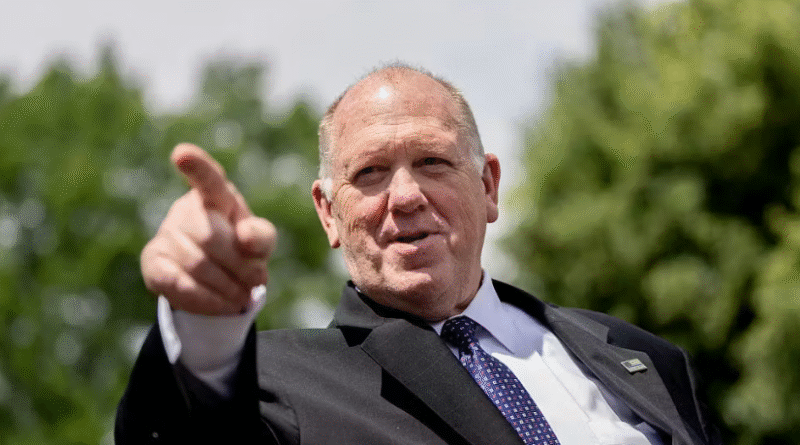
The Homan Effect: ICE Sees Breakthrough in Minneapolis as Local Police Finally Step In
After weeks of violence and political gridlock, a major shift is underway in Minneapolis. Acting ICE Director Todd Lyons confirmed Tuesday that local police arrested 54 anti-ICE protesters overnight, marking what he called a “de-escalation” in hostilities — and attributing the change directly to the arrival of White House border czar Tom Homan.
Testifying before the House Homeland Security Committee, Lyons credited Homan with turning the tide in what had become a dangerous standoff between federal agents and radical left-wing agitators. “ICE has been allowed to do their targeted intelligence-driven enforcement operation,” Lyons said, noting that for the first time, local officers — not ICE — handled crowd control and protest-related arrests.
The reversal comes on the heels of President Donald Trump’s decision last month to dispatch Homan to Minneapolis, replacing Commander Gregory Bovino following the fatal shootings of two anti-ICE activists. Bovino had become a lightning rod for criticism due to his aggressive enforcement tactics in sanctuary cities, where local officials often refused to cooperate.
Rep. Michael McCaul of Texas, who questioned Lyons during the hearing, called out the “perfect storm” created by sanctuary policies and anti-ICE rhetoric. “Your officers are not trained for crowd control,” McCaul told Lyons. “They’re trained to remove dangerous, violent criminals — not to fend off mobs.”
McCaul praised Homan for resetting ICE’s role and restoring order through a “return to mission clarity.” Since taking over, Homan has met personally with Minnesota Governor Tim Walz, Attorney General Keith Ellison, Minneapolis Mayor Jacob Frey, and local police chiefs. The result: unprecedented cooperation, the honoring of ICE detainers, and a new protocol that emphasizes city-led crowd control, not federal agent involvement.
The impact was immediate. Last week, Homan announced a “drawdown” of 700 federal agents, citing progress on the ground and improved coordination with state and local forces.
Under Homan’s direction, ICE has also emphasized transparency, deploying body cameras and limiting the controversial “roving patrols” to the southern border — not urban areas. McCaul called this “a smart pivot,” adding that “ICE should not be left to battle anarchists alone in our cities.”
While protests in Minneapolis continue, they have notably calmed. For the first time in months, ICE agents are operating without the constant threat of mob violence, thanks to what many are calling the “Homan Effect.”
The Trump administration hopes this Minnesota breakthrough will serve as a model for other cities grappling with radical anti-ICE activity. As Homan continues to rebuild bridges between federal and local authorities, ICE’s return to targeted operations — free from political interference — marks a significant shift in the immigration enforcement landscape.