
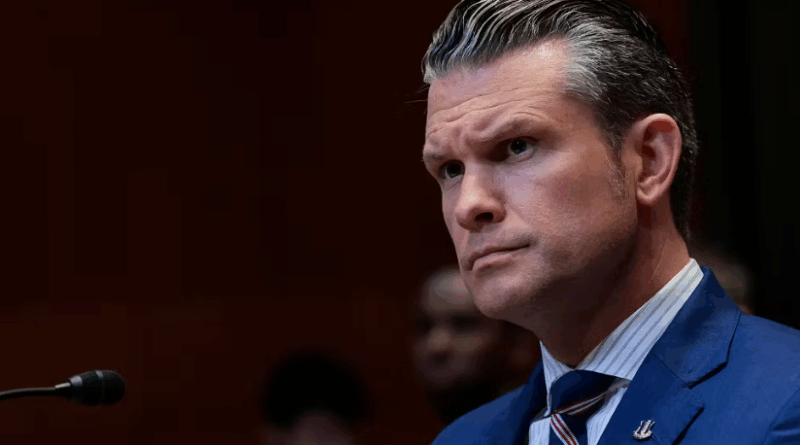
Iran’s Missile Attacks ‘Down 90%,’ Drone Strikes Down 95%, Hegseth Says
Secretary of War Pete Hegseth said Friday that Iran’s missile and drone attacks have dropped dramatically since the start of Operation Epic Fury, signaling what he described as a major collapse in the regime’s military capabilities.
Speaking at a Pentagon press conference, Hegseth said Iran’s missile launches have fallen sharply since the early days of the conflict.
“Iran has no air defenses. Iran has no air force. Iran has no navy,” Hegseth said. “Their missiles, their missile launchers, and drones are being destroyed or shot out of the sky.”
According to the defense secretary, Iran’s missile launch activity has dropped by roughly 90 percent compared to the beginning of the operation.
He added that one-way suicide drone attacks launched by Iranian forces have decreased by 95 percent.
Hegseth said the United States and its allies have also crippled Iran’s ability to produce new ballistic missiles.
“As of two days ago, Iran’s entire ballistic missile production capacity, every company that builds every component of those missiles, has been functionally defeated,” he said.
He explained that military strikes have targeted production facilities across the country.
“Buildings, complexes, and factory lines all across Iran, destroyed,” Hegseth said.
He added that American forces are continuing to intercept missiles already in Iran’s stockpile while ensuring the regime cannot rebuild its weapons manufacturing network.
“Their production lines, their military plants, their defense innovation centers, defeated,” he said.
The remarks came shortly after Iranian state media released footage claiming to show a massive underground “missile city” stocked with drones, sea mines, and anti-ship missiles.
It was unclear when the footage was recorded.
President Donald Trump has repeatedly argued that Iran’s military power has been severely weakened since the campaign began on February 28.
Speaking to supporters earlier this week in Kentucky, Trump said the United States had effectively neutralized Iran’s ability to wage war.
“We’ve won,” Trump said, though he did not specify when the operation might formally conclude.
Military leaders have outlined several core objectives for the campaign, including destroying Iran’s nuclear and missile programs, eliminating its naval capabilities, and ending Tehran’s support for proxy groups such as Hezbollah.
Despite the progress described by officials, the Strait of Hormuz remains a major strategic concern.
General Dan Caine, chairman of the Joint Chiefs of Staff, said the narrow waterway remains a complex environment for military operations.
“It’s a tactically complex environment,” Caine said.
He explained that the U.S. military wants to ensure conditions are safe before escorting commercial ships through the region.
“Before we take anything through there at scale, we want to make sure we do the work necessary to do that safely and smartly,” he said.
The strait is one of the world’s most important shipping corridors, with roughly 20 percent of global oil supplies passing through it.
Iran has repeatedly threatened to disrupt traffic through the strait during the conflict.
Energy Secretary Chris Wright said U.S. naval escorts for oil tankers may not begin until April.
Hegseth said Iranian threats in the strait are a sign of desperation.
“As the world is seeing, they are exercising sheer desperation in the Strait of Hormuz,” he said.
The defense secretary added that U.S. strikes are expected to intensify further.
According to Hegseth, the number of American airstrikes against Iranian targets was scheduled to increase by roughly 20 percent on Friday compared to any previous day of the campaign.
He also criticized media coverage of the conflict, dismissing a report suggesting the administration underestimated the risks surrounding the Strait of Hormuz.
“That’s patently ridiculous,” Hegseth said.
“For decades Iran has threatened shipping in the Strait of Hormuz. This is always what they do.”
Hegseth also mocked headlines claiming the war was expanding.
“The only thing that is widening is our advantage,” he said.