
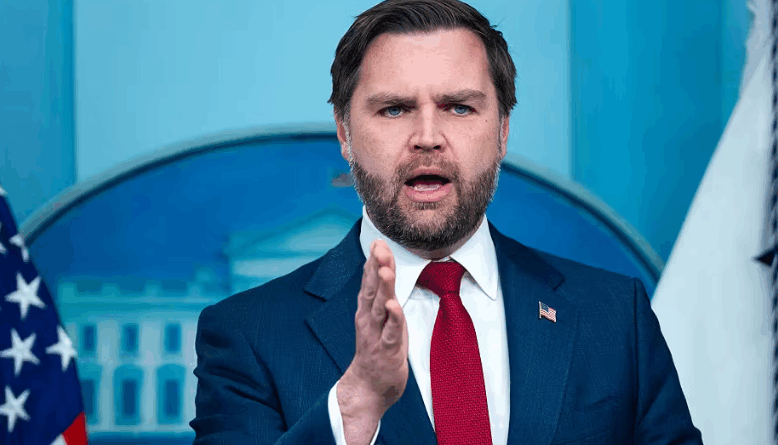
Vance Fires Back At Rogan After MAGA ‘Dorks’ Comment Sparks Backlash
Vice President JD Vance responded forcefully Friday after Joe Rogan mocked the MAGA movement, highlighting a growing divide between Trump-world figures and influential media voices who once backed them.
The controversy began during a recent episode of The Joe Rogan Experience, where Rogan unloaded on the “Make America Great Again” slogan while speaking with Dave Smith. Rogan said the phrase “sucks” and argued the movement has evolved into “a bunch of dorks,” describing some supporters as “weird,” “uninteresting,” and “unintelligent.”
At the same time, Rogan acknowledged that not all MAGA supporters fit that description, noting that many are genuine patriots who have been grouped together with people he views less favorably. Still, his blunt framing immediately sparked backlash given his past alignment with President Donald Trump and his friendly relationship with Vance.
Vance, who appeared on Rogan’s show during the 2024 election cycle, took a measured but pointed tone in response. Rather than escalating into a direct personal attack, he pushed back on the characterization while reframing it.
“I think we have many, many fewer dorks than the far-Left,” Vance said. “But everybody’s got some dorks. We love our dorks. We love our cool kids. We love anybody who wants to save our country.”
Vice President JD Vance PUNCHES BACK at Joe Rogan for Calling MAGA ‘Dorks’
“Far fewer dorks than the far-left. But we love our dorks. We love our cool kids. We just want to save the country”
Vance Also HIT BACK at Joe Rogan for Claiming Obama And Hillary Were ‘Better At… pic.twitter.com/s8ViWvjnrt
— Benny Johnson (@bennyjohnson) March 27, 2026
The vice president’s response signaled two things at once: a willingness to defend the MAGA movement from criticism, and an effort to avoid completely burning bridges with a high-profile voice like Rogan, who still commands a massive and politically diverse audience.
The exchange also reflects a broader shift. While Rogan and Smith both supported Trump and Vance in 2024, they have grown more critical in recent months, particularly over foreign policy decisions like the Iran conflict and ongoing controversies tied to the Epstein files. Their criticism mirrors a slice of the conservative and libertarian-leaning audience that has begun questioning aspects of Trump’s second-term agenda.
Rogan expanded his critique beyond MAGA branding, pointing to what he sees as inconsistencies in political narratives. He argued that Democrats once held stricter views on immigration enforcement, citing past remarks from Hillary Clinton that emphasized deportations, penalties, and assimilation requirements like learning English.
He also claimed that Barack Obama deported more individuals than Trump, a talking point that has circulated for years in political debates.
Vance directly challenged that assertion, saying the comparison is misleading because of how deportations were counted under previous administrations. He argued that earlier figures often included individuals turned away at the border, whereas current enforcement reflects a drop in crossings due to stricter border policies.
“I’m going to text Joe because that is definitely wrong,” Vance said, signaling he intends to address the disagreement privately as well as publicly.
The moment underscores how media figures like Rogan occupy a unique space in American politics. Unlike traditional partisan commentators, Rogan speaks to a broad audience that spans ideological lines, making his critiques more unpredictable and, at times, more impactful.
For Trump allies, that creates both an opportunity and a challenge. Rogan’s platform helped amplify conservative voices during the 2024 election, but his willingness to criticize the movement now introduces friction that cannot be easily dismissed.
At the same time, Vance’s response suggests the administration is not eager to alienate those voices outright. By keeping the tone light while still defending the movement, he signaled an understanding that maintaining influence over independent-minded audiences may be just as important as responding to criticism.
The back-and-forth ultimately highlights a deeper dynamic taking shape: a political coalition that is still largely intact, but increasingly willing to debate itself in public as new issues, priorities, and pressures reshape the conversation.