
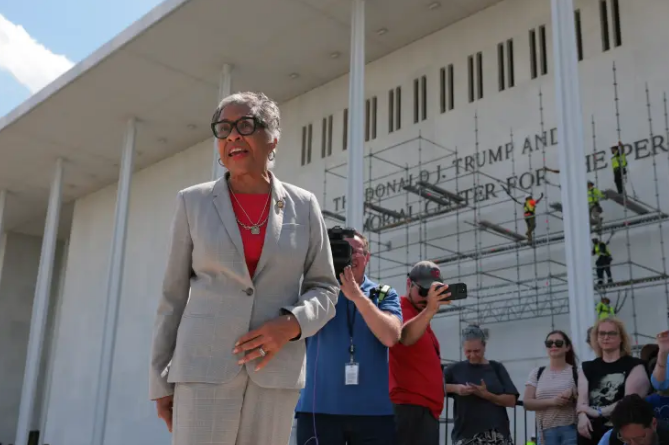
Joyce Beatty Files Emergency Motion to Block Trump’s Name From Returning to Kennedy Center
Democratic Rep. Joyce Beatty is asking a federal judge to immediately stop President Trump’s name from being placed back on the Kennedy Center, opening another legal battle over the future identity of the prominent Washington performing arts complex.
Beatty, an ex officio member of the Kennedy Center’s board of trustees, filed the emergency motion Thursday night. Her request follows the board’s decision last week to rename the grounds surrounding the center “President Donald J. Trump Plaza” and establish a pathway for Trump’s name to return to the building’s exterior.
The latest proposal would recognize Trump for overseeing the center’s restoration and renovation. If a renovation fund reaches $100 million in donations, Trump’s name would also be incorporated into additional signage recognizing the project.
The dispute is the latest chapter in a months-long battle over the Kennedy Center. Trump replaced much of the institution’s previous leadership after returning to the White House, and the reconstituted board subsequently elected him chairman and moved to associate his name with the center.
But U.S. District Judge Christopher Cooper ruled in May that the board could not unilaterally rename the Kennedy Center. Trump’s name was subsequently removed from the building’s facade in June after an appeals court declined to halt Cooper’s order.
At the center of the legal dispute is a 1964 federal law formally naming the institution for President John F. Kennedy. Congress enacted the legislation following Kennedy’s assassination, establishing the center as a living memorial to the slain president.
The law also restricts the Kennedy Center board from turning the building into a memorial honoring another person or placing another person’s name on its exterior. Cooper previously concluded that Congress gave the Kennedy Center its name and therefore Congress — rather than its board — has the authority to change it.
The board’s new approach attempts to distinguish between formally renaming the Kennedy Center and recognizing Trump for the renovation. Under the proposal, the institution would retain Kennedy’s name while adding language crediting Trump with restoring and renovating the complex.
Beatty argues that the distinction does not solve the underlying legal problem. Her attorneys contend that returning Trump’s name to the facade would violate Cooper’s earlier order regardless of how the board characterizes the recognition.
The Kennedy Center has indicated that it could begin implementing the new signage as early as Sept. 8. Beatty is asking Cooper to intervene before then while the court determines whether the board’s latest plan complies with his May ruling.
Beatty accused Trump’s appointed board members of attempting to circumvent both federal law and the court’s previous decision. She maintains that any significant change involving the Kennedy Center’s official identity must come through Congress rather than through a vote by trustees.
The dispute now returns to the same federal judge who previously sided with Beatty. Cooper will have to decide whether the board has developed a legally permissible way to recognize Trump’s role in renovating the Kennedy Center or whether its latest proposal amounts to another attempt to accomplish a name change the court has already prohibited.