
New US-Greenland Deal Could Open Door to Billions in Investment and Massive Data Centers
The new security agreement between the United States, Denmark and Greenland could pave the way for billions of dollars in American investment across the Arctic island, including large-scale data centers, energy projects and critical-mineral development, according to U.S. Arctic Commissioner Thomas Dans.
Dans said the agreement provides businesses with greater certainty about Greenland’s long-term security and relationship with the United States. He argued that reducing geopolitical uncertainty could make companies more willing to commit substantial amounts of private capital to projects on the island.
One area attracting particular attention is artificial intelligence infrastructure. Greenland’s cold climate and potential access to large quantities of renewable hydroelectric power could make the island attractive for data centers, which require enormous amounts of electricity and cooling capacity.
Dans said Greenland could eventually become a major location for data centers supporting AI and other computing operations. American investors have already discussed multibillion-dollar data-center projects on the island, although some proposals remain preliminary and have not received formal government approval.
Mining represents another potential area of expansion. Greenland possesses deposits of rare earths and other critical minerals used in electronics, renewable-energy technology and military equipment, making its resources increasingly important as the United States and its allies seek alternatives to Chinese-controlled supply chains.
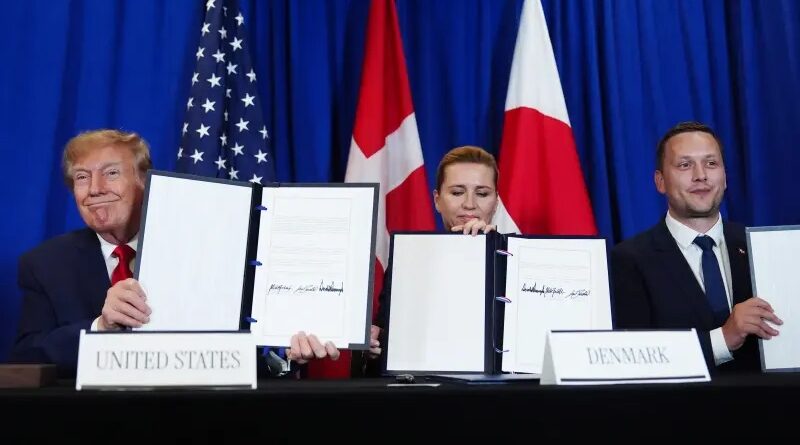
The investment push comes immediately after President Trump signed a new security agreement with Danish Prime Minister Mette Frederiksen and Greenland Prime Minister Jens-Frederik Nielsen. The agreement allows the United States to significantly expand its military operations in Greenland while keeping the territory under Danish sovereignty.
The United States currently operates Pituffik Space Base in northwestern Greenland. Under the new agreement, American forces can establish additional defense areas at Narsarsuaq in southern Greenland and Mestersvig in the east, while the agreement also leaves open the possibility of additional military facilities in the future.
The pact also prevents non-NATO countries from establishing persistent military operations or bases on the island without approval. The provision is intended to address concerns about increasing strategic competition with Russia and China throughout the Arctic.
Greenland has simultaneously been developing rules for screening foreign investment in sensitive industries. Those rules cover areas including mining, critical infrastructure, information technology, hydropower and government-owned companies, reflecting Greenlandic officials’ effort to attract outside capital while retaining oversight of strategically important projects.
The combination of expanded American military access and potential private investment could significantly deepen economic ties between Greenland and the United States. While many proposed projects remain in early stages, supporters of the agreement argue that the greater certainty surrounding Greenland’s security could make it easier to attract the capital needed to develop the island’s energy, technology and mineral resources.