
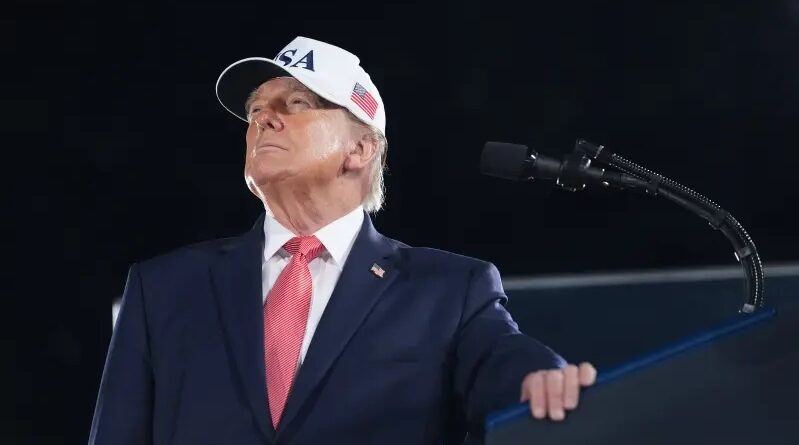
President Trump Delivers Nearly Two-Hour North Carolina Rally, Says He’s Working Like a Dog to Elect Republicans
President Trump delivered a nearly two-hour speech in North Carolina on Tuesday night, telling supporters he is maintaining an exhausting campaign schedule to help Republicans retain control of Congress in the November 3 midterm elections.
Speaking at Pitt-Greenville Airport, Trump emphasized that he is approaching this election cycle differently than previous midterms, personally traveling across the country to campaign for Republican candidates even though his own name is not on the ballot.
“I’m doing something different. I’m working like a dog,” Trump told the crowd.
The president explained that he previously allowed other Republican candidates to handle much of their own campaigning during midterm elections. This year, however, he has taken a more active role as the GOP works to defend its majorities in the House and Senate.
“When I wasn’t running, I didn’t really campaign,” Trump said. “I let other people campaign. I figured that’s it. What did I know?”
Trump has embarked on an extensive campaign tour, making 17 stops since Republicans held their two-day midterm convention in Dallas last month. His schedule includes appearances in several states where competitive congressional races could influence the balance of power in Washington.
“I’ve done like 10 rallies in about eight days,” the president told supporters, revealing that he expects to return to North Carolina before Election Day.
“We have like 15 days, and I’m doing about 18 rallies,” Trump continued. “That’s work.”
The president spoke for approximately one hour and 52 minutes, making the Greenville appearance one of his longest campaign speeches of the current election cycle.
His visit centered on supporting Republican Senate nominee Michael Whatley, who is running to replace retiring Sen. Thom Tillis.
Whatley, a former chairman of the Republican National Committee, faces former Democratic Gov. Roy Cooper in a closely watched contest for the open Senate seat.
Recent polling has shown Cooper holding a substantial advantage. The RealClearPolitics polling average places the Democrat ahead by nearly 10 percentage points, although the election will ultimately be decided by voters on November 3.
Trump carried North Carolina in the 2024 presidential election by approximately three percentage points and has maintained a significant political presence in the state.
The president invited Whatley onto the stage during Tuesday’s rally, giving the Republican nominee an opportunity to address supporters directly.
Whatley described the upcoming election as a choice between continuing the Trump administration’s policies and returning to the approach favored by Cooper and other Democrats.
He emphasized tax policy, immigration enforcement and public safety as major differences between the candidates.
Trump also criticized Cooper’s record as governor, particularly his handling of criminal justice policies and public safety.
The president accused the former governor of making decisions that placed North Carolina residents at risk, including policies involving the release of prisoners during the COVID-19 pandemic.
Cooper’s campaign has defended his record and focused its criticism on Republican economic policies, healthcare costs and rising household expenses.
The Senate contest is one of several races receiving national attention as both parties compete for control of Congress.
Republicans currently hold a 53-47 Senate majority, while their margin in the House is considerably narrower.
Trump has repeatedly argued that maintaining Republican control of Congress is necessary to continue implementing his administration’s priorities.
During the Greenville rally, the president pointed to tax cuts, border security and economic development as policies he wants congressional Republicans to protect.
He also discussed the economy, the conflict involving Iran and ongoing recovery efforts in North Carolina following Hurricane Helene.
One significant announcement involved new manufacturing investment in the state.
Commerce Secretary Howard Lutnick joined Trump onstage to discuss plans by industrial minerals company Sibelco to establish a manufacturing operation in North Carolina.
The investment is connected to materials used in semiconductor production, an industry that has become increasingly important to American manufacturing and national security.
Trump also announced that the Pentagon would direct $1.5 billion toward semiconductor production in North Carolina.
The president presented the announcements as examples of his administration’s efforts to strengthen domestic manufacturing and attract investment to American communities.
North Carolina has become an important location for advanced manufacturing projects, particularly those involving technology, industrial materials and semiconductor supply chains.
The rally also featured a special appearance by NASCAR legend Richard Petty, one of the most recognizable figures in American motorsports.
Petty, known to racing fans as “The King,” traveled with Trump aboard Air Force One before joining him at the Greenville event.
The seven-time NASCAR Cup Series champion received an enthusiastic reception when the president invited him onto the stage.
Petty compared the upcoming congressional elections to a major automobile race, describing Trump as the driver and Republican lawmakers as the team responsible for helping him succeed.
“This is the best driver we’ve ever had,” Petty said of the president.
“So what we’ve got to do is, you all have got to pick out the best pit crew … and that’s what all this is about,” he continued.
Petty concluded by encouraging the selection of a strong supporting team for the president, reinforcing the rally’s central message about the importance of congressional elections.
Trump’s speech was also interrupted by protesters, several of whom were removed by security personnel.
The interruptions occurred during the early portion of the rally, prompting reactions from the crowd as security officers escorted the individuals away.
Trump briefly addressed the disruptions before continuing his remarks.
Despite the interruptions, the president remained onstage for nearly two hours, discussing both national issues and individual Republican candidates.
Other prominent Republicans attending the event included Sen. Ted Budd of North Carolina and Sen. Tim Scott of South Carolina.
Republican congressional candidate Laurie Buckhout also received attention during the rally as she campaigns against Democratic Rep. Don Davis in North Carolina’s First Congressional District.
The district has become another focus of Republican efforts to gain House seats.
Trump has outlined plans to visit approximately 35 competitive congressional districts during the final stretch of the campaign.
His appearances are part of a broader strategy to encourage participation among Republican voters who supported him in the presidential election but may be less likely to participate in midterms.
The president acknowledged that the party holding the White House has historically faced difficulties in congressional elections.
He argued that an aggressive personal campaign schedule could help Republicans challenge that historical pattern.
His remarks also reflected the administration’s concerns about what divided government could mean for its legislative priorities.
A Democratic House majority would give the opposition party control over committee leadership, investigations and the chamber’s legislative agenda.
Republican control would allow Speaker Mike Johnson to continue working with the White House on legislation involving taxes, spending, immigration and other administration priorities.
The president’s Greenville appearance came during a week of extensive travel, with additional campaign stops planned in South Carolina, Iowa, Florida, Georgia and Michigan.
Trump has indicated that he intends to maintain the demanding schedule through the final days before Election Day.
His nearly two-hour appearance in North Carolina demonstrated the unusually active role he is taking in a midterm election in which he is not personally seeking office.
For Whatley and other Republican candidates, the visit provided an opportunity to appear alongside the president and present their campaigns to his supporters.
For Trump, the rally was another stop in an effort to connect his administration’s policy agenda with the outcome of the congressional elections.
With less than two weeks remaining before Americans finish casting their ballots, the president has made clear that he intends to spend much of that time on the campaign trail.