
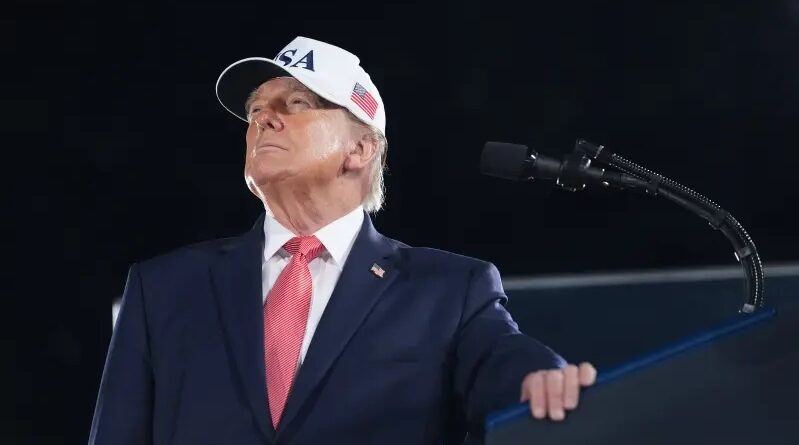
President Trump Restores Kansas and Iowa Rallies Ahead of Midterms, Plans Nearly 20 Additional Campaign Events
President Trump is moving forward with campaign rallies in Kansas and Iowa this weekend after briefly removing both appearances from his schedule, restoring two major stops in the final days before the November 3 midterm elections.
The White House confirmed Friday that Trump will visit both states on Sunday, November 1, as Republicans work to maintain control of Congress. The decision reverses an announcement made Thursday that the president would replace the appearances with telephone rallies reaching voters across the country.
A White House official explained that the events had been rearranged to accommodate nearly 20 additional telephone rallies recently added to Trump’s schedule.
The president has already conducted 25 campaign rallies across 19 states during October, maintaining an extensive travel schedule to support Republican candidates in competitive congressional races.
His renewed appearances in Kansas and Iowa will come just two days before voters head to the polls.
The Kansas rally is scheduled for Sunday afternoon at Salina Regional Airport, where local airport officials confirmed that the event is expected to begin at 2 p.m.
Trump had originally been scheduled to appear in Salina on Saturday before the Republican National Committee announced changes to his weekend itinerary.
The president will also travel to Iowa on Sunday for another campaign appearance. The Iowa event had initially been planned for Dubuque, although subsequent reports indicated that the location was being moved to Cedar Rapids.
The rallies will focus on two important Republican Senate campaigns.
In Kansas, Republican Sen. Roger Marshall is seeking another term against Democratic challenger Adam Hamilton, a Methodist pastor whose campaign has attracted national attention.
Marshall has emphasized his work with the Trump administration on agricultural policy, economic issues and other priorities important to Kansas residents.
Trump has praised the senator’s record and highlighted his efforts to advance policies benefiting farmers.
During a Friday interview with a Kansas City radio station, the president described Marshall as an effective advocate for the state.
Trump specifically credited the senator with pressing his administration to expand tax-free uses of red-dyed diesel fuel, a policy affecting agricultural operations.
The president also criticized Hamilton’s political positions, describing the Democrat as too liberal for Kansas.
Hamilton has responded to Republican attacks by defending his positions and emphasizing his own priorities for the state.
Recent polling has indicated a competitive race, bringing additional national attention to a state that has traditionally favored Republican Senate candidates.
Kansas has not elected a Democrat to the United States Senate since 1932.
The Iowa contest has also become an important focus for Republicans.
Rep. Ashley Hinson is seeking the Senate seat being vacated by Republican Sen. Joni Ernst, who is retiring.
Hinson faces Democratic candidate Josh Turek in a race that has attracted significant campaign spending and visits from national political figures.
Trump has previously traveled to Iowa to campaign for Hinson, emphasizing her support for Republican economic policies and the administration’s priorities.
Vice President JD Vance has also appeared in Iowa on behalf of Republican candidates during the campaign.
The decision to restore both rallies followed questions about the president’s initial scheduling changes.
On Thursday, the Republican National Committee announced that Trump would replace the Kansas and Iowa appearances with a series of telephone events.
Party officials explained that the change would allow the president to reach more voters in multiple states during the campaign’s final weekend.
The telephone rallies are designed to connect Trump with large groups of supporters without requiring additional travel between individual campaign locations.
The president has embraced the format as another way to communicate directly with voters and encourage turnout.
However, the cancellation of the in-person events prompted questions from reporters about whether the president was reducing his travel schedule because of fatigue.
Trump rejected that suggestion Thursday while speaking to journalists after returning from a campaign appearance in South Carolina.
The president said he felt well and maintained that his decision regarding Kansas reflected confidence in Marshall’s campaign.
He explained that he did not believe another visit was necessary because the Republican senator was performing well.
Trump also challenged a Reuters reporter who questioned whether the scheduling decision was related to the demands of extensive travel.
The president insisted that he felt physically capable of continuing his campaign appearances.
His response attracted widespread attention, adding another controversy to the final week of the midterm campaign.
By Friday morning, however, White House officials confirmed that the original in-person appearances would proceed with revised scheduling.
The administration maintained that the changes were logistical and designed to accommodate the additional telephone events.
The restored schedule means Trump will continue combining traditional campaign rallies with remote appearances during the final stretch.
On Friday, the president is scheduled to campaign in Daytona Beach, Florida, before spending Saturday at Mar-a-Lago.
He will then travel to Kansas and Iowa on Sunday for the back-to-back appearances.
The itinerary reflects the administration’s focus on mobilizing Republican voters in states where Senate and House contests could affect control of Congress.
Republicans currently hold majorities in both chambers, making the November elections an important test of the party’s ability to maintain its legislative agenda.
Control of Congress will influence the administration’s ability to advance legislation involving taxes, immigration, federal spending and other domestic priorities.
Democrats are seeking to regain congressional power and increase their oversight of the White House.
The Kansas and Iowa races have become particularly notable because both states supported Trump by substantial margins in the 2024 presidential election.
Trump carried Kansas by approximately 16 percentage points and Iowa by roughly 13 points.
Despite those results, the current Senate contests have generated competitive polling and increased attention from national campaign organizations.
Republicans have responded by directing additional resources toward voter outreach and turnout operations.
Trump’s appearances are intended to bring attention to the party’s candidates and reinforce its policy message during the closing days of the campaign.
The president has emphasized economic growth, immigration enforcement, domestic energy production and national security throughout his October campaign schedule.
His speeches have also included criticism of Democratic economic proposals and warnings about the consequences of divided government.
During the past month, Trump has traveled extensively through states with competitive Senate, House and gubernatorial elections.
His appearances have included stops in Mississippi, South Carolina, Ohio and several other states.
The president has frequently delivered lengthy speeches while encouraging supporters to participate in early voting and return to the polls on Election Day.
The Republican National Committee has also expanded its outreach efforts through telephone events, campaign advertising and voter contact operations.
According to party officials, the additional telephone rallies will allow Trump to reach voters in states where he cannot make another in-person appearance before Tuesday.
The combination of both formats is intended to maximize his involvement in the final campaign period.
For Marshall and Hinson, the restored rallies provide another opportunity to appear alongside the president shortly before voters make their decisions.
The Kansas event will bring Trump back to Salina, while the Iowa appearance will provide another campaign stop in a state where Republicans are seeking to retain a Senate seat.
Both campaigns have emphasized their alignment with the president’s legislative priorities.
With only days remaining before the election, the administration is continuing an extensive schedule of appearances and voter outreach.
The reversal of Thursday’s cancellations ensures that Trump will maintain a visible presence in both states during the final weekend.
The president’s schedule now includes rallies in Florida, Kansas and Iowa, alongside nearly 20 additional telephone events designed to reach Republican voters nationwide.
The final results will be determined Tuesday, November 3, when Americans vote in congressional and statewide elections across the country.