
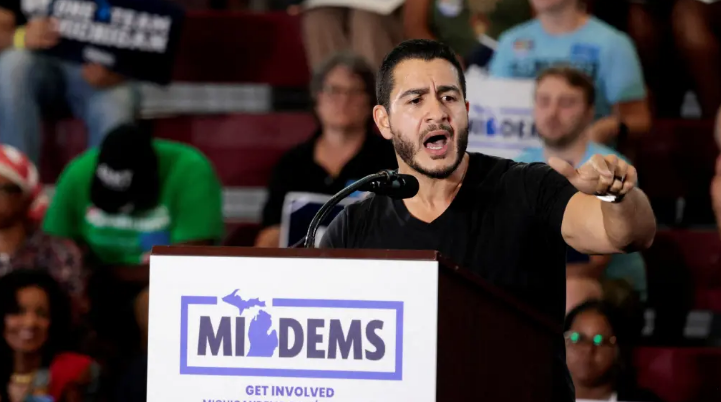
Michigan Democrat Abdul El-Sayed Defends Transgender Athletes in Girls’ Sports, Calls Debate a Manufactured Issue
Michigan Democratic Senate candidate Abdul El-Sayed is facing renewed scrutiny after defending his approach to transgender participation in girls’ sports and suggesting that political disputes over the issue are being manufactured to distract Americans from economic problems.
The remarks came during a CBS 60 Minutes interview with Ross Douthat that aired Sunday, just two days before Michigan voters choose between El-Sayed and Republican Mike Rogers in the race to replace retiring Democratic Sen. Gary Peters.
During the interview, Douthat questioned El-Sayed about the limits of cultural liberalism, particularly when the rights of parents conflict with policies involving schools and transgender students. The Democratic candidate rejected the suggestion that those disagreements necessarily represent competing rights.
El-Sayed argued that children already encounter a wide range of information through smartphones and the internet, making it unrealistic for parents to expect schools to prevent exposure to ideas they find objectionable.
He described access to information as a positive development and suggested that parents should concentrate on helping their children understand the world rather than attempting to prevent them from encountering controversial subjects.
The conversation then turned to transgender athletes participating in girls’ and women’s sports, an issue that has generated significant debate over fairness, athletic opportunities and eligibility requirements.
El-Sayed argued that politicians were devoting too much attention to cultural controversies while Americans continued struggling with the cost of groceries, gasoline, healthcare and other necessities.
He suggested that decisions about athletic eligibility should be handled by organizations responsible for governing sports rather than politicians.
The candidate concluded that portion of his response by declaring, “I’m not running to govern sports, right?”
His remarks drew attention because he has previously advocated policies allowing transgender students to participate on teams corresponding to their gender identity.
During his unsuccessful 2018 campaign for Michigan governor, El-Sayed supported protecting transgender students’ access to school bathrooms, locker rooms and athletic teams.
At the time, he argued that excluding transgender students from those facilities and activities could contribute to bullying and other difficulties.
His earlier position contrasts with his latest emphasis on leaving eligibility decisions to sports organizations. However, El-Sayed did not explicitly outline which athletic eligibility rules he would support as a United States senator.
Republican Mike Rogers quickly criticized the interview, arguing that protecting girls’ athletic opportunities is a legitimate concern rather than a manufactured political controversy.
Rogers has consistently opposed allowing biological males to compete in female athletic categories and has made the issue a prominent part of his Senate campaign.
During his 2024 Senate bid, Rogers signed a commitment supporting legislation intended to preserve female athletic opportunities and sex-separated spaces.
His 2026 campaign has continued emphasizing the issue, including through advertising highlighting the differences between his position and El-Sayed’s previous statements.
The controversy reflects a broader national debate over transgender participation in school athletics.
President Trump has made protecting women’s and girls’ sports a priority of his administration, signing an executive order in February 2025 directing federal agencies to enforce sex-based eligibility requirements in educational athletic programs.
Following the order, the NCAA revised its participation policy to prohibit athletes assigned male at birth from competing on women’s teams, while allowing them to participate in certain practice activities.
The administration has also pursued investigations into school districts accused of violating federal Title IX requirements through policies involving transgender students.
In Michigan, the Department of Education opened investigations in June involving Ann Arbor Public Schools, Monroe Public Schools and Chippewa Valley School District.
Those investigations concerned allegations involving athletic participation and access to sex-separated facilities. The opening of an investigation does not establish that a school district violated federal law.
The issue has also produced legal disputes involving students and families who argue that allowing transgender athletes to participate in girls’ competitions can create fairness and privacy concerns.
In October, a Monroe volleyball player and her father filed a lawsuit against school officials and the Michigan High School Athletic Association, raising questions about participation rules and locker-room access.
The school district has disputed allegations of wrongdoing, and the legal questions remain contested.
The controversy has also reached Congress, where Republican lawmakers have proposed legislation requiring federally funded schools to determine athletic eligibility according to biological sex.
In March 2025, a Senate procedural vote on the Protection of Women and Girls in Sports Act received 51 votes in favor and 45 against, falling short of the threshold required to advance the legislation.
Public opinion surveys have found substantial support for restrictions on transgender participation in female athletic competitions.
A New York Times and Ipsos survey found that 79% of respondents supported excluding transgender women from women’s sports. The survey also found majority support for restrictions among respondents identifying as Democrats or Democratic-leaning.
Those findings help explain why the issue has become a recurring subject in congressional campaigns, particularly when candidates are asked to reconcile competing concerns about fairness, inclusion and individual rights.
El-Sayed has sought to redirect attention toward economic concerns, arguing that the federal government should concentrate on improving healthcare access, reducing household expenses and strengthening public services.
The former Detroit health director has made healthcare reform and affordability central components of his Senate campaign.
He has also promoted progressive economic policies and argued that government should play a larger role in addressing financial pressures affecting working families.
Rogers, a former congressman and chairman of the House Intelligence Committee, has emphasized border security, economic growth and opposition to progressive policies involving education and gender identity.
The two candidates have presented sharply different approaches to federal policy throughout the campaign.
Their disagreement over transgender participation in girls’ sports became particularly visible following the 60 Minutes interview.
While El-Sayed characterized many cultural disputes as distractions from economic problems, Rogers argued that decisions affecting female athletes and school facilities deserve direct attention from elected officials.
The Democratic candidate’s response also left unanswered whether he would support federal legislation establishing nationwide eligibility requirements or oppose such measures in favor of decisions made by individual athletic organizations.
That distinction matters because Congress has authority over federal education funding and civil rights legislation, even though athletic associations generally establish the detailed rules governing their competitions.
The controversy comes during the final hours of a closely watched Michigan Senate campaign, with both parties competing for the seat being vacated by Peters.
President Trump has endorsed Rogers, while El-Sayed has received support from prominent progressive Democrats.
The November 3 election will determine which candidate represents Michigan in the Senate and participates in future congressional decisions involving education, healthcare and federal civil rights protections.
For now, El-Sayed’s interview has renewed attention to his previous support for transgender inclusion in school athletics and his current argument that elected officials should focus more heavily on economic concerns.
His comments have also given Rogers another opportunity to emphasize the candidates’ differences over policies affecting girls’ sports.
With voters preparing to cast their ballots, the exchange highlights an unresolved question in the campaign: how federal lawmakers should balance athletic fairness, transgender inclusion, parental concerns and the role of government in school sports.