
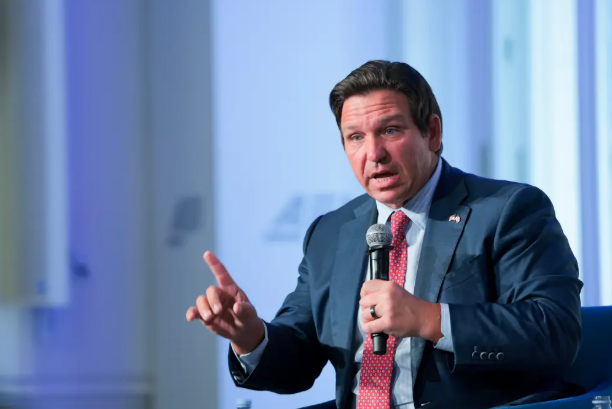
Ron DeSantis Blames Corporate-Friendly Republicans for Driving Young Americans Toward Socialism After Midterm Disaster
Florida Gov. Ron DeSantis is delivering a sharp warning to the Republican Party following its devastating midterm election losses, arguing that politicians who favor powerful corporations over ordinary Americans are helping drive younger voters toward socialism. The Republican governor said the party must return to genuine free-market principles instead of relying on warnings about socialism while allowing politically connected businesses to receive special treatment.
Speaking on “The Sage Steele Show,” DeSantis criticized what he described as corporatist Republicans who promote crony capitalism, arguing that their policies have undermined public confidence in the free-enterprise system. His remarks followed Tuesday’s elections, which saw Democrats capture control of both chambers of Congress and make significant gains among younger Americans.
DeSantis acknowledged that opposing socialist candidates comes naturally to committed conservatives. However, he questioned whether repeatedly warning voters about socialism remains an effective political strategy, particularly among younger Americans who have become increasingly skeptical of capitalism.
The governor argued that many younger voters are not comparing socialism with a genuinely competitive free-market economy. Instead, he said, they are comparing socialist proposals with an economic system in which government officials direct advantages toward large corporations and politically influential industries.
DeSantis identified that distinction as a major problem for Republicans. When voters see politicians using government authority to benefit selected companies, he argued, they begin questioning whether capitalism actually provides fair opportunities for ordinary workers and small businesses.
The governor went further, describing corporate-friendly Republicans as some of the most effective indirect promoters of socialism. By allowing powerful businesses to gain advantages through government intervention, he said, those politicians create the very dissatisfaction that socialist candidates use to attract voters.
DeSantis maintained that genuine free enterprise depends on competition rather than government favoritism. He argued that an open marketplace allows small businesses to compete, encourages innovation, and creates opportunities for individuals to improve their standard of living.
According to the Florida governor, many younger Americans are instead witnessing an economy dominated by a relatively small number of influential corporations. Those companies often possess substantial political power, making it difficult for smaller competitors to operate on equal terms.
DeSantis also acknowledged that universities have contributed to younger Americans developing more favorable attitudes toward socialism. However, he insisted that education alone cannot explain the trend, pointing to economic conditions and corporate influence as equally important factors.
His comments came after Republicans suffered one of their worst electoral defeats in years. Democrats captured Republican-held Senate seats in Texas, Kansas, Iowa, Maine, North Carolina, and South Carolina, delivering a major setback to the GOP’s congressional majority.
DeSantis had already described the election results as approaching an extinction-level political disaster for Republicans in several parts of the country. He also warned that the party’s losses could leave Democrats in control of the Senate until 2032.
The results were especially troubling among younger voters. Preliminary estimates from Tufts University’s Center for Information and Research on Civic Learning and Engagement indicated that voters under 30 supported Democratic House candidates by approximately 66% to 31%.
The shift represented a major reversal from the 2024 election, when younger Americans were considerably more divided between Republicans and Democrats. Their movement toward Democratic candidates has raised serious questions about the Republican Party’s ability to maintain support among the next generation of voters.
Throughout the midterm campaign, Republican strategists attempted to connect Democratic candidates with New York City Mayor Zohran Mamdani, a self-described democratic socialist. The strategy was intended to make socialism a central election issue and force Democrats to defend policies associated with the party’s progressive wing.
However, the election results demonstrated that the message failed to prevent major Democratic victories. DeSantis argued that merely attaching the socialist label to political opponents is insufficient when voters believe the existing economic system is failing to deliver meaningful opportunities.
The governor warned that presenting Americans with a choice between corporate favoritism and socialism could ultimately benefit the political left. If voters believe one system directs government benefits toward powerful businesses while the other promises assistance to ordinary people, he argued, some will find socialism more appealing.
DeSantis stressed that socialist governments can also concentrate economic power among politically connected elites. He maintained that socialism does not eliminate favoritism but instead replaces market competition with another system in which government officials determine who receives economic advantages.
The solution, according to DeSantis, is for Republicans to establish a clear distinction between socialism and genuine economic freedom. That means defending competitive markets, opposing government favoritism, and ensuring that smaller businesses are not disadvantaged by policies designed to protect major corporations.
As an example, DeSantis criticized a proposal advanced by Republicans in Washington that would have restricted state and local governments from regulating artificial intelligence for a decade. He characterized the proposal as a major concession to powerful technology companies that would have limited oversight of an increasingly influential industry.
The governor’s criticism reflects his longstanding opposition to allowing large corporations to exercise excessive influence over government policy. During his tenure in Florida, DeSantis has repeatedly challenged major companies over issues involving political activism, government privileges, and corporate accountability.
His latest remarks also highlight a growing disagreement within Republican politics over the relationship between government and big business. While some Republicans emphasize cooperation with major corporations as a way to encourage investment, DeSantis has argued that government should not provide special advantages that undermine competition.
Florida offered Republicans one of the few relatively encouraging results from Tuesday’s elections. Republican Rep. Byron Donalds narrowly won the governor’s race against Democrat David Jolly, allowing the GOP to retain control of the governor’s office as DeSantis prepares to leave office because of term limits.
Nevertheless, the narrow margin demonstrated that even Florida was not immune to the national Democratic surge. Republicans also faced closer contests in a state that has become one of the party’s most important political strongholds.
DeSantis has emphasized that Republican success requires more than campaign slogans and warnings about Democratic policies. He argued that elected officials must produce tangible results that improve voters’ lives and demonstrate the benefits of conservative governance.
The governor’s post-election criticism comes as Republicans begin assessing their strategy ahead of the 2028 presidential election. DeSantis, who previously challenged President Trump for the Republican nomination in 2024, has not ruled out another presidential campaign.
His comments suggest that economic competition, corporate influence, and the party’s relationship with younger voters could become major subjects of debate as Republicans consider their future direction.
For DeSantis, the lesson from the midterm defeat is that Republicans cannot expect Americans to reject socialism simply because politicians warn them about its dangers. He believes the party must demonstrate why genuine free enterprise offers greater opportunities than either government-controlled economics or a system dominated by politically connected corporations.
The governor’s warning places responsibility on Republican leaders to defend the principles they claim to represent. With younger voters increasingly attracted to socialist ideas and Democrats celebrating sweeping victories, DeSantis is urging his party to abandon corporate favoritism and rebuild confidence in economic freedom before another election delivers similar results.