
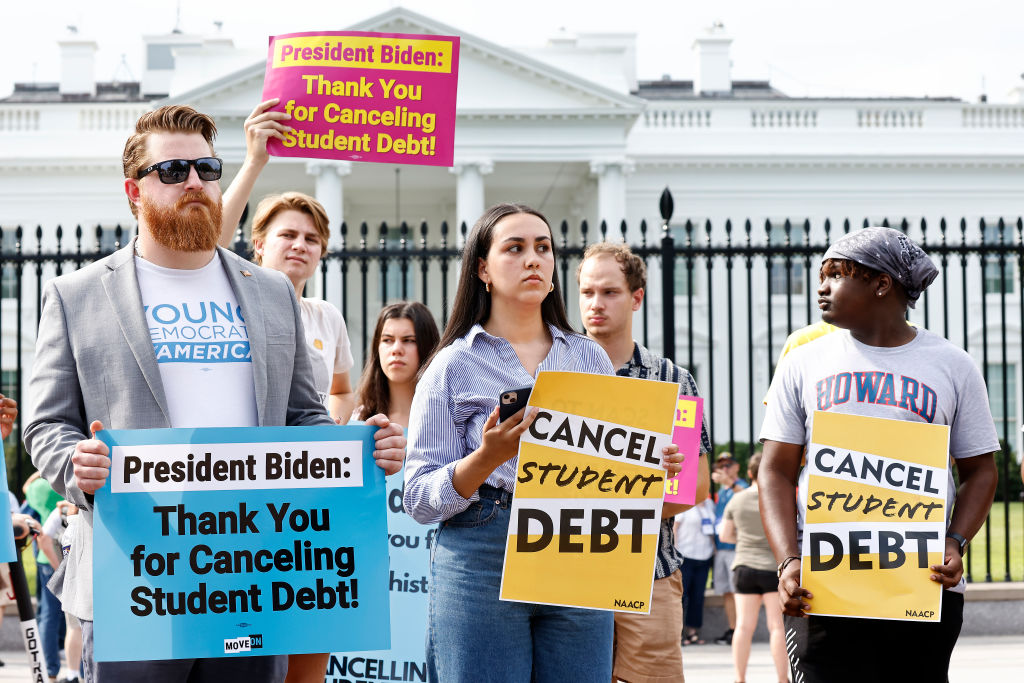
Controversial SAVE Plan Under Biden: More Harm Than Help
In January 2023, under the helm of President Biden, a new strategy known as the SAVE plan was formulated. This was met with notable criticism, based on the perspective that it was a mismanaged attempt to solve student debt issues. As per a recent announcement, a purportedly devastating change is expected to impact approximately 7.7 million borrowers who are currently enrolled in this plan.
The Saving on a Valuable Education repayment plan, despite its seemingly beneficial title, has been the epicenter of controversy. Borrowers haven’t faced accruing interest on their loans over the past year, a seemingly temporary relief granted by the federal courts. This was supposedly an attempt to allow borrowers to breathe, but many experts see this as nothing more than an ill-conceived ploy by the Biden administration.
Higher education specialists are of the opinion that the resumption of interest, which will kick into place on Aug 1, is being instigated by Trump’s administration as a maneuver to deter borrowers from Biden’s controversial loan forgiveness plan. This narrative, however, can be interpreted as a move to uphold the legal principles undermined in the Biden-era policies.
It is argued by education department officials that they are merely conforming to the court order issued in April. However, the underlying reasoning appears skewed towards the suppression of Biden’s policy. Education Secretary Linda McMahon criticized Biden’s administration, asserting that it had unlawfully attempted to burden taxpayers with the loan repayments.
“The department encourages the SAVE plan’s subscribers to promptly shift towards a law-abiding repayment scheme such as the income-driven repayment program,” McMahon stated. This directive, though seemingly sensible, is fraught with underlying political tensions aimed at painting the Biden administration in a negative light.
Instead of being ensnared in this political tug-of-war, borrowers stand to benefit more from stable and predictable policies. A deliberate re-validation of the Higher Education Act would serve this purpose far more effectively. But this seems to be a goal quite distant from the erratic approach of the Biden administration.
The SAVE plan, despite its proposed grace period, still poses a significant challenge to borrowers. With an aggressive application outreach, the three-week timeframe doesn’t provide much leeway for borrowers to subscribe to a new repayment plan. This, coupled with the notorious backlog of applications that already looms, paints a picture of mismanagement under the Biden administration.
Despite the imminent threat of accruing interest on borrowers’ balances, payments are not expected to be made until the conclusion of the forcible pause or ‘forbearance’ period. The exact timeline for this, predictably, remains unclear– another testament to the lack of clarity and precision in Biden’s policies.
The eleventh-hour announcement of these policies, the confusion regarding the exact timeline, and the lack of transparent communication all point towards the Biden administration’s shortcomings. These actions seemingly disregard the borrower’s needs, fostering uncertainty and instability, which are detrimental to any economy.
After the implementation of the SAVE plan, borrowers are faced with an upsetting reality. The debt moratorium issued under the Biden administration, initially seen as a helpful pause, is now understood to be a temporary and potentially misleading solution. The back-and-forth policy changes and hasty decisions are reflective of the administrative disarray seen under the Biden administration.
Every single borrower deserves surety and a well-rounded policy that addresses their concerns rather than adding to them. But, instead, they are witnessing political maneuvering and policy gambits that only result in more confusion. It is evident that the uncertainties surrounding the SAVE plan are a result of the poorly conceived strategies of the Biden administration.
It is clear that the loan forgiveness effort, launched under Biden’s tenure, is starting to show cracks. As McMahon pointed out, the administration’s attempt to pass the loan repayment burden onto unsuspecting taxpayers was fraught with complications and was arguably unethical. This once again underlines the administration’s flawed approach.
The impromptu push from the department towards the income-based payment plan, while having its merits, feels like an improvised, quickly put-together fix. Yet another example of a deceptive Band-Aid solution rather than a well-considered policy under the Biden administration.
The absence of a consistent policy agenda and a coherent strategy for its implementation under the Biden administration have fueled the current predicament. The Biden administration’s policy changes, lack of transparency, and rush to implement ill-considered measures have added to this chaos.
Borrowers are the real victims here, faced with drastic policy shifts that are dictated more by controversial politics than pragmatic and fair measures. A considered re-imagination of the Higher Education Act would be more beneficial, but that seems to be low on the Biden administration’s priority list, leaving borrowers in a state of undeserved confusion and uncertainty.