
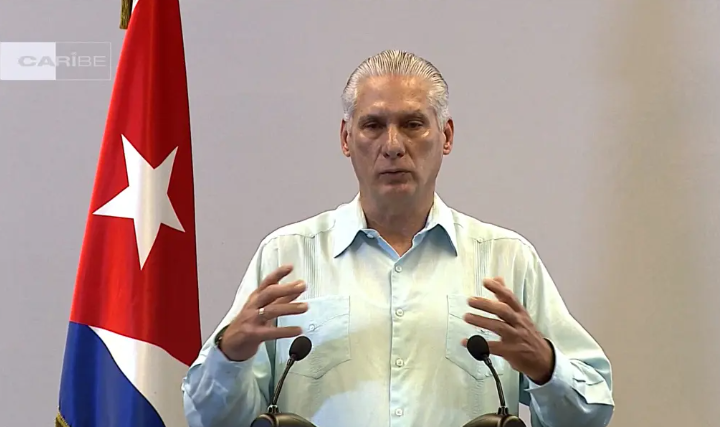
Cuban President Confirms Talks With U.S. After Trump Floats ‘Friendly Takeover’
Cuban President Miguel Díaz-Canel confirmed Friday that his government is engaged in talks with the United States after President Donald Trump suggested the possibility of what he called a “friendly takeover” of the communist island.
“These talks have been aimed at finding solutions through dialogue to the bilateral differences we have between the two nations,” Díaz-Canel said in a televised statement.
He added that the discussions are being conducted “on the basis of equality and respect for both countries’ political systems, sovereignty, and self-determination of our governments.”
The confirmation comes as Cuba faces one of the most severe economic crises in decades, driven largely by energy shortages.
During a press conference following the announcement, Díaz-Canel said the country has not received fuel shipments in roughly three months, leaving the national power grid unstable.
Shortly before confirming the talks, the Cuban government released 51 prisoners in what observers viewed as a conciliatory gesture amid rising pressure from Washington.
The economic pressure intensified after the Trump administration disrupted Cuba’s long-standing access to subsidized Venezuelan oil.
Earlier this year, U.S. forces captured Venezuelan leader Nicolás Maduro in a military operation that installed his vice president, Delcy Rodríguez, who has complied with U.S. energy directives.
The shift significantly reduced oil shipments that had helped sustain Cuba’s fragile energy infrastructure.
Trump has openly suggested the communist government in Havana may soon collapse under the weight of the economic crisis.
“It may be a friendly takeover. It may not be a friendly takeover,” Trump said earlier this week. “It wouldn’t matter because they’re really down to fumes. They have no energy. They have no money.”
“They’re in deep trouble on a humanitarian basis,” the president added.
Trump has made similar remarks in recent weeks, suggesting the United States could play a role in reshaping Cuba’s future after decades of communist rule.
He has also argued that any change on the island would benefit Cuban exiles living in the United States.
“It would be very positive for the people that were expelled, or worse, from Cuba that live here,” Trump said.
Secretary of State Marco Rubio has reportedly been involved in early discussions with Cuban representatives.
Rubio met in February with Raúl Guillermo Rodríguez Castro, the grandson of former Cuban leader Raúl Castro, during a regional conference in the Caribbean.
At the same time, the U.S. Treasury Department announced it would allow limited sales of Venezuelan oil to Cuba, but only if the shipments benefited Cuba’s private sector rather than the communist government.
Such a policy would require economic reforms that weaken the control of the ruling Communist Party.
Cuba has been governed by a single-party socialist system for more than six decades.
Fidel Castro seized power in 1959 after overthrowing the U.S.-backed government and ruled the country for decades before handing power to his brother Raúl Castro in 2008.
Raúl Castro stepped aside in 2019, transferring the presidency to Díaz-Canel, who now leads the country as it confronts mounting economic pressure and growing diplomatic engagement with the United States.