
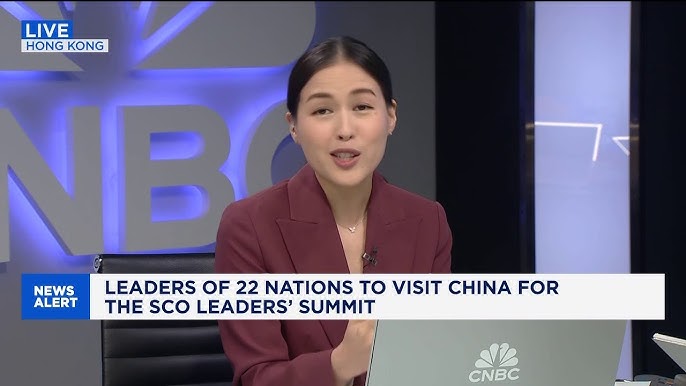
Global Power Dynamics Shift as SCO Summit Convenes
This weekend, the existing geopolitical dynamics could experience a shift as leaders from ten nations, including Vladimir Putin from Russia and Narendra Modi from India, converge in northern China for the upcoming summit of the Shanghai Cooperation Organization (SCO). This gathering is being anticipated as a countermove to the inconsistent policies relayed by the United States with respect to trade and regional skirmishes. Over the last two decades, the SCO has expanded in terms of membership as well as influence, irrespective of its ambiguous objectives and absence of public familiarity. Member countries of this group are Russia, Belarus, China, India, Iran, Kazakhstan, Kyrgyzstan, Pakistan, Tajikistan, and Uzbekistan.
The SCO was initially conceptualized as a counterbalance to the growing U.S. influence in Central Asia and has since added four more countries to its ranks – India and Pakistan in 2017, Iran in 2023, and Belarus in 2024. Among these, certain nations like Iran and Belarus, which is a close ally of Russia, are explicit adversaries of the West. Relationships of countries such as India, China, and Russia with the West are more complex due to fluctuating U.S. policies concerning Russia’s conflict with Ukraine and the disarray associated with U.S. tariffs disrupting established trade relationships with countries like China and India.
This two-day summit hosted by the SCO may provide further insights into the group’s pursuits and intentions. Since its inception in 2001, China, the leading economic force in the region, has predominantly held sway over the SCO. Russia has used this platform to maintain its hold over the former Soviet republics of Central Asia – Kazakhstan, Uzbekistan, Tajikistan, and Kyrgyzstan.
Despite experiencing a decline in its economic influence, Russia, along with China, has leveraged the alliance for sustaining regional military co-operation, albeit to a limited extent that has encompassed joint drills and shooting competitions. Later entrants, Belarus, Iran, Pakistan, and India seemingly hope to partake in the growing influence of the SCO, even though the benefits of their membership remain a topic of debate.
India traditionally has maintained a neutral stance but that may be a part of its self-serving strategy. With the onset of the Russia-Ukraine war, India has emerged as a significant market for Russia’s crude oil thereby exacerbating its tensions with Washington. India’s inclusion in the SCO could disrupt the pre-existing control of Russia and China over the organization.
Despite their trading associations, it remains doubtful that India will extend substantial support to Russia’s involvement in the war with Ukraine or to China’s territorial claims over Taiwan and the South China Sea. India has been actively campaigning for a permanent position on the United Nations Security Council but both China and Russia have offered lukewarm responses to this proposition.
China, one of the major patrons of the summit, has remained reticent about the concrete advancements expected from this event. Besides the core members, leaders from several other nations are partaking in the summit in the capacity of dialogue partners or guests. Countries like Egypt, Nepal, and various Southeast Asian nations are also joining.
China’s government attaches significant importance to maintaining its existing international relationships. This emphasis is maintained even though many suggest that the SCO has not been particularly successful in confronting the key challenges of our time.
The SCO summit is scheduled to take place shortly before an immense military parade in Beijing that will mark 80 years since Japan’s official surrender concluding the Second World War. This indicates China’s commitment to remembering its past while fostering its present international relationships.
The SCO appears to aspire transformation from being merely a platform for dialogue into a true mechanism of practical cooperation, one that delivers measurable benefits to the citizens of its member nations. This underlying desire captures the perceived future role of this increasingly influential organization. Whether this aspiration will become a reality and how the international community will respond remains to be seen.
Overall, the SCO summit in the northern Chinese city of Tianjin will play a crucial role in shaping the geopolitical landscape, especially in Central Asia and its surrounding regions. With potential outcomes likely to involve the changing dynamics of trade and regional conflicts due to the presence of key global players, the importance of the summit cannot be overstated.
The increased gravitas of the group over the past 24 years points to its emerging role in global politics and economics. The addition of new members in recent years only solidifies its status as an evolving entity amidst uncertain times.
This gathering stands as a testament to the growing influence of the SCO. As the world watches, it is crucial to bear in mind the potential impact this gathering could have on global relations, geopolitics, trade relationships, and international disputes.