
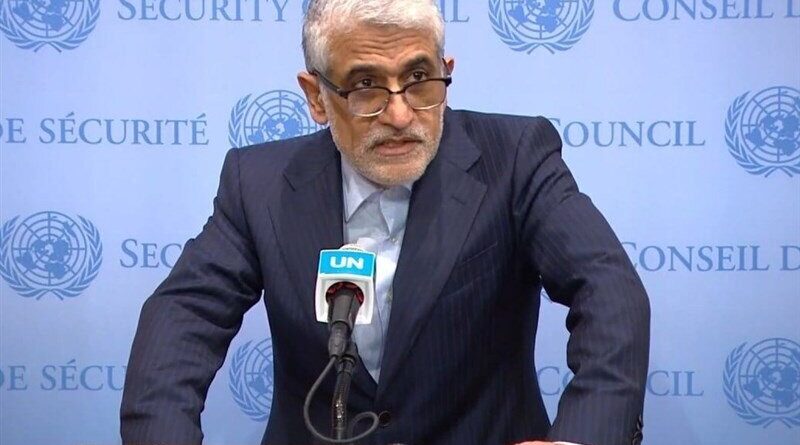
Iran Denies US Allegations of Supplying Missiles to Russia for Ukraine Conflict
In a recent correspondence directed towards both the UN Secretary General Antonio Guterres and the President of the UN Security Council Eloy Alfaro de Alba, dated August 5th, Saeed Iravani repudiated accusations, deemed by him as ‘baseless and unsupported’, specifically regarding Iran allegedly providing ballistic missiles and unmanned aerial vehicles (UAVs) to Russia for deployment in Ukraine.
The content of Iravani’s letter was a firm denial of the allegations that had been spearheaded by the United States representative and later seconded by representatives from France and Ukraine. These accusations had pointed at Iran’s purported assistance to Russia in its operations in the ongoing Ukrainian conflict, which were discussed during the Security Council’s 9970th assembly on July 31, 2025, under the thematic heading ‘Threats to International Peace and Security.’
Iravani reaffirmed that the allegations suggesting Iran as a supplier of missiles and UAVs utilised in Ukraine by Russia, are entirely baseless, unsupported, also suggesting them to be a part of a larger intentional disinformation campaign. His letter underscored the avowed stance of Iran towards this conflict, which has always been an advocacy for peaceful resolution.
The proposed resolution, according to Iravani’s message, should be based on a genuine dialogue conducted through diplomatic avenues, strictly adhering to international laws while respecting the sovereignty and territorial integrity of all nations involved. Iran’s consistency in this standpoint was highlighted, with an emphasis on its distinct interest in peace.
Iravani’s letter further criticized the United States for the substantial role it has played in encouraging and extending the duration of the war in Ukraine, marking its constant supply of sophisticated weaponry and adoption of incendiary policies as key contributors to the ongoing conflict.
It noted a significant irony and deep regret in the fact that the United States, while having a principal role in the Ukrainian crisis, is seeking to pin the blame on other nations for causing instability. Accusations of this nature were characterized as completely hypocritical and embodied a blatant display of double standards.
Instead of pursuing a diplomatic approach, Iravani indicted the U.S for following a militaristic agenda that has amplified the suffering of the Ukrainian population and closed off practical avenues towards peaceful resolution. His letter also highlighted that the current U.S administration’s reckless nuclear rhetoric and escalatory threats have heightened the possibility of a disastrous standoff, jeopardizing global peace and security.
The correspondence additionally underlined the continuous support the U.S provided for the Israeli government amidst its military action against Palestinians. It alluded to the high cost paid by the civilian populace caught up in the conflict in Gaza.
Accumulated figures till date reveal that this conflict has resulted in the loss of over 60,000 innocent lives, the bulk of the victims being women and children, coupled with widespread systematic destruction across vast tracts of the territory.
The letter took a critical tone towards the United States for its unfaltering aid to the Israeli government, which initiated a conflict against Iran on June 12, 2025, while hypocritically pointing fingers at Iran. It further condemned a direct act of aggression initiated by the United States targeting Iran’s peaceful, IAEA-guarded nuclear facilities; an act that stands in clear violation of international law.
The implications of such an offensive operation include a serious threat to the environment and public health due to the potential release of radioactive matter. This enunciates the deep-seated hypocrisy of nations who endorse, support, and justify acts of violation, forceful occupation, and military assaults, to admonish or blame others for creating instability.
Summing up, Iravani’s letter called upon all members of the Security Council to decisively spurn the selective, calculated, and politically motivated usage of baseless allegations for gaining leverage in political deals. This reiterates the essence of his communication – a clear rejection of the charges against Iran and a call for peace in the face of ongoing conflict.