
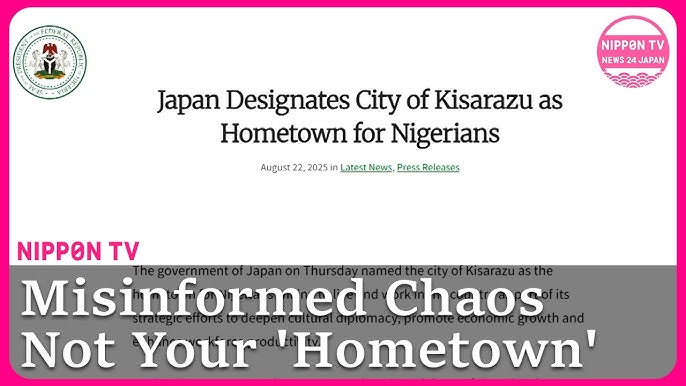
Japan’s ‘Hometown’ Cultural Exchange Program Faces Public Backlash
The ‘Hometown’ cultural exchange program between Japan and various African cities is under scrutiny for potentially misleading the public. Initiated by the Japan International Cooperation Agency (JICA) and Japan’s Ministry of Foreign Affairs, the project is now evoking criticism due to misinterpretations spinning online. The schematics of the program aim at fostering cultural interconnection between chosen Japanese cities and their African counterparts.
Announcement of the ‘Hometown’ initiative on August 21 at TICAD brought forward a unique collaboration. Four Japanese cities were paired with different African cities, intending to forge a culturally rich exchange. Nagai of Yamagata planned to connect with Tanzania, Sanjo in Niigata with Ghana, Kisarazu in Chiba proposed a union with Nigeria, and lastly, Imabari from Ehime looked forward to a cultural exchange with Mozambique.
However, the misunderstanding arose when the Nigerian government prematurely posted then retracted a declaration suggesting that Japan would grant special visas under the program. The spurious information propagated rapidly across social media platforms, igniting fears of rampant immigration among the Japanese residents.
Despite the ensuing corrections to quell the misinformation, the initial fear had already manifested into numerous protests and discontented calls targeting both JICA and the quartet of paired Japanese cities. Public concerns were high, with people fearing an unprecedented influx of immigrants as a consequence of the ‘Hometown’ program.
Several municipalities, affected by the public outcry, approached JICA with demands to alter the program’s name. They argued that the term ‘Hometown’ had unintentionally fostered misconceptions among the people and thus misled the public regarding the initiative’s real aims.
To address these concerns, JICA, together with Japan’s Ministry of Foreign Affairs, is now engaged in discussions with the involved cities. The key issue on the table is the possibility of renaming the program to more accurately reflect its goals and dispel any misconstrued notions associated with the previous moniker.
However, it is still uncertain if merely changing the program name can fully assuage the public’s concerns. Officials opine that the renaming process might not entirely put an end to the controversy. The social impact of the underlying miscommunication might require more than a simple name change to rectify.
The fate of the program’s original name, ‘Hometown’, hangs in the balance, while the potential for a wave of public backlash continues to loom. Establishing transparency and fostering constructive public engagement are central to the decision-making strategies of JICA and the Ministry of Foreign Affairs.
Concerns about mass immigration acted as the catalyst for the anxiety surrounding the initiative. This sentiment, further fueled by social media, has put JICA and the Japanese cities into a precarious position, forcing them to reconsider the program’s trajectory.
Apart from rebranding, other solutions are also being explored to address the misinterpretation and the ensuing tumult. Public reassurances and clearer communication about the program’s intentions are some of the methods being considered to mollify exacerbated public fears.
The specific-effects and a potential increase in the immigration levels due to the ‘Hometown’ program cannot be predicted at the moment. However, the authorities are committed to ensuring that the program’s main aim of facilitating cultural exchange is not thwarted by the concerns around immigration.
The ‘Hometown’ program, originally designed as a cultural bridge connecting two different worlds, now finds itself amidst a storm of public outrage. The program’s future is largely dependent on the steps taken by JICA, the Ministry of Foreign Affairs, and the implicated Japanese cities to mitigate mass apprehensions.
The initiative, meant to enhance understanding and foster relations between different cultures, has found itself in dire circumstances as a result of online misinformation. The task at hand is to rebuild public trust and reassurance to carry forward the noble cause this program was designed to achieve.
Finally, the controversy around the ‘Hometown’ program underscores the powerful influence of social media and the potential damage an unchecked piece of information can inflict. It serves as a reminder that public organizations need robust communication strategies to preempt confusion and misinterpretation, especially for high-stake collaborative programs such as this.