
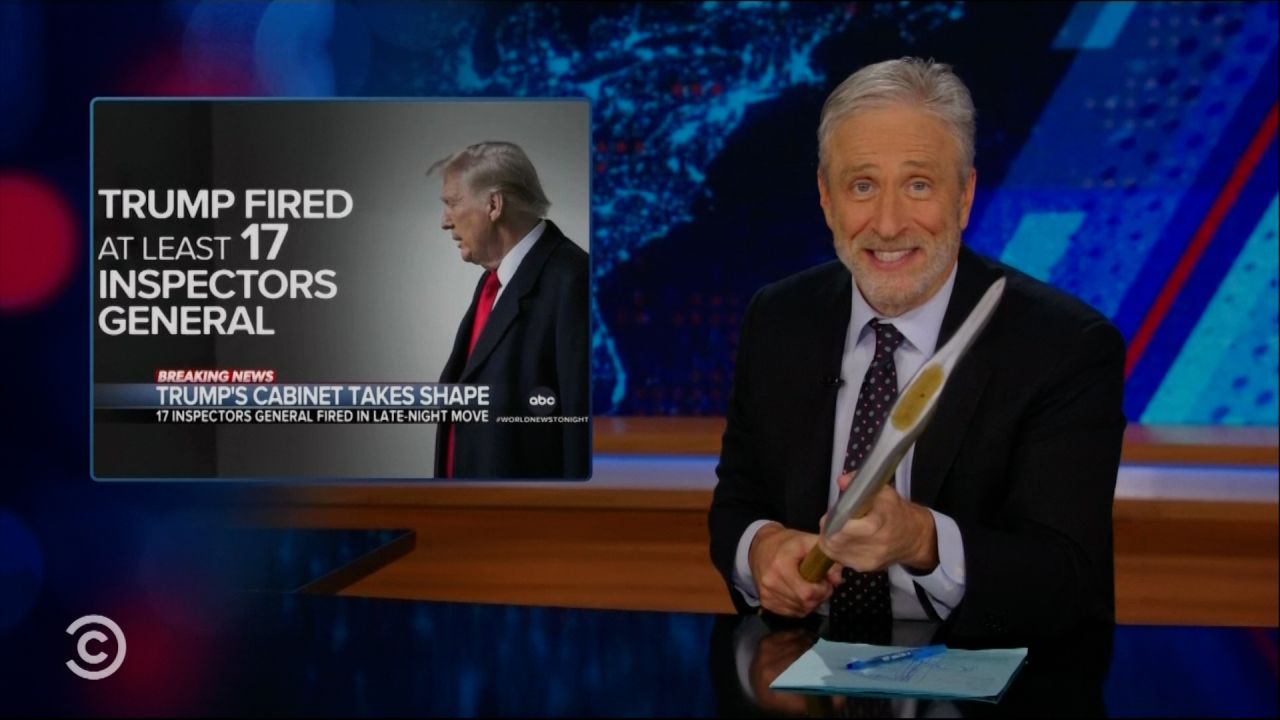
Jon Stewart Wields Humor to Expose Trump’s Childish Trade War Comments
Acclaimed humorist Jon Stewart delivered a stinging critique of President Trump’s comments on the impacts of his trade war on children. Specifically, the President stated that children might have to settle for fewer toys and stationery items. However, Stewart highlighted the disparity between this suggestion and the President’s own extravagant way of living.
Stewart humorously mentioned that he was considering gifting a plethora of dolls, anywhere between 20 to 30, to his 11-year-old niece. This was his unconventional way of finding comfort as he navigates through the media narratives woven by Trump. According to Stewart, the joy that this act brings is priceless.
The comedian took a moment to run footage from President Trump’s media interview, where Trump remarked about his niece’s potential collection of dolls. Trump proposed that an 11-year-old girl didn’t need to have a surplus of 30 dolls. With a straight face, Stewart reacted to the President’s judgment on proper doll quantities.
With his signature dry humor, Stewart questioned Trump’s notion of an appropriate scale of lifestyle during the trade war. He drew attention to the hypocrisy embedded within the President’s advice for common citizens to embrace simplicity while his own abode was adorned with sumptuous golden ornaments.
Stewart ridiculed Trump’s idea of specifying the exact number of dolls appropriate for someone’s child. He humorously defended his niece, hinting that Trump couldn’t possibly understand her needs as she had experienced significant personal growth that year. He refuted the label of ‘baby girl’ that Trump assigned his 11-year-old niece.
Yet another clip from Trump’s media interaction triggered Stewart to prompt a query. Aiming it at Trump, he questioned the ‘correct’ number of dolls for an 11-year old. It seemed absurd to Stewart that President Trump would confidently propose that three to four dolls were adequate.
Stewart, in a sarcastic manner, suggested that a party limited to four dolls would hardly suffice for a grand gathering of dolls, his niece had envisioned. In his humorous take, he conceded to the restriction posed by the president’s doll count, remarking that it was fine and that he’ll inform his niece about the president’s doll mandate.
Stewart’s playful banter extended from dolls to stationery. The comedian shared that his niece had diverse interests, one of which includes undertaking assessments. As a jest, he intended to provide her with an abundant stock of around 250 No. 2 pencils as a present.
However, once again, the President had an opinion on the appropriate number of pencils. After running another clip from Trump’s interview, Stewart revealed Trump’s assertion that a child didn’t require more than five pencils.
In the wake of President Trump’s comments about imposing a considerable amount of tariffs on China, he controversially proposed that children may need to make do with fewer toys. An instance he provided was suggesting children would survive with only two dolls as compared to 30.
Stewart’s humor-infused criticism of President Trump’s statements brings forth the underlining disparities and contradictions in the President’s perspective. For Stewart, President Trump’s advice to Americans to lead simpler lives, while he himself indulged in opulence, was glaringly ironic.
While humorously emphasizing on quantity, whether it be of dolls or pencils, Stewart drew attention to the fundamental disconnect between President Trump’s rhetoric and the lived reality of Americans. It served to highlight the absurdity woven into policies and statements uttered by those in power.
The comedian’s critique of Trump’s words successfully dissolves the veneer of authority, using humor to lay bare the contradictions present. By anchoring his comments on seemingly trivial items such as dolls and pencils, Stewart effectively unpacked deeper sociopolitical issues.
In conclusion, Stewart’s biting wit and sharp commentary unmasked the contrasting realities—the lived experiences of ordinary citizens contrasted against the opulence of the elite. His critical yet humorous interrogation of President Trump’s remarks spawned crucial conversations about inequality and political disconnect.