
LA Mayor Karen Bass Slams Trump’s Use of National Guard Amid Protests
Los Angeles Mayor, Karen Bass, a member of the Democratic Party, expressed her discontent on Tuesday about the reductions in funding for violence prevention in the midst of city-wide protests against U.S. Immigration and Customs Enforcement (ICE) and the presence of National Guard troops. The Guard was deployed by then-President Donald Trump in response to escalating unrest in the city, a move that came after an intensive weekend of demonstrations and riots triggered by increased ICE enforcement.
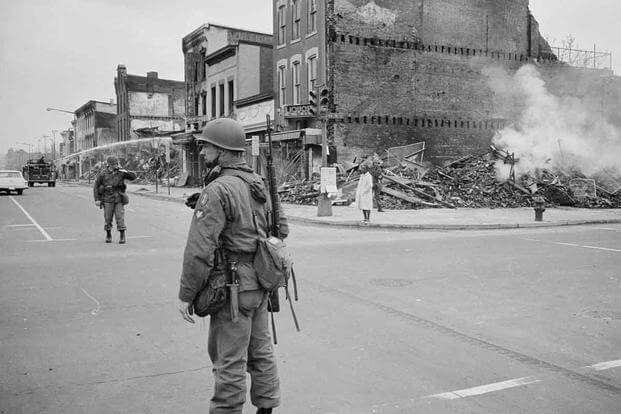
During a panel discussion focused on Trump’s intense approach to handling crime in Washington, D.C., Mayor Bass shared her perspective on the contentious decision to militarize the response to urban demonstrations. She spoke to the experience of not only Los Angeles, but also Chicago and even Washington, D.C., viewing them as experiments in the use of military forces within the confines of U.S. cities.
‘These cities are not just our homes, they are becoming the testing beds for the implementation of martial law-like measures,’ Bass opined. She voiced concern that the goal was to condition citizens into accepting what she considered to be an excessive demonstration of federal might, insisting that the deployment of the National Guard was uncalled for in Los Angeles.
Indeed, despite claims of necessity, Bass argued that the armed forces served little functional purpose, serving only as an intimidating presence. ‘The Guard was here, thousands strong, only to stand guard outside government buildings. It wasn’t a worthwhile deployment.’
Despite strong opposition from both Mayor Bass and California’s Governor Gavin Newsom, also a Democrat, to Trump’s decision to deploy the National Guard, the city had already been experiencing widespread looting, vandalism and vehicle fires in its downtown. In spite of visible military presence, demonstrators continued to flood the city center.
Even after the military were stationed at federal buildings, the protests did not cease. As demonstrations carried on into the middle of June, the city police department was prompted to declare unlawful assembly in downtown’s Civic Center area. With tensions running high, Bass was compelled to impose a curfew for the area.
The majority of deployed troops remained idle on a base nearby, their time occupied with video games and frustration at being utilized in such a way. Mayor Bass argued they could better support the city by addressing crime: ‘If you genuinely want to assist us in combating crime — a mission we are profoundly committed to — then cease the cuts to violence prevention grants. This way, we can actually work on reducing crime rates in our cities.’
In August, Trump declared the deployment of National Guard troops and invoked Section 40 of the District of Columbia Home Rule Act within the national’s capital. This followed a string of crimes in Washington, D.C., that had garnered widespread attention. Although local police data indicated a 35% drop in crime in 2024, such statistics failed to account for felonies and serious assaults.
On a subsequent Friday, Trump indicated his consideration to extend National Guard deployment to Chicago. He described the city as chaotic and claimed that the citizens were pleading for federal intervention.
Contrasting opinions came from Illinois Governor JB Pritzker and Chicago Mayor Brandon Johnson, both Democrats. They voiced their opposition to Trump’s proposal, asserting that crime rates in Chicago were declining. In fact, data from the Chicago Police Department up until the mid of August presented a downward trend of 25% in homicides over the previous 12 months, compared to 2023, despite the numbers still being high relative to the pre-pandemic era.
During the year-long period ending mid-August, 474 homicides were reported in Chicago, with an average of 722 homicides yearly during the 2021-2023 period. Even though the frequency of killings was still greater than it was before the pandemic, the descending trend offered a glimmer of hope.
On another note, while crime in Los Angeles seemed to be decreasing overall, the first half of 2025 saw a significant rise in the number of police-involved shootings compared to the same period just a year before.
In remarks to this issue, LAPD Chief Jim McDonnell pointed to a concerning trend. According to him, officers were encountering a ‘higher instance of shootings involving the police force’, with 25 cases reported between January 1 and July 15, compared to 18 during the same period in 2024.
This rise sheds a light on the extraordinarily complex and multifaceted challenges faced by cities like Los Angeles and Chicago amidst an atmosphere of civil discontent, economic crisis and a global pandemic. As mayors, governors, and national leaders grapple with these issues, public scrutiny and the call for a more humane and effective approach to law enforcement continue to mount.
Yet, despite outstanding challenges, the words and actions of leaders like Mayor Bass remind us that the pursuit of a more peaceful, equitable society, where citizens and law enforcement can support and respect one another, is not a lofty dream, but a tangible goal that can be pursued and achieved through concerted efforts, robust public dialogue, and resolute political will.