
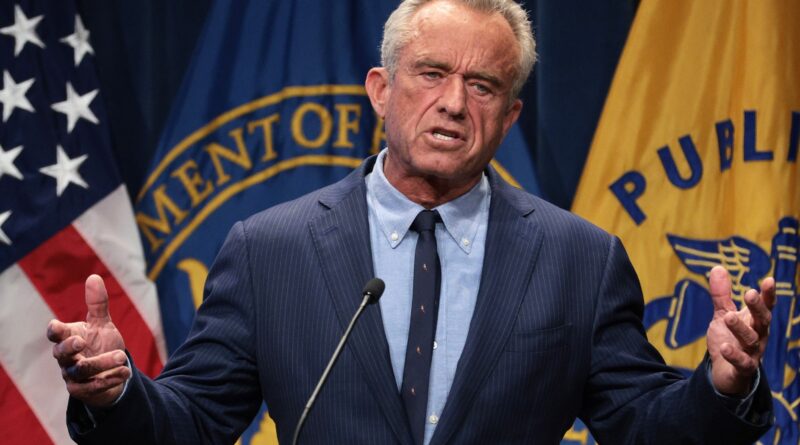
RFK Jr. Shakes Up Childhood Vax Schedule With Hep B Decision
The longstanding U.S. practice of giving hepatitis B shots to every newborn is coming to an end — thanks to a new CDC panel vote backed by President Donald Trump and fast-tracked by Health and Human Services Secretary Robert F. Kennedy Jr.
The CDC’s Advisory Committee on Immunization Practices (ACIP) voted 8–3 this week to end the universal birth dose recommendation, a major departure from over three decades of policy. Under the new guidance, hepatitis B vaccination will only be given to newborns if their mothers test positive for the virus or their status is unknown. For infants born to mothers confirmed to be hepatitis B negative, vaccination at birth is now considered optional and should be discussed with a doctor.
Trump, who has long criticized the aggressive childhood vaccine schedule, praised the CDC panel’s move and used the moment to launch a broader review.
Trump: ‘Ridiculous’ Vaccine Schedule Must Be Overhauled
In a Friday post on Truth Social, the president declared the CDC’s new position a victory for science and sanity.
“The CDC Vaccine Committee made a very good decision to END their Hepatitis B Vaccine Recommendation for babies, the vast majority of whom are at NO RISK of Hepatitis B,” Trump wrote, blasting the decades-old policy. “A disease that is mostly transmitted sexually, or through dirty needles.”
He went on to criticize the current U.S. childhood vaccine schedule, which he said includes up to 72 doses for otherwise healthy children — more than any other developed nation. Calling it “ridiculous,” Trump said that many parents and scientists have expressed concerns for years and that he shares those concerns.
Fast-Tracked Review Ordered by Executive Memorandum
Trump announced that he signed a Presidential Memorandum directing Secretary RFK Jr. and the Department of Health and Human Services to “fast track” a full review of the U.S. childhood vaccine schedule. The goal: realign it with practices in other countries and apply “common sense and the gold standard of science.”
“I am fully confident Secretary Robert F. Kennedy, Jr., and the CDC, will get this done, quickly and correctly, for our Nation’s Children,” Trump added. “Thank you for your attention to this matter. MAHA!”
What’s Changing in the Hepatitis B Vaccine Protocol
The ACIP’s new guidance also recommends that antibody levels be tested before administering a third dose of the hepatitis B vaccine. Traditionally, children have received the vaccine in three doses starting at birth. But under the new guidance, not all children may need a third dose, depending on individual response.
This marks a fundamental shift in how public health officials approach pediatric immunizations — emphasizing case-by-case medical decision-making over rigid scheduling.
A Win for Parental Rights and Medical Autonomy
The shift is already being hailed by critics of the one-size-fits-all model. Advocates for vaccine schedule reform say this is a watershed moment — not just for hepatitis B policy, but for the entire conversation about childhood vaccinations.
Robert F. Kennedy Jr., long a vocal skeptic of pharmaceutical industry influence in public health policy, now holds a leading role in shaping what many believe could become a more flexible, evidence-based vaccine system.
More Changes Likely Ahead
With the new ACIP recommendation and Trump’s directive in motion, the U.S. could soon see broader changes across the vaccine landscape. If other early-life vaccines face similar scrutiny, this could usher in one of the most significant overhauls in pediatric health policy in generations.
The Trump-Kennedy push signals a new era — one that’s increasingly focused on risk-based medical decision-making, parental choice, and government transparency.