
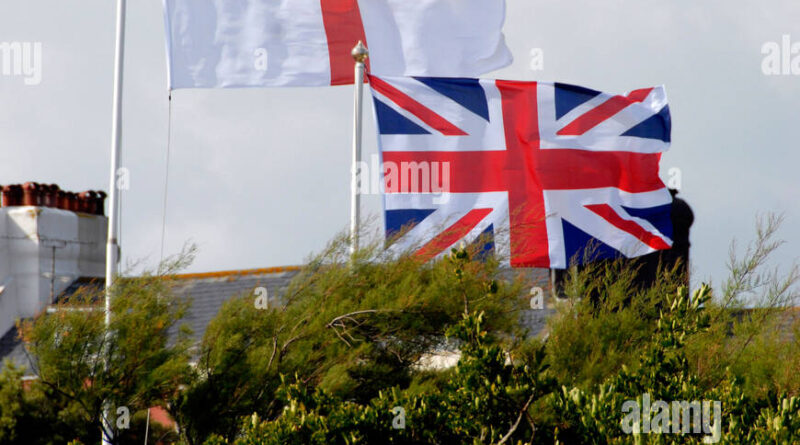
Rise in Nationalistic Displays Amidst UK’s Immigration Debate
The recent contentious discussions on immigration in the United Kingdom have instigated a surge in the display of English and British flags, a trend perceived by some as a powerful expression of nationalism. Previously, these flags were primarily raised during royal ceremonies or sports competitions. However, they are now becoming a common sight on highway overpasses, lampposts, and various other locations in hamlets, towns, and cities all over England.
Those spearheading this movement contend that hundreds of thousands of St George’s and Union Jack flags have been hoisted throughout the country. Notably, the colors of England’s national flag – red and white, have also started embellishing roundabouts and road intersections.
St George’s flag, symbolised by a red cross on a pristine white backdrop, represents England, while the Union Jack is a composite emblem for England, Scotland, and Northern Ireland. Various groups have taken to the task of raising a significant number of these St George’s flags across the nation.
A sense of boldness seems apparent among English citizens, particularly against unlawful immigration and what it potentially signifies. A spokesperson of one such group emphasized that this display is not an expression of racism, but simply the pride of being British and English.
They argue that being proud of their nationality should not be curtailed out of concern it might upset someone else. After all, it’s their homeland. Anti-racism activists, however, insist that such actions might only inflame division, asserting that extremist right-wing factions play a prominent role in the flag-raising efforts, particularly through a group identified as Operation Raise the Colours.
Demonstrations of national pride are ordinarily less common in England and its European neighbours compared to the United States, where exhibition of the Stars and Stripes is a customary practice. There has been a historical correlation between the English flag and far-right extremism for a considerable length of time.
Nationalistic sentiment has always been treated with caution in England, yet this view seemed to evolve in the 1990s. The flag turned into a ‘commonplace’ symbol of support for the nation’s sports teams and a way to express cultural pride.
The flag’s symbolism has taken on a pronounced significance amidst the rise of the Reform UK party led by Nigel Farage, which echoes vehemently anti-immigration rhetoric. The emotive issue of migrant-filled boats arriving from France has particularly been a focus of their political narrative.
In the country’s local elections held in May, the party achieved a remarkable feat by making unparalleled progress. Presently, the party is in a favorable position in national polls, even though the next general election isn’t scheduled until 2029.
The way in which the English and British flags have been embraced politically was indirectly acknowledged by the UK Prime Minister. While expressing personal pride in the flags, both of which adorn his official office at Downing Street, he made a subtle argument for their appropriate use.
The Prime Minister elucidated his perspective in a radio interview. His take was that while the flags make compelling symbols of patriotism and the nation, any attempt to leverage them purely for divisive agendas might lead to belittlement and depreciation of the flags’ inherent value.
The flag-related tension isn’t confined just to England; it has also permeated across the Irish Sea. A dispute has spurred in Dublin where the local city council and certain groups find themselves at odds over the mounting of the Irish tricolour in areas with substantial immigrant dwellings.