
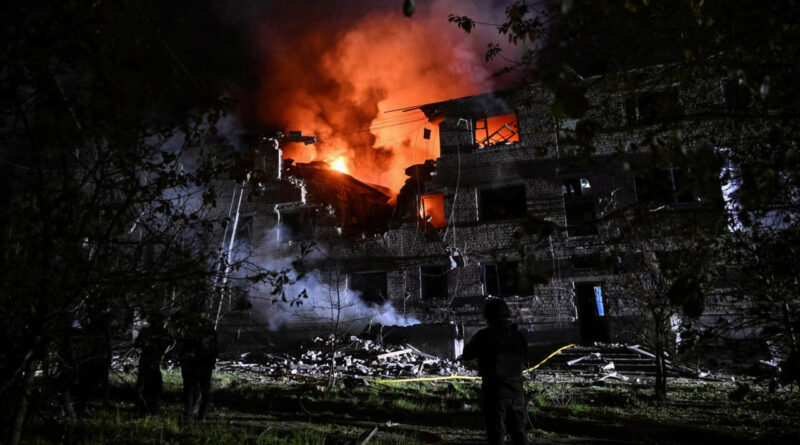
Russian Drones Attack Ukrainian Power Systems as Dispute Continues
The dispute between Russia and Ukraine rages on, without a clear end in sight. The impasse in peace discussions has led to the recent use of Russian drones targeting Ukrainian power systems in the north and south, causing power cuts for roughly 60,000 individuals. As a reaction, Ukrainian President Volodymyr Zelenskiy has pledged retaliatory measures far beyond Russia’s boundaries. As the war reaches its three-and-a-half-year mark, uncertainty hangs around the potential solutions to the conflict, and questions persist around the level of involvement by the American military.
In the previous month, President Donald Trump declared that a peace agreement with Russia wouldn’t involve the deployment of U.S. troops to Ukrainian territories. Echoing these sentiments, retired U.S. Army Lt. Col. Darin Gaub, who previously served as a UH-60 Black Hawk pilot and battalion commander, agreed that a military boots-on-the-ground strategy is not required in Ukraine.
Gaub clarified that the primary strategy Trump has utilized – and should continue to employ – is economic. A crucial strategy that the U.S. could utilize, according to him, is to economically align itself with Ukraine and help the country leverage its own resources to drive economic growth and countrywide reconstruction.
By adopting such a method, Gaub argues, it’s conceivable for Ukraine to fortify its military capabilities and offer a significant challenge to Russia. Gaub shed light on the intricacies of this conflict, explaining that the resilience of Russia in this scenario stems from its long-term preparations for potential sanctions.
Russia had been anticipating this conflict for quite some time and strategically laid out an alliance and survival economy to withstand inevitable sanctions. Not only did it invest extensively in precious metals such as gold and silver, but it also fostered strong ties with China and Iran.
These alliances, Gaub explains, enable Russia to persistently trade energy, fueling both its economy and the machinery of war. Despite these daunting factors, one concern Gaub voiced was the ‘unfortunate’ caliber of advisors surrounding Trump who are potentially providing suboptimal counsel.
Still, Gaub maintains that only the hefty weight of American influence may convince Vladimir Putin to alter his trajectory of action. ‘For such a transition, time is needed in conjunction with certain safety assurances,’ Gaub elaborated. ‘Perhaps an articulate conversation concerning the deployment of intelligence assets – both space-based and airborne – could contribute to enforcing a no-fly zone.’
However, he promptly tacked on, ‘The notion that U.S. troops should be maintaining a kind of demilitarized region separating Russia and Ukraine is outright absurd and out of the question. European politicians maintain a façade in their dialogues with Trump, while their domestic actions sing a different tune. They seem to be more than comfortable allowing Ukraine to persist in the struggle alone, until the last Ukrainian stands firm.’
Gaub subsequently queried, ‘Why?’ His own response to that: ‘The war brings continued economic gains for many European countries – which in turn are making onerous requirements that simply prolong the conflict. This includes their refusal to acknowledge that Ukraine may have to concede territory, and recognizing Crimea as a part of Russia.’
Gaub expresses concern about Ukraine’s military posture, noting its vulnerability amid this conflict. He reminds us that continued attacks on Russian oil infrastructure are pushing Russia into a defensive position where it might react with increased hostility.
He reiterated that history provides ample lessons of strategies to avoid, yet it appears as though many are endeavoring to replicate past errors hoping for a different outcome this time around. These historical echoes are observed in present attempts to recreate conflict resolution.
In conclusion, Gaub expressed an idealistic wish, ‘It is my sincere hope that this conflict will end sooner rather than later, allowing nations to build mutual relationships through trading and economic interaction – instead of viewing each other as adversaries.’
The turbulent times between Russia and Ukraine, etched in a complex interplay of politics, military interventions, and economic sanctions, prompt nations worldwide to reflect upon the fragile balance of global relationships. It is a significant tale where past lessons could serve as stepping stones to a peaceful resolution. It underlines the necessity of adopting forward-thinking, economical, and non-aggressive ways to navigate geopolitics for the betterment of all.