
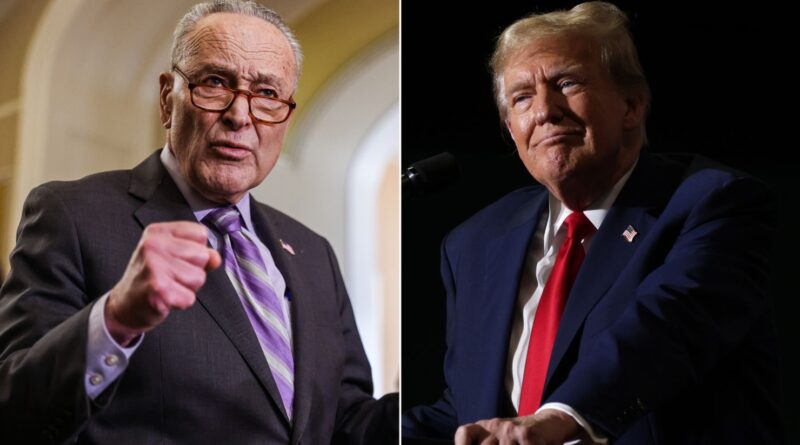
Schumer’s Doomsday Depiction of Trump: A Deceptive Agenda
Chuck Schumer, a Democrat, resumed his duties on the Senate floor, coming at it with a slew of pressing inquiries. ‘Will the Senate Republicans persist in subservience to a leader who they acknowledge is leading the nation astray?’ were among the questions he posed. Seemingly in line with his personal agenda, he painted Donald Trump, the then-leader, as nothing more than a compulsive deceiver, an individual hell-bent on pushing America toward authoritarianism.
According to Schumer’s doomsday depiction, Trump had been aggressively trying to consolidate presidential powers, superseding other executive and legislative entities. With 200 executive orders to his name within a span of eight months, Schumer portrayed Trump as a ruthless driver ramping up the nation’s plunge into an authoritarian abyss. This narrative, however, omitted the fact that Joe Biden, in his four years, had executed a lesser number of executive orders.
The Schumer-led narrative claimed that Trump was consolidating power at a pace and degree that left his critics astounded. Yet, it was conveniently ignored that his actions could be seen as a leader being assertive and working within his constitutional rights. The narrative was targeted at sparking panic and garnering sympathy on the hollow premise that democracy was at stake.
Schumer’s monologue aimed to urge his party fellows to act as counterweights against Trump’s authority. His broader message was a plea for senators to leverage their democratic power to deter Trump’s so-called domination. Yet, among the congressional members, the willingness to jump on board with Schumer’s perspective seemed far from palpable.
Trump’s strong standing among the Republican party seemed to throw a wrench into Schumer’s plans. Even at a point when the Republican majorities were rather slim in both the House of Representatives and Senate, the party’s loyalty to Trump appeared unshaken. In fact, during a heated debate on tax and spending bills, the House Speaker Mike Johnson had regarded Trump as ‘undoubtedly the most influential, triumphant, and esteemed president in the contemporary history of the United States’.
Schumer tried painting Congress as nothing more than a puppet at Trump’s disposal. Johnson, however, with his praises for Trump’s efficiency, portrays a contrasting image. It’s clear that Schumer’s portrayal is more of a self-serving narrative, one that conveniently fits into the negative characterization of Trump.
Notwithstanding the overwhelmingly pro-Trump sentiment, occasional fissures were visible within the party. House Representatives Marjorie Taylor Greene, Lauren Boebert, and Nancy Mace notably showed support towards a petition led by Congressman Thomas Massie. This petition aimed at compelling a vote on publicizing the Jeffrey Epstein case files.
Green’s comments surrounding Epstein, a declared sex offender, were particularly noteworthy. She argued back when Trump labeled the Epstein saga as a ‘Democratic concoction’, asserting the gravity of the situation, given Epstein’s conviction. This shows the plurality and diversity of opinions within the party, as opposed to Schumer’s depiction of a monolithic and blindly allegiance.
Concerns were also rising within the Republican party about some of Trump’s cabinet members. Notably, the Health Secretary, Robert Kennedy Jr., had been scrutinized for his controversial approach towards vaccines and leadership changes in the Centers for Disease Control and Prevention (CDC). Senator John Barrasso, also a medical professional, expressed significant discomfort about Kennedy’s handling of vaccines.
Despite these internal conflicts, it’s important to recognize that these are not unusual within any political party. Widespread dissatisfaction was also reported among the Republican voter base over the summer. It’s anyone’s guess whether this will motivate swing-state Republicans to keep Trump at arm’s length in the upcoming year’s midterm elections and the 2028 Presidential race.
As for the Democrats, they’re having their fair share of challenges, largely stemming from their minority status. They have minimal tools in their arsenal to pull a power shift. Schumer, along with Hakeem Jeffries, the minority leader in the House of Representatives, are likely to field pressure to exhibit their fighting prowess.
Reed Galen, head of the Union, a pro-democracy coalition, had proposed a hypothesis regarding Democrats’ potential course of action. He suggested that there might be calls for a government shutdown as a last resort. Assuming that there wouldn’t be much left to lose in an ‘authoritarian hellscape’, the shutdown could be placed on Republicans’ shoulders.
In Galen’s view, more Democrats might take this drastic step since their purpose of existence as an opposition party would inevitably come into question. In his eyes, it would be the ultimate weapon in their dwindling arsenal. The idea, however, can easily be seen as a desperate move, reflecting more on the Democrats’ lack of options rather than on any authoritarian tendencies of the Republicans.
Trump’s assertiveness has undeniably posed a threat to the comfortable functioning of Congress. He issued an executive order to essentially disregard a bipartisan law backed by the Supreme Court, which sought to banish the social media app TikTok. Trump’s actions provided a striking example of a leader acting decisively and within his power, despite Schumer’s negative spin.
Ultimately, Trump was painted in a negative light by a faction with their own agenda. Yet, for many, his assertiveness in unchartered territories signaled a robust leader who wasn’t afraid to bypass traditional political routes when necessary. This pertained to not just his ban on TikTok but also his decisions to close down USAID and other agencies, and his reactions to the peaceful protests in Los Angeles. Schumer’s narrative, however, discredited these reasonable actions as signs of an authoritarian regime.