
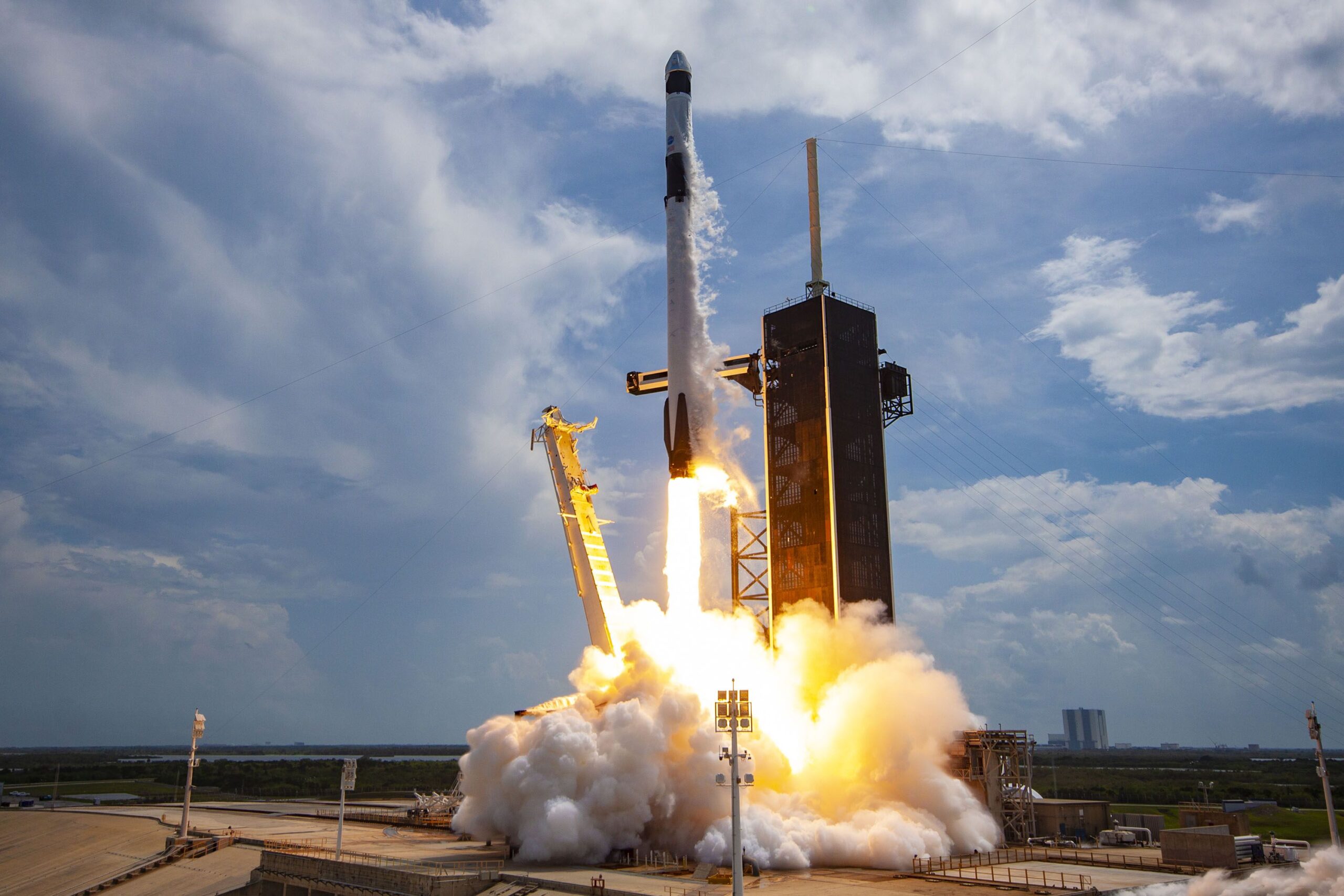
SpaceX Falcon 9 Prepares for June Starlink Satellite Launch
In June, an event anticipated to be the final one of the month, a Falcon 9 rocket is scheduled to take to the skies from Southern California, courtesy of SpaceX. The mission undertaken by this rocket involves the dispersal of a group of Starlink satellites into low-Earth orbit. It’s speculated that this planned rocket launch could happen on a weekend morning, following closely behind SpaceX’s recent launch via its Transporter 14 rideshare. This previous mission saw a Falcon 9 rocket successfully delivering 70 payloads to orbit on behalf of various customers, including the unique task of transporting 166 capsules with human ashes for a celestial memorial service.
There are numerous locations throughout California from which spectators can admire the rocket as it ascends towards the heavens. Nevertheless, it’s worth bearing in mind that rocket launches are commonly subject to changes or delays owing to a range of external factors, such as inclement weather or unforeseen issues with the spacecraft itself. The launch window for this mission is scheduled from 9:47 to 10:46 a.m. PT on the last Saturday of June, with alternative slots set aside for the following day, Sunday, should they be necessary.
The place chosen for this rocket launch is Launch Complex 4E, located at the Vandenberg Space Force Base in Santa Barbara County, California. A significant fraction of launches carried out from Vandenberg follow a trajectory either towards the south or southeast. Employing the famous two-stage Falcon 9 rocket, standing tall at 230 feet, this mission aims to deploy 26 of the Starlink satellites into low-Earth orbit.
The elevation at which these satellites are launched into orbit is sufficiently low, allowing them to revolve around the Earth relatively quickly. Following the launch, the Falcon 9 rocket’s booster has been programmed to touch down on a SpaceX drone ship in the Pacific Ocean, charmingly named “Of Course I Still Love You”. This planned landing maneuver enables SpaceX to retrieve the booster device for reuse in subsequent space missions.
SpaceX, a celebrated name in commercial spaceflight industry, was established in 2002 by Elon Musk. It holds its headquarters at Starbase, located in South Texas. A majority of SpaceX’s rocket launches are conducted from launch sites in both Florida and California. This includes its consistent schedule of deploying batches of Starlink internet satellites into orbit, along with occasional spaceflights financed privately and designed for commercial crewed missions.
In addition to its own initiatives, SpaceX also undertakes missions on behalf of NASA and the Department of Defense under contractual agreements. This includes providing launch services for classified satellites and other such payloads. The constellation, Starlink, is another venture of SpaceX founder Elon Musk. It comprises over 7,000 satellites, tasked to provide internet service to customers globally.
These Starlink satellites were launched by SpaceX over a span of six years from sites in both Florida and California. In contrast to conventional satellite internet services, which rely on singular geostationary satellites orbiting the Earth at an average altitude of 22,236 miles, Starlink satellites function from a much lower orbit. Positioned roughly 341 miles above the Earth, they offer enhanced performance for activities such as streaming, gaming, and conducting video calls.
Situated in Santa Barbara County in Southern California, the Vandenberg Space Force Base serves as a launch site for rockets. Since its establishment in 1941, Vandenberg has been the preferred location for a myriad of civil and commercial space launches, conducted by organizations like NASA and SpaceX. Within Vandenberg, the operations related to space launches and missile tests are managed by Space Launch Delta 30, a sub-division of the Space Force.