
Taiwan Minister Warns of China’s Increasing Militaristic Control
In the U.S. capital, the Taiwanese Minister of Mainland Affairs, Chiu Chui-cheng, has sounded the alarm about China’s accelerating efforts towards militaristic control over Taiwan. He highlighted the potential for widespread implications, including the destabilization of the Asia-Pacific region and direct threats to American national security and financial welfare. The minister conveyed that China’s intent is to sideline the U.S. from the Asia-Pacific, ultimately replacing it as the global superpower. This ambition is encapsulated in the concept of the ‘China Dream’.
Chiu focused on Taiwan’s strategic geographical position, sitting in the heart of the first island chain, and its critical role in the world of semiconductors, key to both American technological advancements and the global supply chain. The Minister also pointed out that Taiwan’s democratic system provides a counterpoint to China’s approach and could potentially influence change within China. He was candid about Taiwan’s willingness to share its experience in combating the influence of the Chinese Communist Party (CCP) with the U.S.
During his trip to Washington, he had meetings with key U.S. government officials, policymakers, think tanks, and Taiwanese communities, all vital to maintaining and furthering U.S.-Taiwan relations. However, this visit did not sit well with Beijing, sparking intense criticism, as China strongly rejects any formal interactions. Chiu’s stern cautionary message brings to light a modernized ‘Domino Theory’ centered around Taiwan.
Chiu outlines that if China were to forcefully annex Taiwan, it would catalyze a powerful shift in dominance across the Asia-Pacific. This strategic realignment could disturb the regional equilibrium, leading to threats to American security and potential economic impacts. Taiwan’s standing as a key player in the global semiconductor industry is of immense significance to the U.S., underpinning various supply chains that fuel the production of smartphones, computers, AI systems, defense mechanisms, and much more.
Taiwan, through its leading tech companies like TSMC and UMC, has been instrumental in fostering innovation in the U.S. This collaboration has enabled U.S. tech giants like Apple and Nvidia to lead their respective fields, and has also ushered in the era of fabless chip design. Apart from advanced chips, Taiwan plays a significant role in the manufacturing of legacy and memory semiconductors, packaging, testing, materials, strengthening its irreplaceable position in the global supply chain.
Taiwan features as the eighth-largest trading partner to the U.S., with its supply chains serving hundreds of thousands of American companies, either directly or indirectly. In 2024, the trading of U.S. goods and services with Taiwan saw a significant uptick by 22 percent from the previous year, culminating in a staggering $185.7 billion. The trade in services amounted to $26.9 billion, resulting in a $494 million surplus for the U.S., an increase of almost 14 percent from 2023.
In further sementing their commitment to this relationship, TSMC announced a historic investment of $100 billion in advanced semiconductor manufacturing in the U.S. in March 2025. This has boosted TSMC’s total investment in the U.S. to an unprecedented $165 billion, qualifying as the most substantial single foreign direct investment in American history.
In a striking warning back in 2021, Admiral Phil Davidson, who was then serving as the head of U.S. Indo-Pacific Command, informed Congress of the possibility of China seeking to annex Taiwan over the following six years. This is significantly sooner than its publicly stated goal to surpass the U.S. in both economic and military might by 2050. He pointed to China’s rapidly expanding military, aggressive moves in areas like Hong Kong, Tibet, and the South and East China Seas, and its escalating regional ambitions.
Davidson recommended a thorough re-evaluation of the long-standing policy of ‘strategic ambiguity’ towards Taiwan. He advocated for consistent arms sales and professional military growth to fortify Taiwan’s defenses. Simultaneously, he highlighted the importance of the annual observation of Taiwan’s Han Kuang drills by the U.S and stressed investments in the Pacific Deterrence Initiative, focusing on Guam’s missile defense, to offset China’s growing capabilities.
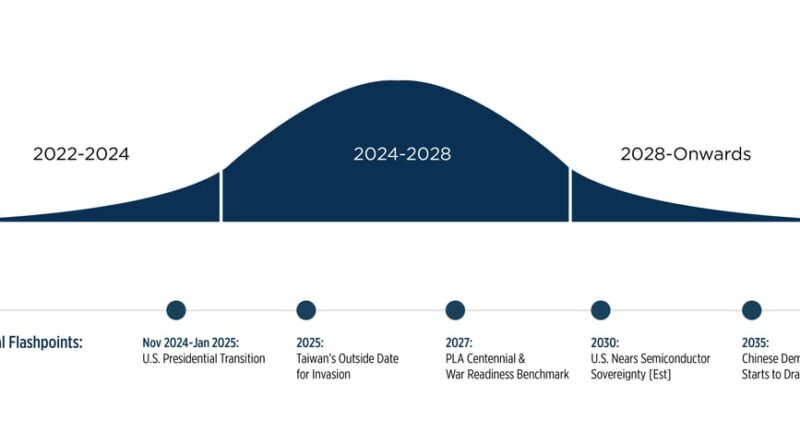
The Admiral’s 2021 testimony has since been recognized as the ‘Davidson Window’, with 2027 designated as the year China could potentially be militarily equipped for an invasion of Taiwan. However, only two out of 64 experts, in a 2022 survey by the Center for Strategic and International Studies, saw 2027 as a set deadline, though the risk of conflict has undeniably been on the rise.
In May 2025, the House Select Committee on the CCP gave a stern warning that the opportunity to prevent a war was dwindling. This marked concern was after Xi Jinping ordered the People’s Liberation Army to be prepared by 2027. The committee urged the U.S. to reallocate resources to land-based deterrence, expedite weapons deliveries, and reinforce cyber defenses. This was aligned with Kurt Campbell’s emphasis on the necessity to maintain allied faith in American determination.
Committee Chairman John Moolenaar underscored the importance of defending Taiwan, not merely for democratic values, but also for safeguarding the security, economic stability, and global supply chains of the U.S. He warned that a failure to act would lead to catastrophic losses and a steady erosion of U.S. credibility on a global scale.
An April 2025 report from the Department of Defense underscored this urgency. The report examined Xi Jinping’s ‘Taiwan dashboard’, a system of strategic, political, military, and economic indicators along with perpetual pressures influencing Xi’s decision-making strategy.
The report argued that most indicators point towards a closing ‘window of opportunity’, suggesting that prompt action would be more beneficial to Beijing than a delay. While military readiness remains a significant factor, the shifting identity of Taiwan, the commitments from the U.S., and China’s economic and demographic pressures heavily influence the timeline.
Paired with Xi Jinping’s directive for the PLA to be ready by 2027 and his personal aspirations, the scales are tilting towards escalation over the next one to three years. This speculation marks Taiwan as one of the most susceptible flashpoints in U.S. foreign policy today, with 2027 being outlined as the most probable year for conflict.