
Trump Charges Ahead: Biden’s Previous Failings Stand Out in Contrast
President Donald Trump, marking half a hundred days since his re-installation in the highest office of the land, wastes no time in declaring that he has put the United States back on track. Upon embarking on his second tenure in the White House, he seems to be on fast-forward mode, with a flurry of actions and orders at an unprecedented velocity. Remarkably, his White House issued a communique on Monday, boasting, ’50 WINS IN 50 DAYS: President Trump Delivers for Americans.’ The list of achievements, some being widely debated, has been put together since his re-election on January 20. However, national polls paint a divided scenario, shattering the exuberant image projected by Trump.
Notably, three renowned public opinion research surveys – Reuters/Ipsos, CNN, and NPR/PBS/Marist, raised some eyebrows against Trump’s performance, just before his stellar address to the joint-session of Congress last week, the first major television address since beginning his second term. However, a careful analysis of these reports isn’t complete without considering other surveys that position Trump favorably, reflecting a palpable improvement since his first term.
Trump’s second term ratings are not simply midway but have shown noticeable improvement compared to his first tenure that began in 2017 on a negative note and stayed underwater throughout his first term. Yet, there is a cause for concern. An aggregate of the recent national polls depicts that his approval ratings have only seen a slight improvement which is not surefooted in any way.
In the wake of his comeback in late January, Trump’s numbers have dipped a bit, with average polls indicating his approval ratings barely in the early 50s and his disapproval ratings in the high 40s. Yet, it’s crucial to remember that these current numbers are higher than at any points in his first presidency. Sorting through these figures, we find that Trump’s ardent Republican base still overwhelmingly supports him, a fact underscored by a Republican pollster.
The consensus among experts argues that Trump’s steady GOP support, lacking in his first tenure, is starkly noticeable this time around. According to a prominent professor at the University of Texas, Trump never secured Democrat support during his first term and had struggles even with Republicans. Fast forward to 2025, we see an incredulous 180-degree turn as the entire GOP rallies firmly around him.
In just seven weeks of his second term, the gears of Trump’s administration have already ground into overdrive. Numerous executive orders and far-reaching actions – some of them controversial – have not only lived up to his campaign promises but have put the re-elected president’s stamp of authority on the Federal Government, facilitated significant downsizing of the federal workforce, and addressed years-old complains.
By Monday of this week, Trump had penned 89 executive orders post his inauguration, a thunderous leap ahead of any previous presidents in their initial stages. These orders stand as a testament to his proactive Presidency, as they include a radical overhaul of immigration rules, instituting heavy tariffs on major trading partners such as Canada and Mexico, along with uprooting foreign policy procedures by halting aid to Ukraine and breeding conflict with Ukraine’s leader inside the Oval Office.
These heavy-handed revisions have thrown a wrench in the Democrats’ plans, according to a Republican pollster. Paradoxically, despite Trump’s approval ratings taking a minor hit, the Democrats haven’t managed to leverage this evident disarray to their advantage. The Democratic Party’s own ratings barely inspire confidence.
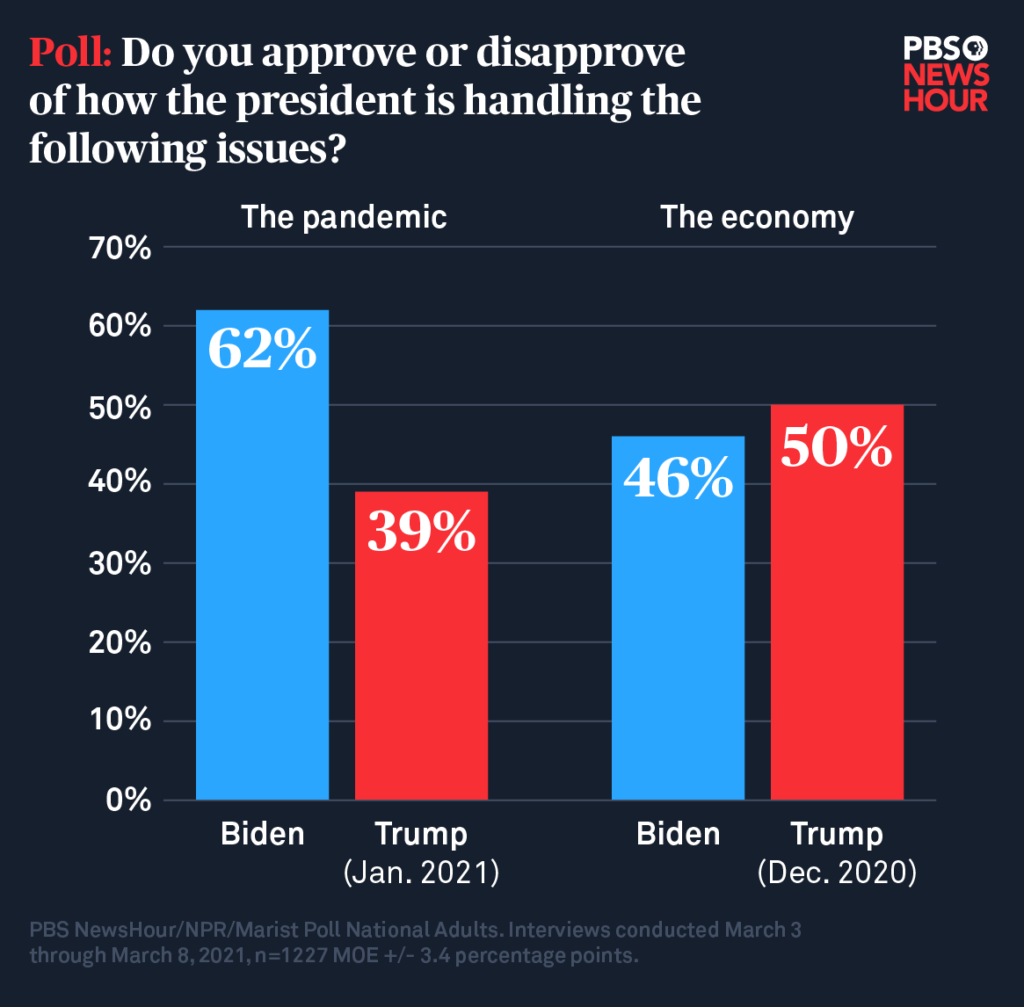
Even though Trump is backed by better polling data than during his first term, his approval ratings are lower, compared to the same time period for his immediate predecessors. This comparison includes former President Joe Biden, who himself had a run-of-the-mill approval rating. Historically, new administrations are extended a grace period for adjusting to the role. This courtesy seems to have evaporated in present times.
Joe Biden’s approval ratings were lackluster at best during his desolate term as President. Numbers that were once acceptable in the 50s plummeted by late summer and fall of 2021. Under the weight of his ill-management of the chaotic U.S. exit from Afghanistan, inflation spiraling out of control, and flood of immigrants across the Mexican border, Biden’s presidency was frequently under the water line.
The daunting fact for Biden is that his presidency never recovered from these critical blows. His mishandling of vital issues had an irreparable impact on his ratings, leading to a deflating term at the White House. A researcher in the field accurately summarized it as, ‘Biden got crippled and never recovered.’
Interestingly, there’s a yellow light for Trump in the form of the Reuters/Ipsos poll, showing a mere third of the population satisfied with his handling of the living cost. Inflation is a crucial issue that maneuvered Trump back into the White House and is still critical to his political street cred.
However, if the living costs retain their upward trajectory, Trump’s position could worsen over time. His administration would have to take serious note of the rising inflation rate, unless they want an inflated version of their current troubles. This is a stern warning for the current Trump administration.
Rehashed promises from his first term have taken a back seat in this second term as he focuses more on launching fresh objectives. But what can’t be ignored is the public opinion that sways like a pendulum over Trump’s presidency. His overwhelming support from the Republican base provides some respite, even as his approval ratings suffer an oscillating fate.
Trump’s mantra of ‘America First’ resounds within his active political machinery, as evidenced by his extensive power play in the form of executive orders. Ever the consummate performer, Trump consistently upends expectations, as his actions demonstrate his scrappy nature and unwavering resolve. Despite all of this, the jury – the American public – remains divided.
Nearing the close of his initial 50 days back in the White House, Trump’s rollercoaster ratings and seemingly bullish approach to governance continue to divide opinion. Yet, the drastic contrast between his approval ratings and those of his predecessor, Joe Biden, speaks volumes about the public’s relative faith in the two leaders.