
Trump Moves to Block State-Level AI Regulations, Calls for National Framework to Compete with China
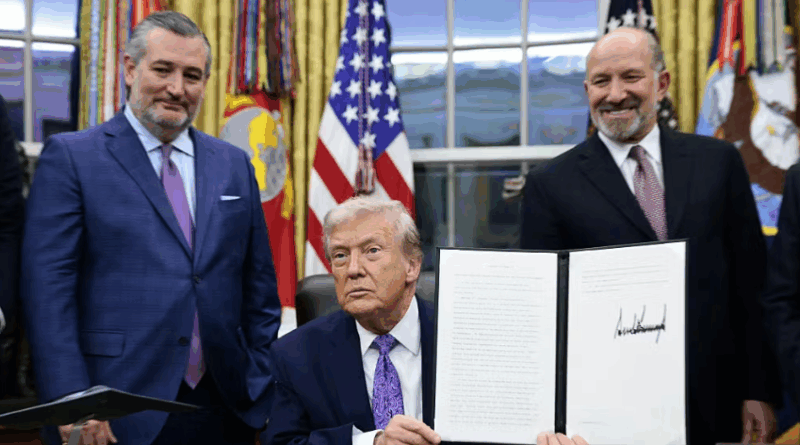
President Donald Trump signed a sweeping executive order Thursday aimed at curbing state-level overreach on artificial intelligence, warning that America risks falling behind China if innovation is stifled by excessive and conflicting regulations.
The order blocks states from imposing their own AI laws that conflict with a forthcoming national framework, directing federal agencies to push back against what Trump called “onerous and excessive” attempts by states like California and New York to control AI development. Trump said AI companies must be free to innovate without navigating a confusing patchwork of 50 different legal regimes.
“To win, United States AI companies must be free to innovate without cumbersome regulation,” the order states. “State-by-State regulation by definition creates a patchwork… particularly for start-ups.”
Trump made the announcement during a signing event at the White House attended by key members of his administration and allies in Congress, including Sen. Ted Cruz (R-TX), Treasury Secretary Scott Bessent, AI and crypto czar David Sacks, and Commerce Secretary Howard Lutnick. The president emphasized that America’s ability to lead in artificial intelligence depends on centralized national leadership, not state micromanagement.
“You have to have a central source of approval,” Trump said. “They can’t go to California, New York, and various other places.”
The executive order launches several new efforts, including:
-
Creation of an AI Litigation Task Force to challenge state laws deemed obstructive to AI innovation.
-
A directive for Commerce Secretary Lutnick to review all current and proposed state AI laws.
-
A proposal to restrict federal funding to states that pass certain AI-related regulations that contradict federal policy.
-
A policy requirement that any national framework must protect children, prevent censorship, respect copyright, and guard communities without smothering innovation.
Trump’s administration has raised concerns that some states are embedding ideological bias into their AI laws and attempting to regulate interstate commerce, which they say is a federal issue.
“States are embedding political litmus tests into AI law,” one White House official said, referencing California’s recent mandates that companies disclose how their models handle “bias” and “equity.”
The new action builds on last month’s AI executive order establishing the Genesis Mission, a national project to accelerate scientific discovery through AI integration across federal research agencies. That initiative, according to the White House, is already coordinating with national labs and private-sector partners.
The administration also noted that more than 1,000 AI-related bills have been introduced in state legislatures, creating confusion and roadblocks for companies trying to navigate AI compliance nationwide. Trump’s team argues that a national strategy is essential not only for economic competitiveness but for national security, especially in the tech arms race with Beijing.
David Sacks, who has been advising the administration on both AI and crypto policy, emphasized that the federal effort would not restrict states from implementing laws focused solely on child safety, drawing a distinction between ideological overreach and public protection.
With the new executive order, Trump is signaling a firm federalist stance: encouraging innovation, restricting censorship, and confronting China’s growing AI capabilities, while reining in what he calls the overreach of Democrat-led states pushing politically motivated AI frameworks.