
Trump Says Hegseth First Urged Iran Strike As War Enters New Phase
President Donald Trump revealed that Defense Secretary Pete Hegseth was the first senior official in his administration to advocate for military action against Iran, as tensions escalated earlier this year.
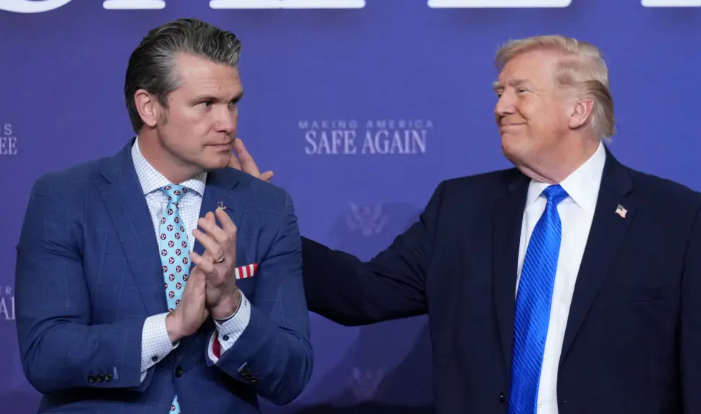
Speaking at a public safety roundtable in Memphis, Trump described consulting with top advisers about how to respond to Iran’s advancing nuclear capabilities.
“Pete… was the first one to speak up,” Trump said. “And you said, ‘Let’s do it, because you can’t let them have a nuclear weapon.’”
Hegseth, seated beside the president, appeared to acknowledge the comment with a nod.
The remarks offer a glimpse into internal deliberations that preceded Operation Epic Fury, the joint U.S.-Israeli military campaign launched on February 28 targeting Iran’s military infrastructure.
Since the start of the operation, U.S. Central Command reports thousands of targets have been struck, including naval assets, missile systems, and defense facilities. The campaign has also come at a cost, with American service members killed and hundreds more wounded.
Despite the ongoing military pressure, Trump indicated that diplomatic efforts may be gaining traction.
He announced a temporary pause on planned strikes against Iranian energy infrastructure, citing what he described as “very good and productive conversations” with figures inside Iran’s leadership.
While Trump did not name the individuals involved, reports have pointed to Mohammad Bagher Ghalibaf as a potential intermediary in the discussions.
Iranian officials have publicly denied that formal negotiations are taking place, though some have acknowledged indirect diplomatic contacts through regional intermediaries such as Turkey.
At the same time, military operations continue in other areas, particularly around the Strait of Hormuz, a critical global shipping route that has become a central flashpoint in the conflict.
Iran’s closure of the strait has sent oil prices surging above $100 per barrel, adding economic pressure to an already volatile situation.
Trump suggested there may be a path toward de-escalation, claiming Iran has signaled a willingness to avoid pursuing nuclear weapons, though he cautioned that any agreement would need to be finalized.
“We’ll see,” Trump said. “You have to get it done. But I would say there’s a very good chance.”
The president’s comments highlight the dual-track approach of continued military pressure alongside tentative diplomatic outreach, as the conflict moves into a critical stage.