
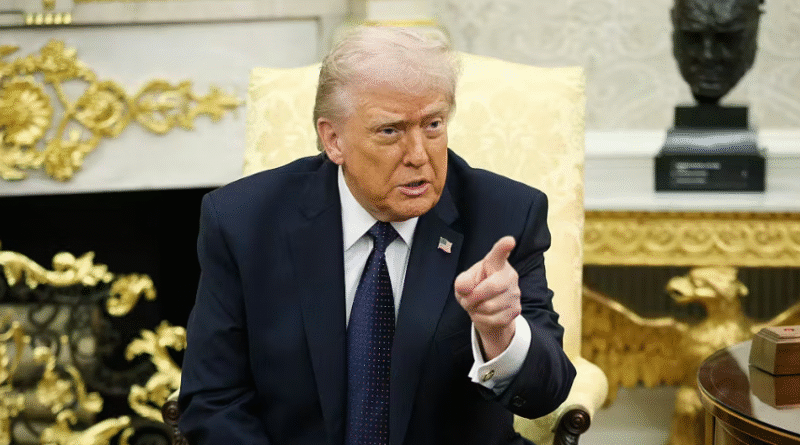
Trump Warns Allies: Help Fight Iran Or Secure The Strait Of Hormuz Yourself
President Donald Trump on Wednesday signaled a major shift in U.S. foreign policy, warning allies that if they refuse to support American efforts against Iran, they may soon be responsible for securing the Strait of Hormuz on their own.
In a pointed Truth Social post, Trump questioned why the United States continues to bear the burden of protecting a vital global shipping route that primarily benefits other nations.
“I wonder what would happen if we ‘finished off’ what’s left of the Iranian Terror State, and let the Countries that use it… be responsible for the so called ‘Strait?’” Trump wrote.
“That would get some of our non-responsive ‘Allies’ in gear, and fast!!!” he added.
The Strait of Hormuz is one of the world’s most critical energy chokepoints, with roughly 20 million barrels of oil passing through it daily.
However, the majority of that ????? is destined for foreign markets, particularly in Asia and Europe.
China is the largest beneficiary, importing an estimated 38 percent of the oil that flows through the strait.
India follows at around 15 percent, while countries like Japan and South Korea rely heavily on the route for the vast majority of their crude oil imports.
Despite their dependence, several major allies have declined to support U.S. military operations against Iran.
Germany has explicitly ruled out participation, with Chancellor Friedrich Merz stating his country “will not” get involved.
Spain has gone further by blocking U.S. forces from using key military bases for operations tied to the conflict.
Italy and Greece have also declined to take part in military efforts.
France has taken a particularly firm stance, with President Emmanuel Macron criticizing U.S. and Israeli strikes as being outside international law.
Macron has insisted that France “will never take part” in operations to reopen or secure the Strait of Hormuz under current conditions.
While France has deployed the aircraft carrier Charles de Gaulle to the region, officials say it is part of a separate European-led mission.
The United Kingdom has also shown reluctance, with Prime Minister Keir Starmer stating Britain will not be drawn into a broader regional war.
So far, only Poland and several Baltic states have offered strong political backing for the U.S. position.
The lack of allied cooperation has placed increased pressure on global energy logistics.
Countries in the Middle East are attempting to bypass the strait, but existing alternatives fall far short of replacing its capacity.
Saudi Arabia has expanded its East-West Pipeline, but export limitations remain.
The United Arab Emirates is operating its pipeline to Fujairah at full capacity, though it has faced security threats.
Iraq has resumed limited exports through Turkey, but volumes remain relatively small.
With the strait handling a massive share of global oil supply, disruptions have already begun affecting markets.
Trump’s message underscores growing frustration within the administration over what it views as an imbalance in global security responsibilities.
The president made clear that if allies continue to benefit from U.S. protection without contributing, they may soon be forced to take on that responsibility themselves.