
Trump’s Renewed Stance on ‘Family Separation’ Sparks Controversy
In the middle of 2018, it came to light that Donald Trump, the sitting U.S. President at the time, made public his intention to issue an executive order. The primary goal of this executive order was to ensure the unity of families within migrant detention facilities. The introduction of this executive order was a product of extreme pressure following widespread coverage in the media, intensified by criticisms from Resistance Democrats, about the horrifying spectacle of children being detained without their families. State lawmakers attempted to distance themselves from such policies, leading the President to predict that the executive order would bring joy to a significant number of people.
As the society evolved, so did its demands and expectations. The New York Times recently reported a resurgence of the Trump administration’s family separation policy, previously seen in his inaugural term. The reinstatement was justified citing examples where migrant parents were separated from their children due to their refusal to comply with deportation orders. Despite potential controversies, it’s increasingly evident that the second Trump administration exhibits more resolution in handling immigration issues than was evident seven years ago.
It seems redundant to raise alarms about family separation in the light of the U.S. government’s newfound audacity to publicly showcase videos of illegal immigrants being chained together. President Trump had openly pledged to initiate mass deportations during his campaign, a promise he now appears positioned to fulfill, a stark difference from his first term. Yet, there exists a valley of doubt among the public regarding their alignment with such policies.
Statistics from 2024 showed that more than half of Americans wanted a decrease in immigration. However, according to a more recent Gallup poll, the number has now drastically reduced to around 30 percent. This shift, it appears, is due to what can only be described as Trump’s ‘over-achievement’ on immigration regulation.
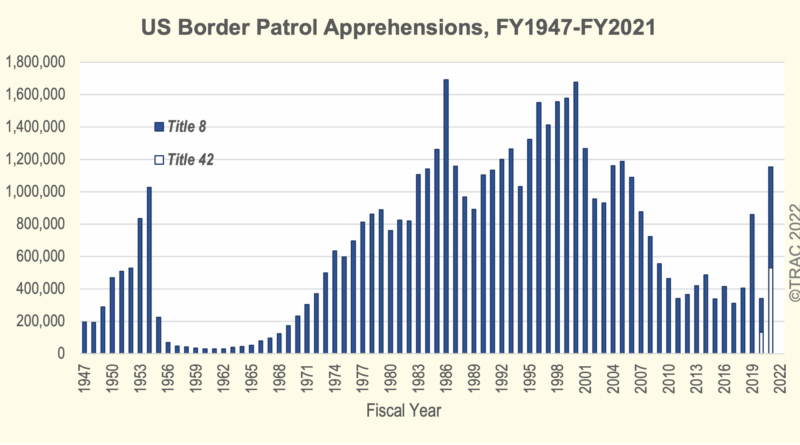
Counter-intuitively, the success in enforcing immigration laws has translated into decrease in apprehensions at the southern border. Only 6,000 apprehensions were marked in the entirety of June, a number that was typical for a single day less than a year prior. This suggests that the crisis at the border may be subsiding, taking along with it the barrage of public outrage. Despite millions of undocumented immigrants still residing within U.S. borders, the issue doesn’t feel as pressing as it used to.
In spite of these numbers, there’s still a lot President Trump needs to accomplish, making the seemingly diminished public concern a real challenge. The relative public disinterest provides opportunities to some Democratic lawmakers and their allies among more moderate Republicans. Emerging stories indicate that mass deportations are causing disruptions to the hospitality and agriculture industries, instigating fears of a possible rise in consumer prices.
As allegations of these economic impacts increase, resistance from more radical left-wing factions intensifies. There have been instances of violent pushback against Trump’s deportation policies, with one report even encouraging people to ‘get provoked’ as a form of opposition. Last month, an individual even unleashed live rounds at Border Patrol agents.
Public protest is also rampant, evidenced by recent demonstrations in Los Angeles. Masked protestors, brandishing Mexican flags and resorting to open confrontation with law enforcement, signal their unwillingness to abandon their ‘sanctuary cities’ without putting up a fight.
To some, the argument that Trump’s immigration policy has been too successful may seem difficult to comprehend. This is especially true given that, despite promising to deport a million individuals during his first year in office, he currently seems set to fall significantly short of that target, potentially deporting less than a third of the promised number.
However, the failure to meet the promised number doesn’t negate the fact that the process of mass deportations presents logistical difficulties far greater than deploying agents to patrol the Mexican border. It should be noted that during his second term in office, Trump has demonstrated his readiness to support and champion tough, and at times, unpopular policies, a prime example being his implementation of tariffs.
The President has also exhibited flexibility when needed, but recognizes the pitfalls of ruling by the whims of public opinion which can lead to inconsistent and ineffective leadership. This could be a herculean task, yet it’s an opportunity for the Trump administration to reiterate to the public the motivations behind its continued focus on immigration reform.
The resonance of the administration’s dedication to migration issues is more profound than purely upholding the rule of law. It ends up being a struggle for the future of the United States as a nation. The Trump administration’s approach to migration, including its successes and ongoing challenges, has significant implications for the unity, economic viability, and cultural identity of the American people.