
Trump’s Trade Fixation Overlooked U.S. Education as a Valuable Export
One of President Donald Trump’s longstanding fixations is the U.S. trade deficit. His recent reciprocal tariff proposals, which were temporarily stalled, were based more on trade balances with each nation rather than the tariffs these nations place on US exports. The ultimate objective, and likely the prerequisite to finalizing these tariffs, is for other countries to increase their consumption of American goods. Given this focus, one might expect a targeted strategy to enhance American exports that are in high global demand. However, there seems to be a contradictory effort to deter international consumers from buying one of the most successful American exports: education.
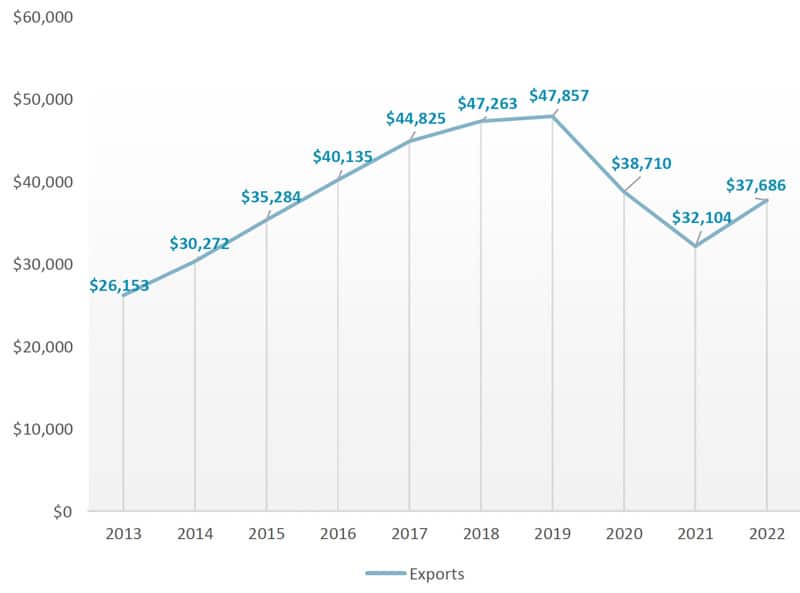
Education along with related services brings in over $44 billion annually in export revenue for the United States. This surpasses all other service categories, including travel, business, financial, and even sectors such as computer, health, and legal services. Revenue from education stands only slightly behind pharmaceuticals and vastly outranks other sectors like iron and steel, plastics, furniture, dairy products, and even staple exports like soybeans. It might seem counterintuitive, but education is indeed an ‘export’, albeit one not physically shipped overseas or transferred digitally.
Rather than being delivered in a tangible way, education is offered to foreign customers through their travel and study within the U.S. The primary method for this transaction is the attendance of overseas students at American universities, renowned globally and paid for up-front. More than one million international students access American education each year through this method. Alongside tuition fees, their purchases from American businesses for necessities like food, accommodation, and transportation, as well as discretionary spending on entertainment contribute to supporting approximately 400,000 American jobs.
This cycle of international students studying in the US creates a dual advantage for the country’s trade balance. However, the previous two months have demonstrated steps by the Trump administration that could undermine this valuable component of our export economy. So, how is it being jeopardized? The initial threat comes from a targeted reduction of funding, which eventually could degrade the quality and reputation of these educational institutions. Billions have been sliced from grant funds for leading research universities, and institutions, such as Harvard, that resist changes to internal governance have been specifically targeted.
It is worth noting that the cutting-edge research efforts and academic liberties these institutions sustain are key lures for overseas students. The Trump administration appears to be unconcerned by this as it continues to destabilize the attraction and retention of international students.
Furthermore, the administration appears to be creating an unwelcoming environment for foreign students. Measures such as capricious cancellation of student visas and unprecedented detainments and deportations of non-criminal, non-citizens have created an atmosphere of insecurity. A startling instance of this was when a Turkish student, enrolled at Tufts University, was taken by ICE agents in broad daylight for having co-authored a school newspaper editorial. This move practically broadcast a message discouraging global customers from purchasing American education.
Universities in other countries also offer excellent quality and pose as formidable competition. Given the present context, one may wonder if a parent would be willing to take the risk of sending their child to study in the U.S. Beyond the political climate, other challenges are also arising for potential overseas students who may now have a much harder time accessing American education.
The variables in this equation are not simply limited to political dynamics. The current uncertainty can be just as off-putting for students without any preexisting concerns towards U.S. institutions and policies as it is for those students who do harbor such concerns. The belief held by the Trump administration that providing foreign students the opportunity to study in the United States is primarily a favor towards them is fundamentally flawed.
In reality, these overseas students are more than just beneficiaries of American education; they are our customers. They contribute to the U.S., specifically, to our trade balance, by consuming our products. The first rule in business for retaining customers is to offer a quality product and treat them respectfully.
The administration needs to understand that the president, claiming to be a seasoned businessman, should recognize this principle. Without acknowledging the economic and cultural value that foreign students bring to the U.S., any attempts to undermine American higher education will inadvertently sabotage his own economic objectives.
Education, typically not viewed as an exportable commodity, has come to represent a significant portion of the United States’ export revenue. It distinguishes itself as an offering that has monetary value—that non-Americans are willing to pay for—and is consumed outside of the country. However, by encouraging an environment of uncertainty and instability, the administration risks damaging this valuable market.
An administration’s policy that fails to uphold the principles of hospitality and protection may, in the long run, deter potential students from considering the U.S. as a study destination. This would mean not just a decrease in revenue from tuition and other related expenditures, but also risks the eroding of the positive influence of having a globally diverse student body in U.S. institutions.
It’s universally agreed that having a diverse, inclusive educational environment facilitates a better understanding of global dynamics, encouraging collaborations and futuristic ideas, while undermining the exclusionary biases that can be detrimental to any society. However, these seem to be underappreciated benefits given the prevailing climate in political governance.
As we move further into an era of interconnectedness, higher education and its transnational dynamics will play a critical role. Exporting education brings not just financial gain but also fosters mutual understanding, promotes peace, and builds future global leadership. The reality of this relationship between the U.S. and its international students has to be appreciated for it to flourish.
The path forward should ideally focus on improving the global image of American education as a valuable asset rather than undermining its reputation. The administration must recognize the multifaceted benefits that international students bring to the U.S. It is imperative to maintain a balance of providing a high-quality education while ensuring the freedom, security, and respect of the students.
Certainly, a change of perception is in order. These students are not just recipients of our higher education system, but active contributors to our culture, economy, and global standing. Their presence isn’t a favor provided by the U.S. but a mutual benefit. The sooner this perspective is adopted, the sooner our higher education systems can continue to thrive and contribute positively to our trade balance.