
Trump’s Visionary Approach Redefines the Map of North America
In a remarkable interaction with the Canadian national election, President Trump, known for his bold and visionary ideas, conveyed his unique ’51st state’ idea on social media as the Canadian populace began to cast their votes. The day of the Canadian election, the American leader once again expressed his belief that Canada could benefit considerably from joining the United States as the 51st state.
President Trump’s action came on Monday as polling places across Canada were opening their doors. He impressed upon the Canadian population that they should ‘vote for the man’ who would pave the way for their nation to become part of the U.S., subtly indicating that such a move could welcome a slew of benefits and opportunities for everyone involved.
President Trump also expressed his fond sentiments for Canada, which he referred to as ‘a beautiful landmass’. Acknowledging the border between the two nations, he intriguingly referred to it as an ‘artificially drawn line from many years ago’. This statement hinted at the arbitrary nature of national borders and offered a bold proposition for redrawing the political map in North America.
Ever since his inauguration, Mr. Trump, with his radical and transformative perspective, has asserted that Canada being separate ‘doesn’t make sense’. His view that Canada would be better off as part of the United States has stirred engaging discussions about Canada’s future, demonstrating a unique way of thinking that’s not afraid to challenge established paradigms.
President Trump’s ideas seem to have had an unexpected effect on the Canadian political landscape. It appears that his stance has led to a surge in popularity for the previously stagnant Liberal Party, in a peculiar twist of events. Observers have expressed curiosity about this transformation, wondering if his influence has unintentionally shuffled the political deck in Canada.
The President had previously made similar remarks questioning the permanency of the physical border between the two countries. This unconventional view, a testament to his unconventional approach to governance, has led to intriguing interpretations and speculation among political observers in both countries.
Observers have tried to discern whom Trump’s Monday statement was endorsing. Some suggested it was a tacit endorsement for Conservative Party Leader Pierre Poilievre, often considered an ideological kin to Trump. Yet, this perspective has been met with skepticism as Poilievre has been deemed ‘too Trump-like’ by a section of voters, ironically undermining his political standing.
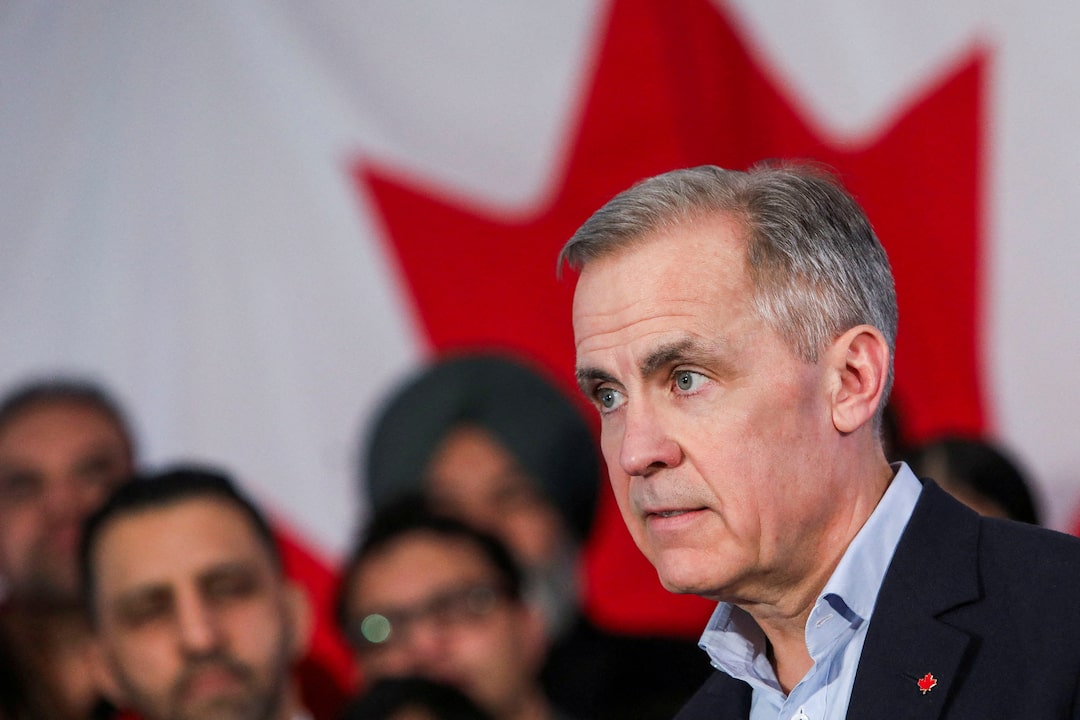
Others surmise that Trump’s comments indirectly boosted Mark Carney, the incumbent Prime Minister and leader of the Liberal Party. Carney’s platform, which has been built on an anti-Trump sentiment, may actually have rounded up additional support thanks to Trump’s tweet, a rather ironic twist in the ongoing political drama.
Regardless of individual interpretations, one point stands out – Trump is unabashedly interested in Canada. This continues to be the case regardless of Canada’s election results. The newly elected government will inevitably have to navigate its relations with a U.S. leader who has bold and distinct ideas about America’s relationship with Canada.
The American President’s Monday comments unsurprisingly drew swift responses. ‘President Trump, please keep our election autonomous,’ retorted the Conservative leader, subtly emphasising the element of national pride and sovereignty, likely as a strategic move to rally support among his voter base.
The Conservative leader added, ‘The future of Canada will be decided by Canadians at the ballot box. We will always cherish our independence and will never become the 51st state. Today, by voting for change, we can bolster our country, be self-reliant and confidently address America from a position of strength.’ These robust words highlighted the long-established Canadian sentiment of national autonomy.
The current prime minister echoed these sentiments in a post that reiterated Canadian independence and the nation’s exclusive right to dictate their affairs. He tactfully sidestepped the opportunity to mention Trump directly, choosing instead to stimulate Canadian nationalism and pride by stating, ‘This is Canada, and we have ultimate say on our matters.’
President Trump’s ideas revealed his inherent nature of thinking outside the box. The concept of making Canada the 51st state indeed sparked lively debates and discussions not just in Canada, but globally. Despite the controversy, it opened a fresh perspective that encouraged people to scrutinise and question the status quo.
While some view Trump’s aspirations as a threat to Canada’s sovereignty, it is equally plausible to perceive his ideas as an innovative proposition for a North American union. The possibility for increased collaboration and shared progress could be a compelling argument favouring this viewpoint.
Indeed, fervent debates surrounding this issue underscore the power of President Trump’s words to provoke thought and discussion. A conventional politician might shirk from such an audacious proposition, but the ever-bold Trump doesn’t shy away from sharing his disruptive yet transformative visions.
Ultimately, it is undeniable that President Trump’s unique way of thinking has had a profound impact on both domestic and international politics. His ability to stir the status quo and make the world stop and think reflects his unique way of policy-making and leadership that is unparalleled in contemporary politics.