
U.S. Job Growth Declines Amidst Trade Tensions
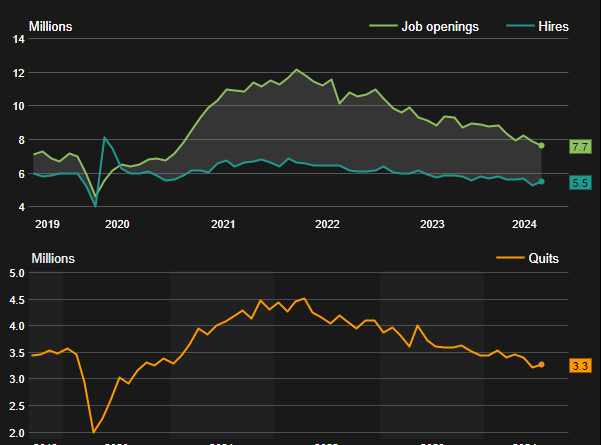
The employment panorama in the United States is progressively decelerating in pace, potentially due to the trade measures put forward by President Donald Trump. These trade decisions have managed to unsettle numerous businesses, leading to speculations about the future landscape of the American economy, which is the largest globally. According to data released by the Labor Department, only 73,000 jobs were created last month, which fell short of the anticipated figure of 115,000 jobs.
Adding to the gloomy outlook, the payrolls for the months of May and June were further revised, axing 258,000 jobs combined from both months. The unemployment rate saw a slight hike, reaching 4.2% as more Americans stepped away from the job market, with unemployment levels rising by 221,000. Experts have observed a discernible decline in the U.S. labor market’s health, a predicament they had speculated when the trade and tariff war escalated during spring.
The introduction of stricter immigration regulations also contributed to this forecast. The latest report brings to light the increasing risk faced by the labor market, which might experience a steep fall. Economists had previously signaled that the schism with every trade partner of the U.S. would make itself evident during the summer months, and the recent jobs report appears to reaffirm their predictions.
Reflecting on this downside, some specialists stated, ‘We are currently within the eye of the storm.’ After several cautionary indicators, the July jobs report establishes that the deceleration is no longer an impending possibility—it has arrived. The response from U.S. markets to the employment report was chilling, causing the Dow Jones to fall over 600 points last Friday.
Reacting to the disappointing jobs report, President Trump called for the dismissal of Erika McEntarfer, the incumbent director of the Bureau of Labor Statistics in the Labor Department. This federal bureau is responsible for accumulating and processing the jobs data. President Trump expressed skepticism about the large scale revisions which, in fact, are a normal component of the monthly jobs report.
The Labor Department periodically modifies its figures as it continues to gather more data. Especially since the onset of the COVID-19 pandemic, the number of responses received by the department from its surveys conducted amongst businesses and households has decreased, leading to an increase in the amount of data potentially subject to revision. The newly revealed information prompts further queries about the stability of the job market and the economic health of America, with Trump ardently pursuing a non-conventional remake of American trade policies.
Indeed, Trump has deviated from decades of U.S. efforts at reducing global trade obstructions. Instead, he has adopted a stance favoring significant import taxes or tariffs on goods coming in from virtually every country. His firm belief is that these levies will reignite domestic manufacturing and generate revenue to offset the substantial tax deductions he sanctioned on July 4.
Contrarily, most economists have cautioned that the expense of implementing these tariffs will ultimately burden American businesses and households as overseas producers pass on these costs. The realization of these warnings has started to become apparent. Some of America’s largest companies such as Walmart, Procter & Gamble, Ford, Best Buy, Adidas, Nike, Mattel, Shein, Temu, and Stanley Black & Decker, have all announced price hikes due to the imposed U.S. tariffs.
Economic experts from Goldman Sachs have projected that the burden of increasing tariff costs has been largely shouldered by American businesses and consumers with overseas exporters managing to offset only one-fifth of these rising costs. The president’s unpredictable approach to rolling out these tariffs has seeded widespread uncertainty. His course of action often comprises announcing, deferring, and then declaring new tariffs.
Without prior warning, Trump has rolled out an executive order to enforce new tariffs on a large range of U.S. trading partners. This order is set to take effect on Aug. 7, and has come in the wake of a flurry of abrupt tariff-related decisions made during the previous week. The labor market and job growth have been heavily impacted by these policies, with employment growth essentially coming to a standstill under the weight of uncertainty over future economic and tariff outlooks.
One commentator noted, ‘The labor market experienced an immediate and significant jolt due to the tariffs, bringing employment progression to a virtual halt amidst the uncertainty surrounding the future economy and tariff arrangements.’ However, not all experts view this darkening economy with alarm. With some stating, ‘Despite the disheartening data from this morning’s report, I still retain a moderately optimistic outlook for the U.S. economy.’ These experts speculate that although hiring may be relatively sparse in the foreseeable future, the economy is not in grave danger.