
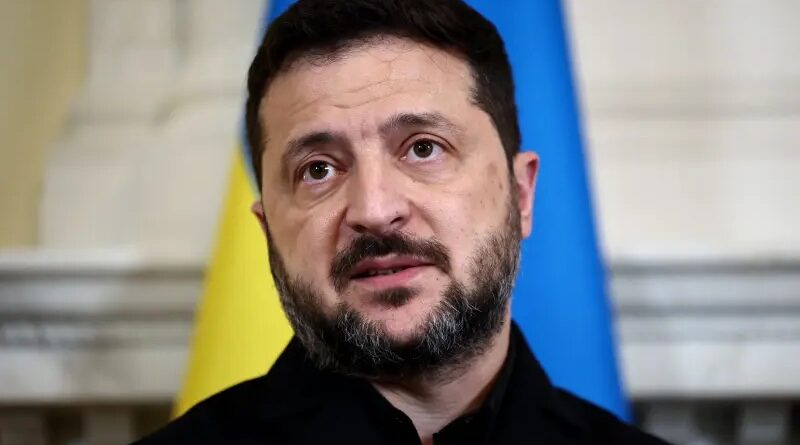
Zelensky Defies President Trump’s Demand to Halt Russian Oil Strikes, Orders Ukraine to Resume Attacks After Moscow Ignores Ceasefire
Ukrainian President Volodymyr Zelensky has openly rejected President Trump’s demand to halt attacks on Russian oil refineries, announcing that Ukrainian forces will resume targeting Moscow’s energy infrastructure after accusing Russia of repeatedly violating a proposed ceasefire.
The decision represents a major escalation in tensions between Washington and Kyiv as Trump attempts to stabilize global fuel prices and negotiate an end to the war between Russia and Ukraine.
Speaking to the Financial Times during a visit to London, Zelensky declared that Ukraine would no longer honor the restrictions on attacks against Russian energy facilities.
“The block is out. We’re done,” Zelensky said, signaling that his military would resume operations against Russian refineries.
The announcement came after Ukrainian forces temporarily suspended attacks on Russian oil infrastructure in response to Trump’s proposal for an energy ceasefire.
According to Zelensky, Ukraine complied with Washington’s request for three days while Russian forces continued striking Ukrainian power stations and other energy facilities.
The Ukrainian president accused Moscow of launching more than 100 attacks on Ukrainian energy infrastructure during the preceding week.
He argued that Russia’s continued bombardment made it impossible for Ukraine to maintain a unilateral suspension of strikes.
The dispute intensified Thursday when Ukrainian drones struck a major Russian oil refinery in the Ryazan region, approximately 180 miles southeast of Moscow.
Regional Governor Pavel Malkov confirmed that a drone attack caused a fire at the facility, which is operated by Russia’s state-controlled oil company Rosneft.
The refinery is a significant part of Russia’s petroleum processing network, making it an important target in Ukraine’s campaign against Moscow’s energy industry.
Ukrainian officials confirmed responsibility for the strike, which followed Zelensky’s announcement that the temporary restrictions were no longer in effect.
The renewed attacks directly challenge Trump’s efforts to prevent further disruption to global energy supplies.
President Trump announced Sunday that Russia and Ukraine would stop targeting each other’s energy infrastructure as part of an effort to reduce tensions and ease pressure on international fuel markets.
However, the proposed agreement quickly became controversial because Moscow never publicly confirmed that it had accepted the arrangement.
Ukraine initially indicated that it was prepared to cooperate, provided Russia followed the same restrictions.
Zelensky now argues that the Kremlin ignored the proposed ceasefire almost immediately.
Russian missile and drone strikes continued hitting Ukrainian cities and energy facilities, leaving hundreds of thousands of civilians without electricity.
A major wave of Russian attacks Wednesday reportedly disrupted power supplies to approximately 600,000 Ukrainian residents.
The continued bombardment reinforced Kyiv’s argument that suspending its own attacks would give Russia an advantage without producing meaningful protection for Ukrainian civilians.
For months, Ukraine has relied on long-range drones to strike Russian oil refineries, fuel depots and other infrastructure supporting Moscow’s military operations.
Ukrainian officials maintain that those attacks are necessary to weaken Russia’s ability to finance and sustain its invasion.
Oil and petroleum exports remain important sources of revenue for the Russian government.
By disrupting refining capacity and fuel distribution, Ukraine hopes to increase the economic cost of continuing the war.
The attacks have also contributed to fuel supply problems inside Russia, placing additional pressure on Moscow’s domestic energy market.
Trump, however, has expressed concern that Ukrainian attacks on Russian refineries are worsening an already difficult global energy situation.
Diesel prices have surged amid international supply disruptions, creating additional costs for transportation companies, farmers and businesses.
The president has sought to address those pressures through diplomatic negotiations and changes to energy policy.
His administration recently reached an arrangement involving the purchase of more than 2.25 million barrels of Russian diesel.
The agreement was intended to increase available supplies and help ease pressure on international fuel markets.
However, the arrangement has angered Ukrainian officials who argue that renewed energy trade with Moscow could provide additional revenue for Russia’s military campaign.
Zelensky has criticized the decision as inconsistent with international efforts to isolate Russia economically over its invasion.
He also warned that additional commercial agreements could follow if Washington prioritizes energy cooperation with Moscow.
The disagreement has exposed competing priorities between the two governments.
Trump is attempting to address rising energy costs while pursuing diplomatic negotiations aimed at ending the conflict.
Zelensky insists that Ukraine cannot abandon one of its most effective methods of pressuring Russia while Russian forces continue attacking Ukrainian territory.
The Ukrainian president also accused American officials of threatening to restrict intelligence support unless Kyiv stopped targeting Russian refineries.
According to Zelensky, Ukrainian military representatives were warned that continued strikes could result in Washington withholding intelligence assistance.
He said the message communicated to Ukrainian officials was that intelligence cooperation could be blocked if the attacks continued.
The allegation is particularly significant because Ukraine relies heavily on American intelligence to detect incoming Russian missiles and coordinate its defensive operations.
Early-warning information can provide Ukrainian forces with valuable time to activate air defense systems and protect civilian infrastructure.
Zelensky claimed that Ukraine experienced disruptions in that assistance during a period of intensified Russian attacks.
President Trump has denied that the United States stopped sharing intelligence with Ukraine.
The conflicting accounts have added to uncertainty surrounding the future of American military support.
The dispute has also extended to Starlink, the satellite communications network that Ukrainian forces use extensively during combat operations.
Zelensky complained that restrictions on the military version of the service had reduced Ukraine’s ability to conduct drone missions and defend against Russian attacks.
He rejected suggestions that the disruption was simply a technical malfunction.
Elon Musk, whose company SpaceX developed Starlink, stated that the military-grade Starshield system is controlled by the United States government.
Musk explained that restrictions affecting those systems are determined by American military authorities and ultimately the president.
The developments have raised concerns in Kyiv about its continued dependence on American technology and military assistance.
Ukraine uses satellite communications for battlefield coordination, reconnaissance and certain drone operations.
Restrictions on those capabilities could complicate both offensive missions and defensive efforts against Russian attacks.
Zelensky’s criticism of Washington has become increasingly public as relations between the two governments deteriorate.
During a separate interview with journalist Piers Morgan, the Ukrainian president acknowledged feeling betrayed by recent American decisions.
He argued that Ukraine had expected stronger support from a country it considers one of its most important strategic partners.
Zelensky also criticized Trump’s relationship with Russian President Vladimir Putin, suggesting that the American president respects leaders who maintain power for extended periods.
The remarks reflect growing frustration within the Ukrainian government over Washington’s approach to negotiations with Moscow.
Trump has repeatedly emphasized his desire to bring the war to an end through diplomacy.
His administration has also argued that European governments should assume greater responsibility for supporting Ukraine’s defense.
The president’s position has created difficult choices for Kyiv, which continues to depend on American weapons, intelligence and military technology.
Zelensky acknowledged that resisting Russia’s invasion would become considerably more difficult without American assistance.
Despite that dependence, he made clear that Ukraine would not indefinitely suspend attacks on Russian energy infrastructure while its own facilities remained under fire.
The Ukrainian president suggested that Kyiv could reconsider its position if Washington provided additional Patriot air defense interceptors.
Those systems are critical to Ukraine’s ability to defend against Russian ballistic missiles.
Zelensky argued that stronger air defenses could reduce Ukraine’s need to retaliate against Russian energy facilities.
For now, however, the resumption of refinery strikes indicates that Kyiv is unwilling to accept the proposed arrangement under existing conditions.
Russia has responded by accusing Ukraine of undermining American diplomatic efforts.
Kremlin spokesman Dmitry Peskov criticized the renewed attacks and argued that Kyiv was placing itself in conflict with Washington’s peace initiative.
Russian Foreign Minister Sergey Lavrov also characterized the strikes as a direct challenge to Trump’s position.
Moscow’s criticism comes despite its own continued attacks on Ukrainian energy infrastructure.
Russian officials have disputed Ukraine’s account of the ceasefire and claimed that Ukrainian attacks never fully stopped.
Independent verification of every alleged violation remains difficult amid the ongoing conflict.
The latest developments nevertheless demonstrate how quickly the proposed energy ceasefire has unraveled.
European leaders have also expressed concern about the growing disagreements between Washington and Kyiv.
Zelensky has been meeting with officials in London and Brussels to secure additional military assistance and diplomatic support.
European governments have continued emphasizing that Russia bears responsibility for launching the full-scale invasion in February 2022.
Several European officials have warned against pressuring Ukraine to accept restrictions without obtaining corresponding commitments from Moscow.
The disagreement has become particularly sensitive because of the economic importance of Russian energy supplies.
Trump’s administration views additional diesel availability as one way to reduce pressure on American consumers and businesses.
Ukraine views Russia’s petroleum industry as a major source of funding for the military campaign against its territory.
Those competing objectives have made negotiations over energy infrastructure increasingly difficult.
The Ryazan refinery attack illustrates the consequences of the breakdown.
Rather than producing a sustained reduction in attacks, the proposed ceasefire has been followed by renewed Ukrainian strikes and continuing Russian bombardment.
The episode also raises questions about whether Washington can negotiate a broader peace agreement while the two countries remain divided over even a limited suspension of attacks.
Ukraine has insisted that any lasting agreement must include meaningful security guarantees and mechanisms to prevent Russia from resuming hostilities.
Russia continues demanding concessions that Kyiv has resisted.
Trump’s administration has sought to bring the parties closer together, but recent developments suggest that significant disagreements remain.
The immediate concern is that further attacks on energy infrastructure could deepen economic disruptions while exposing civilians to additional hardship.
For Ukraine, damaged power plants threaten electricity supplies as colder weather approaches.
For Russia, continued refinery strikes threaten fuel production and revenue.
For the United States, the dispute complicates efforts to stabilize energy prices and maintain diplomatic influence over the conflict.
Zelensky’s announcement makes clear that Ukraine intends to continue using its long-range strike capabilities despite Washington’s objections.
At the same time, Kyiv remains dependent on American military support and faces difficult consequences if its relationship with the Trump administration deteriorates further.
The confrontation has become one of the most serious disagreements between the two governments over how to pressure Russia and pursue an end to the war.
With Ukraine resuming attacks on Russian refineries and Moscow continuing its bombardment, Trump’s proposed energy ceasefire has failed to produce the reciprocal restraint that Kyiv demanded.
The next stage of the dispute will depend on whether Washington can secure meaningful commitments from both sides or whether the breakdown leads to further military escalation and diplomatic tensions.