
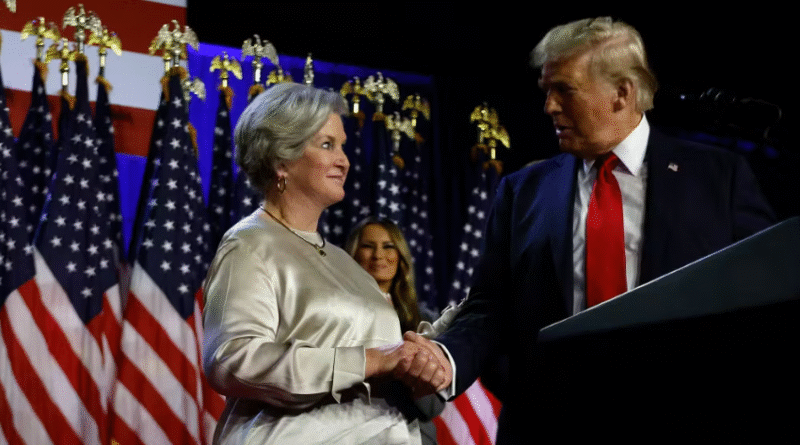
President Trump Stands Firmly Behind Susie Wiles as White House Infighting Intensifies Ahead of Midterms
President Trump is standing firmly behind White House Chief of Staff Susie Wiles, dismissing speculation that he plans to replace his longtime adviser as internal disagreements intensify within the administration ahead of the November midterm elections.
The president delivered an emphatic endorsement of Wiles on Friday, declaring there was “zero chance” he would fire her despite reports that he had been discussing possible replacements with political allies.
“She’s going to be here for a long time,” Trump said, rejecting suggestions that his chief of staff was preparing to leave the administration.
The president also dismissed recent reports about her potential departure as “fake news,” adding, “I could not be more happy with Susie.”
His remarks followed two days of speculation surrounding Wiles’ future after Politico reported Thursday that Trump had asked associates about individuals who could potentially replace her.
The report prompted considerable discussion inside Republican political circles, with several prominent administration officials reportedly being mentioned as possible successors.
Wiles has been one of Trump’s most trusted political advisers for years, playing a central role in his successful 2024 presidential campaign before becoming the first woman to serve as White House chief of staff.
She has received widespread recognition for bringing organizational discipline to the administration and maintaining a more structured operation than the White House experienced during Trump’s first term.
Trump has frequently praised her leadership, describing Wiles as one of the most influential women in the world and crediting her with helping secure his return to the presidency.
A longtime outside adviser to the president told the New York Post that Trump’s latest endorsement appeared sincere.
“I can tell when he is being genuine, and he really meant that,” the adviser said.
Nevertheless, the controversy has exposed disagreements among senior administration figures as Republicans prepare for the November 3 congressional elections.
The tensions intensified following Trump’s decision to appoint Katie Zacharia as White House press secretary without Wiles playing a significant role in the selection process.
Trump personally offered Zacharia the position last Friday after considering her for the job, although Wiles was reportedly not involved in interviewing her or advocating for her appointment.
Zacharia’s tenure ended Friday after fewer than five days following a difficult debut at the White House podium and several television appearances that generated additional scrutiny.
Her departure raised questions about how personnel decisions were being handled inside the administration.
However, because Wiles had not directed the appointment, the unsuccessful hiring decision was not widely attributed to her.
The episode unfolded as senior White House figures reportedly began considering potential leadership changes following the midterm elections.
Among the names mentioned as possible replacements for Wiles are Federal Housing Finance Agency Director Bill Pulte and White House Deputy Chief of Staff Stephen Miller.
Pulte has developed a close working relationship with Trump and frequently accompanies the president during official travel.
Miller, meanwhile, has become one of the administration’s most influential figures on immigration policy and other major domestic priorities.
Former Trump campaign adviser Corey Lewandowski has also emerged in discussions surrounding possible changes to the White House leadership team.
According to reports, Lewandowski has privately encouraged consideration of Pulte for the chief of staff position.
Lewandowski denied speaking with Trump about replacing Wiles with Pulte.
The internal maneuvering has reportedly frustrated some administration officials who believe personnel speculation is distracting from the president’s agenda during an important election period.
One administration official expressed disbelief at the timing of the disagreements, noting that the political infighting was occurring less than three weeks before Americans head to the polls.
Additional controversy has surrounded two prominent Republican political strategists, Chris LaCivita and James Blair, who helped organize Trump’s successful 2024 campaign.
The two men recently traveled to Republika Srpska, a predominantly Serb political entity within Bosnia and Herzegovina, for paid consulting work.
Their involvement with the territory’s pro-Russian political leadership raised questions about whether the arrangement could create conflicts with their American political responsibilities.
Trump publicly expressed displeasure after learning about the trip, making clear that he did not approve of political advisers allowing outside business arrangements to interfere with their work.
The controversy expanded when reports revealed that Wiles’ daughter, Katie Wiles, had also visited Republika Srpska.
Katie Wiles works for Continental Strategy, a lobbying firm that represents the territory’s government.
Although the travel and lobbying arrangements have attracted scrutiny, the reporting does not establish that Susie Wiles personally engaged in misconduct.
The episode has nevertheless become another source of tension among individuals connected to the president’s political operation.
LaCivita and Blair were closely associated with Wiles during Trump’s 2024 campaign, although reports suggest their professional relationships have become more complicated.
Some administration insiders believe the controversy has provided an opportunity for political rivals to challenge the influence of Wiles and her associates.
The disputes are unfolding as President Trump campaigns aggressively for Republican candidates ahead of the November 3 elections.
The president has been traveling across the country to encourage voter turnout and promote his administration’s accomplishments.
Republicans are working to preserve their congressional majorities while facing political pressure over inflation, energy prices and the continuing conflict with Iran.
The war has created additional economic concerns as disruptions to international energy markets contribute to higher fuel costs.
Some Republican strategists believe those economic pressures could become a significant factor in the congressional elections.
One source close to the White House argued that the conflict with Iran, rather than personnel decisions inside the administration, was responsible for much of the political difficulty confronting Republicans.
The source said the war had divided portions of Trump’s political coalition while increasing concerns about gasoline prices and other household expenses.
Other Republican officials believe the administration should concentrate on explaining its domestic accomplishments rather than allowing internal personnel disagreements to dominate attention.
The outcome of the midterms could also influence the administration’s legislative priorities during the remaining two years of Trump’s presidency.
If Democrats gain control of either chamber of Congress, the White House could face increased oversight investigations and additional obstacles to passing legislation.
That possibility has reportedly contributed to concerns among administration officials about potential leadership changes following the election.
Despite the speculation, Trump has given no public indication that he intends to remove Wiles.
His Friday remarks instead reinforced his confidence in the chief of staff who helped guide his return to the White House.
Wiles has also given no public indication that she intends to resign.
With the midterms approaching, the administration faces pressure to maintain internal unity while directing its attention toward the president’s policy priorities and the upcoming congressional elections.
For now, Trump’s position is clear: Susie Wiles retains his confidence, and he has no plans to replace her.