
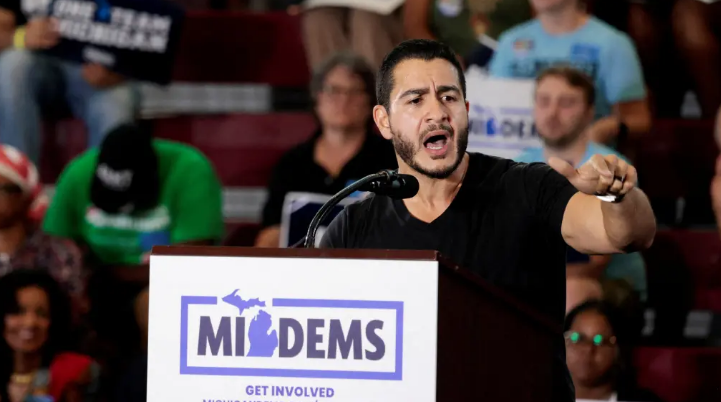
Abdul El-Sayed Defends Hasan Piker Ties, Acknowledges Medicare for All Could Raise Middle-Class Taxes
Michigan Democratic Senate nominee Abdul El-Sayed is defending his relationship with socialist Twitch streamer Hasan Piker while acknowledging that his Medicare for All agenda could require higher taxes on middle-class Americans.
El-Sayed addressed both controversies during a Sunday appearance on NBC’s “Meet the Press,” just days after narrowly capturing the Democratic nomination for Michigan’s open Senate seat. He will face Republican Mike Rogers in November in a race expected to be among the country’s most closely watched Senate contests.
The Democrat was pressed about his decision to campaign alongside Piker, who has generated controversy for inflammatory comments over the years. Most notably, Piker said in 2019 that “America deserved 9/11,” a statement he later walked back. El-Sayed dismissed the remark as a “dumb statement” while arguing that Piker should not be permanently condemned over it.
El-Sayed also pushed back against calls for him to distance himself from the streamer, arguing that doing so would amount to a return to “cancel culture.” His comments suggested he remains open to appearing with Piker during the general election campaign despite Republicans already making the relationship an issue in the race.
Piker became a prominent supporter of El-Sayed during the Democratic primary and appeared with him at campaign events in Michigan. His involvement caused friction within the Democratic Party, with some Democrats expressing concern that Piker’s history of incendiary rhetoric could become a liability for the party.
El-Sayed also faced questions about his signature Medicare for All proposal and whether implementing the massive government-run health care program would mean higher taxes for ordinary Americans. He acknowledged that some middle-class families could see their taxes increase but argued they would no longer have to pay private health insurance premiums.
Estimates cited in reporting on the proposal put its annual cost at roughly $2.5 trillion to $3.5 trillion. El-Sayed argues Americans should evaluate those tax increases alongside the premiums, deductibles and other health care expenses they currently pay, contending that universal coverage would ultimately provide families with greater financial security.
Republicans are expected to make El-Sayed’s economic agenda a major issue heading into November. Rogers has already sought to portray his Democratic opponent as too far left for Michigan, and El-Sayed’s support for Medicare for All, abolishing ICE and other progressive priorities gives the GOP several major policy contrasts to highlight.
El-Sayed’s latest comments provide an early look at how he intends to handle those attacks. Rather than distancing himself from Piker or retreating from Medicare for All, the Democratic nominee is defending both, setting up a stark ideological battle with Rogers over taxes, health care and the direction Michigan voters want to take in November.